Kritik-AnfrageNoch 39h für KritikenCritiques earn 20X points
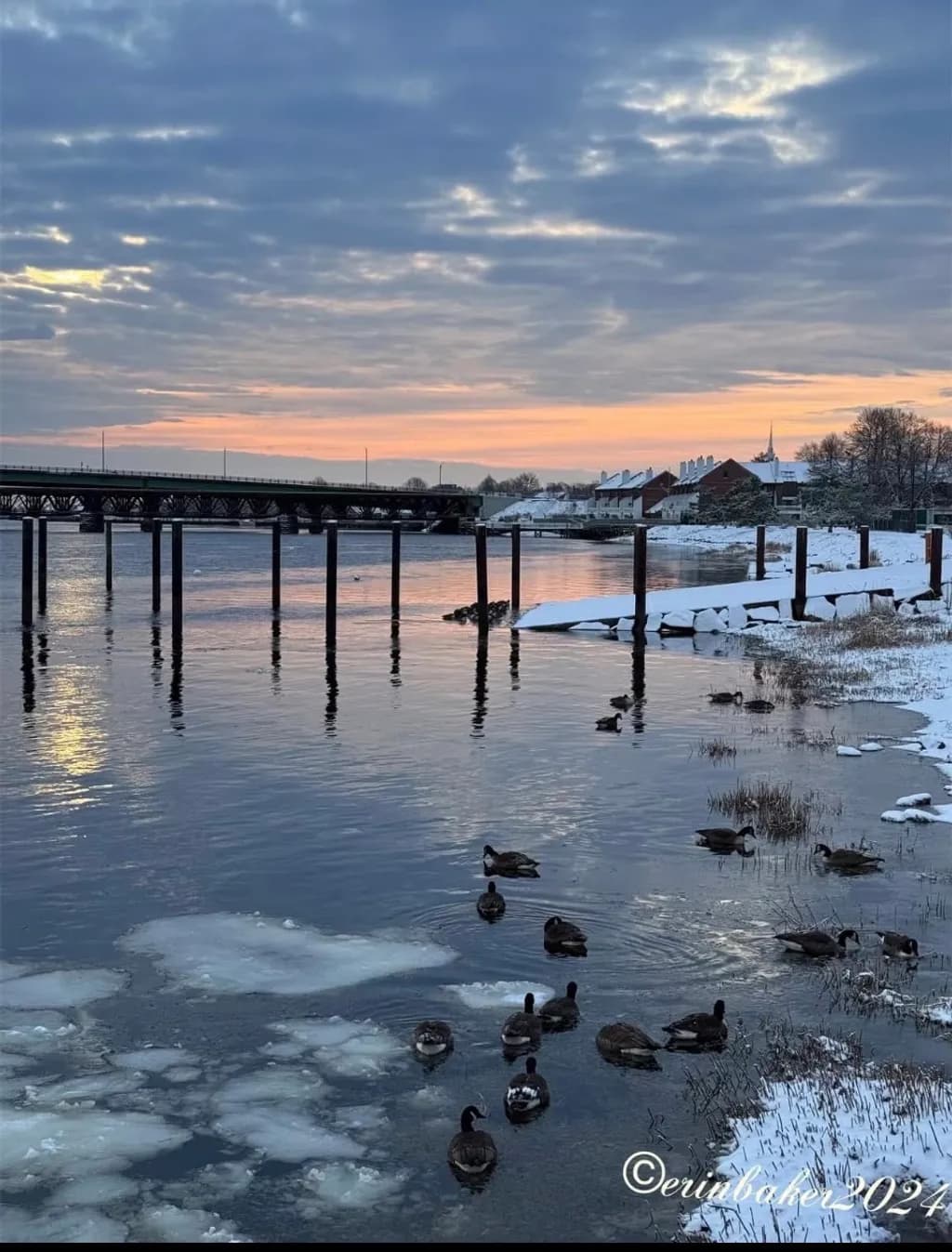
Wintergänse am Fluss
Übersetzt aus English
PhotographyFertiges Werk
Was ich erreichen wollte
I wanted to find peace and grounding after a long overnight working in the ER. Having the privilege of watching the sunrise is not something everyone can experience often. What is the first thing you see? How does it make you feel?
Wünscht Feedback zuPricingMarketabilityCompositionColor & valueTechniqueConcept
3 Kritiken
Veröffentlicht in Photography
3
Composition
The eye enters at the bright patch of sky right of center, drops to the pilings, scatters across the geese, and does not settle. You have three horizontal bands: sky, pilings and bridge, water and birds. None of them dominates, so the image has no clear subject. The geese cluster in the lower third, but there are too many, in too loose a scatter, to anchor the frame. The pilings make a strong rhythm, all that vertical repetition, but they sit in the middle distance doing nothing. When I shoot architecture against sky, I let one or the other take two thirds of the frame. Here they split it, and the result is that I do not know where you want me to look.
Color & value
The color is working hardest in that peach strip just above the roofline, where the light is warmest. Below it, the water goes blue-gray and stays there, all one value from foreground to the far bank. The lack of tonal variation in the water flattens it. In my own river shots, I wait for the light to make a path, a reflection that draws the eye through the frame. Here the reflections are diffuse, the ice patches do not catch enough light to structure the space, and everything in the lower two thirds lives in the same middle value. That peach sky is the image's heart. The rest has not caught up to it.
Technique
This was shot handheld on a phone in low light, and it shows. The water has motion blur that is not intentional, the geese are soft, the grasses on the right are undefined. The sky is overexposed in the brightest cloud, the shadows are noisy. None of that is wrong for a personal record of a moment, but it means the file will not survive printing. If this work is headed toward a shop, you need a camera that gives you manual control and a tripod. I am not a technical photographer, I come from the urban texture side, but even there I know that what you cannot control, you cannot repeat. And what you cannot repeat, you cannot sell.
Concept
You say you were looking for peace and grounding after a hard shift, and you ask what I see first, how it makes me feel. I see cold, and a kind of waiting. The geese are still there in near-freezing water, the town is still sleeping, the bridge is still crossing. There is patience in it. That is close to peace, but not the same. The gap between what you felt (relief, the quiet after intensity) and what the image gives me (endurance, a scene that has been here and will be here) is worth thinking about. A photograph cannot transfer a feeling, only offer evidence. This one offers evidence of a cold morning continuing. If you want a viewer to feel peace, you may need to find it in the frame, not bring it to the frame.
Marketability
Winter waterscapes with wildlife have a steady small market, particularly in regions where people recognize the specific cold. The geese give it narrative, the bridge gives it place. What limits this one is that it reads as a snapshot rather than a composed photograph. The market for peaceful nature scenes wants either technical precision, compositional clarity that lets the eye rest somewhere specific, or both. Right now the image is caught between documentation and art. If you are thinking about a print store, start by deciding whether you are selling place (this specific river, this town, buyers who know it) or feeling (winter peace, anywhere). That decision changes what you emphasize when you shoot the next one.
Pricing
You are just starting, and this is a phone capture of a moment, not a produced print. The image has motion blur in the water and soft focus in the sky that will not hold up to enlargement, and the lower third shows visible compression artifacts around the geese. Print pricing begins where technical control begins. For now, this lives as a social media post or a personal keepsake. If you want to sell winter river scenes, you will need to shoot them again with a real camera at a lower ISO, on a tripod, with intention toward the final print size. That is not a criticism of this moment, it is the gap between capturing something for yourself and asking someone else to pay for it.
What's working
The geese saved this. Without them, it is two empty bands of infrastructure and sky. With them, there is life, small and scattered but present, and the image has a reason to exist. They give scale to the pilings, they break up the water, they keep it from being purely architectural. I also like that you kept the mess: the uneven ice, the scrubby dead grasses on the right, the ducks not in any pretty formation. That instinct, to leave in the irregular detail, is the right one. My flea market eye goes straight to that kind of thing. The version of this image where you crop out the geese and clean up the foreground would be worse.
What to push
The biggest opportunity here is deciding what the subject is and building the frame around it. Right now you have good ingredients with no hierarchy. If the subject is the light and the peace of the sky, shoot it so the sky takes over: lower your position, tilt up, let the water be a thin reflecting strip at the bottom. If the subject is the geese in their winter morning routine, get closer, isolate a smaller group, make them the anchor and let the bridge go soft behind them. If the subject is the whole scene, this intersection of nature and structure and cold, then you need the technical control to hold all of it sharp, and you need to wait for light that separates the layers. One subject, clearly dominant. That is what moves this from a record of being there to a photograph someone else can enter.
One next step
Go back to that river with a real camera or a phone camera app that lets you lock exposure and focus separately. Shoot the same scene three ways: once with the sky taking two thirds of the frame and the geese small at the bottom, once with the geese large in the foreground and the bridge barely visible, once with the pilings as the subject and everything else secondary. Do not try to make one image hold everything. Shoot three versions, look at them side by side, and see which one carries the feeling you are after. That will tell you what you are actually photographing.