Sarah Andersen Saw the Monster Forming in 2022. She Wasn't Wrong.
On December 31, 2022, cartoonist Sarah Andersen published an op-ed in The New York Times that would become one of the most cited pieces in the fight for artist rights. The essay was titled "The Alt-Right Manipulated My Comic. Then A.I. Claimed It." In it, she described what happened when she typed her own name into Stable Diffusion and watched the machine spit out images in her style. Images she never made. Characters she never drew. Work that looked like hers but wasn't.
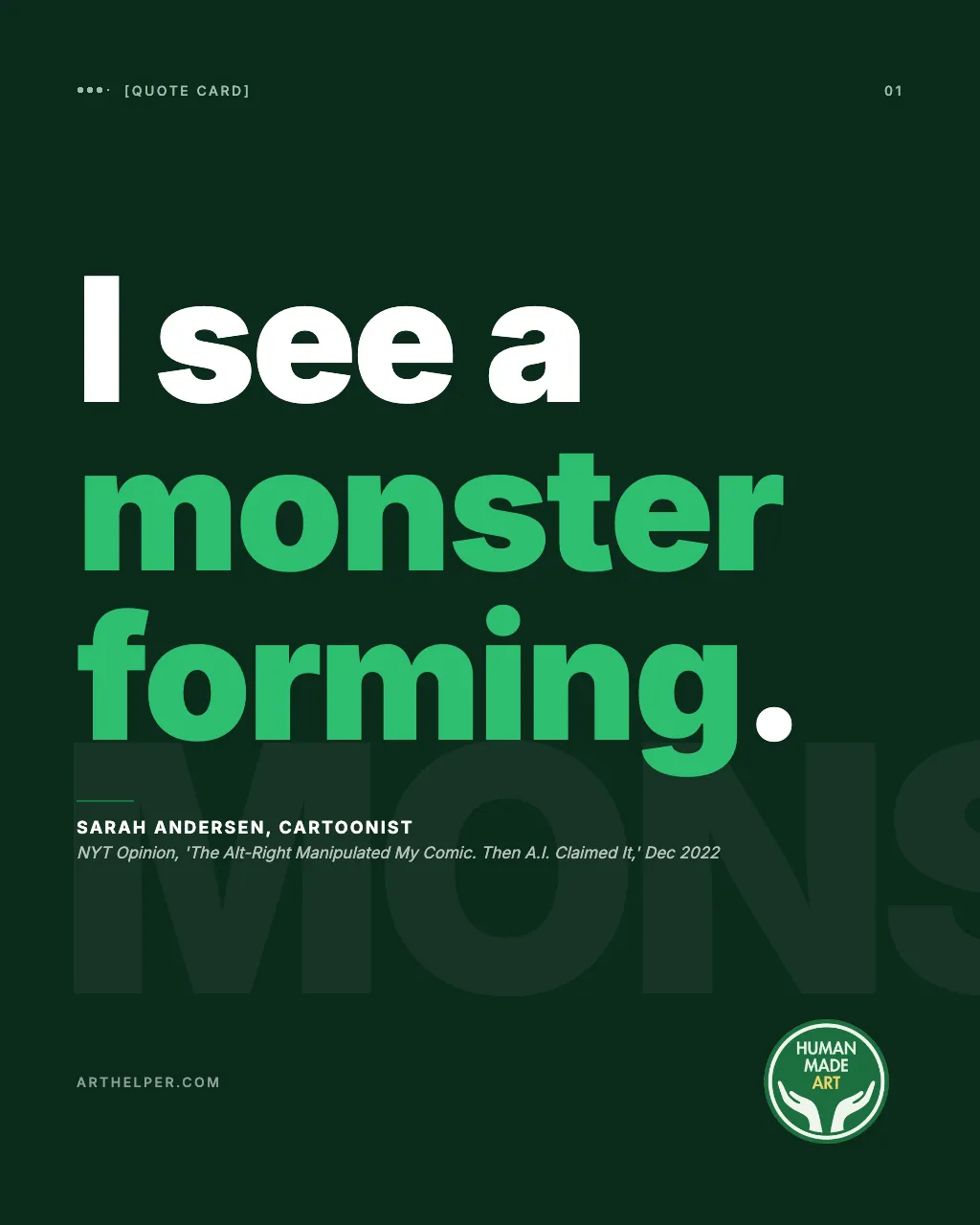
Her assessment: "I see a monster forming."
The Quote, In Full Context
Sarah Andersen is the creator of "Sarah's Scribbles," a comic series read by tens of millions. She's not a critic on the sidelines. She's a working artist whose livelihood depends on the recognizability of her voice. When AI scraped her work and made it replicable on demand, she didn't stay quiet. She wrote. She named the problem. And then she did something else.
On January 13, 2023, just two weeks after the op-ed published, Andersen became one of the lead plaintiffs in Andersen v. Stability AI, a class action lawsuit against Stability AI, Midjourney, and DeviantArt. The case alleged that these companies trained their models on billions of images scraped from the internet, including the copyrighted work of artists who never consented. It's one of the most significant legal challenges to generative AI in the art world.
What's Changed Since 2022
Three and a half years later, the monster she saw forming is no longer forming. It's here. AI image generators are faster, more accessible, and more integrated into platforms than they were when Andersen first wrote that line. But so is the resistance.
The lawsuit survived. In August 2025, U.S. District Judge William Orrick denied Stability AI's motion to dismiss the copyright infringement claims. The case is now in discovery, with a trial scheduled for September 2026. A third amended complaint was filed in February, and the legal ground has shifted in ways no one could have predicted when Andersen first went public.
And beyond the courtroom, something else happened. Artists started organizing. Communities like this one formed. The phrase "human made" became more than a preference. It became a stance.
Why This Matters to You
Andersen didn't just describe a problem. She named it early, clearly, and in a venue where millions would read it. That takes courage. It also takes a kind of clarity that only comes from lived experience. She knew what it felt like to see her work used without permission. She knew what it meant when a machine could replicate her voice faster than she could draw.
Her words in 2022 gave language to a feeling that thousands of artists were just starting to have. And her lawsuit gave them a legal front to watch.
The monster she saw forming? It's still here. But so are we.
Your Turn
What's the line from a creator, artist, or writer that crystallized your own stance on AI in art? Drop it in the comments. Let's build a library of the words that mattered.
"We live in capitalism, its power seems inescapable — but then, so did the divine right of kings. Any human power can be resisted and changed by human beings." - Ursula K. Le Guin
For me, this defines the ethos of human solidarity in arts.
If humans prioritize supporting human creators and human-made art, humans and human made art will ultimately prevail.
As humans need to take actions like Sarah did. We need to support the human artists and human made art.