
civilization
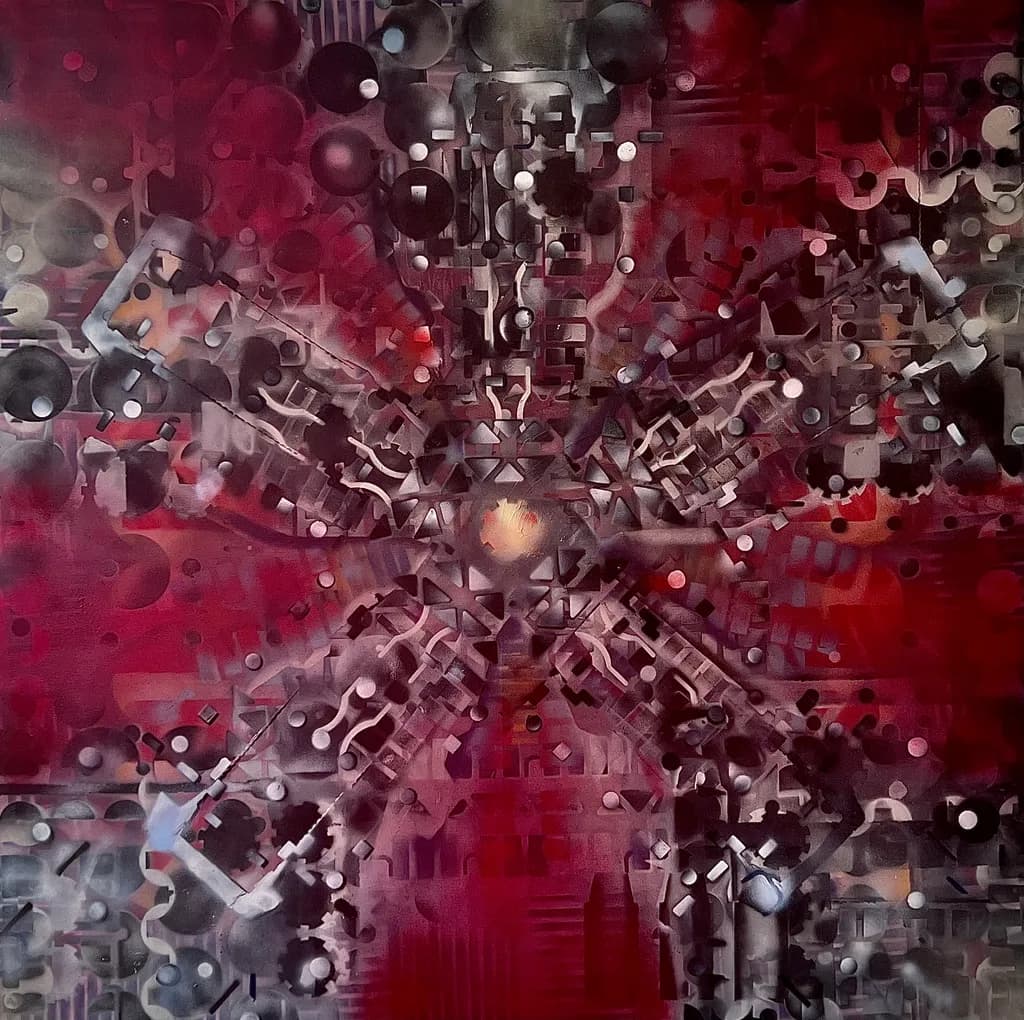
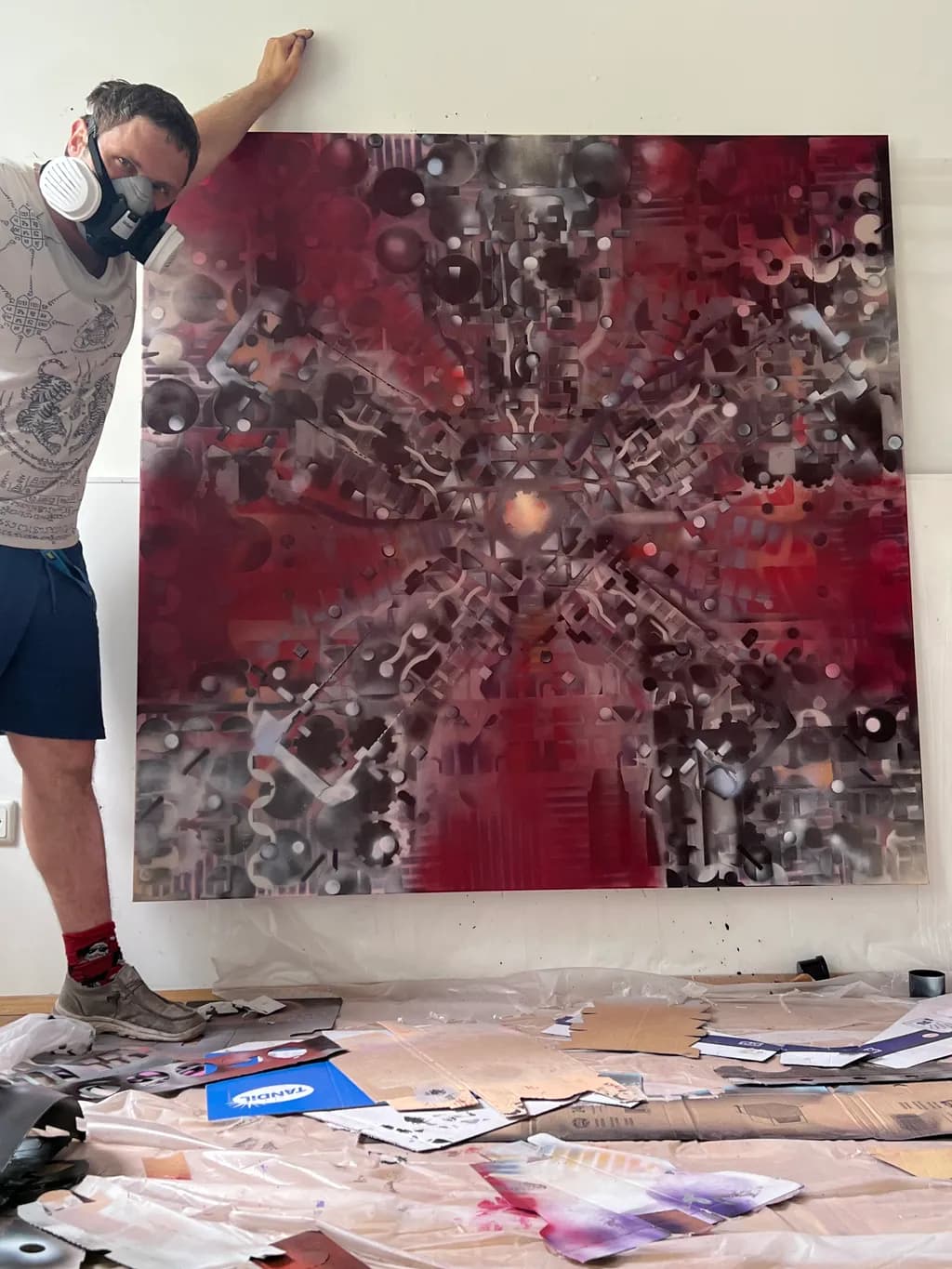
I use purely functional industrial patterns and forms in multiple layers and variations.
By doing so, I attempt to visualize certain dynamics driven by the urge for optimization and efficiency.
The result often feels futuristic because of the repeated application of these forms — in this case, cardboard packaging structures — onto the canvas: clear lines, modular repetition, and basic geometric objects.
In this particular work (1.5 x 1.5 m), the result triggered the following question in me, which is why I named it “Civilization”:
“What would a civilization look like — which patterns and shapes would emerge — if it were far more advanced in technology, scale, and industrial capacity? Advanced enough to harvest all, or almost all, of the energy of a star (Kardashev Scale Type II)?”
The painting reminds me of this idea. However, I do not intend to impose this exact interpretation on the viewer.
Packaging structures as the building block for a Type II civilization thought is such a specific, earned leap.
Thanks for your words.
As I said, the Type-II civilization is an idea of mine that has captured me in a special way.
In general, this style is an engagement with technoid elements. I am continually fascinated by the potential these elements can unleash when you remove them from their original context and experience them in an alternative way. The geometric basic shapes contained in them also often represent natural or mathematically stable optima.
To return to my association: If certain geometric basic shapes repeatedly prove to be stable and efficient solutions in nature, technology and mathematics—why should they not also shape the visible structures of a highly developed civilization?