Jennifer White Art
Artista Visual
Jennifer White Art é um artista de Watercolor baseado em Butler, Pennsylvania.
Eu crio arte inspirada pela natureza, pela beleza e por momentos de silêncio — convidando você a pausar, olhar de novo e descobrir o extraordinário no cotidiano.
Traduzido de English
Butler, Pennsylvania, United States
Entrou em agosto de 2026


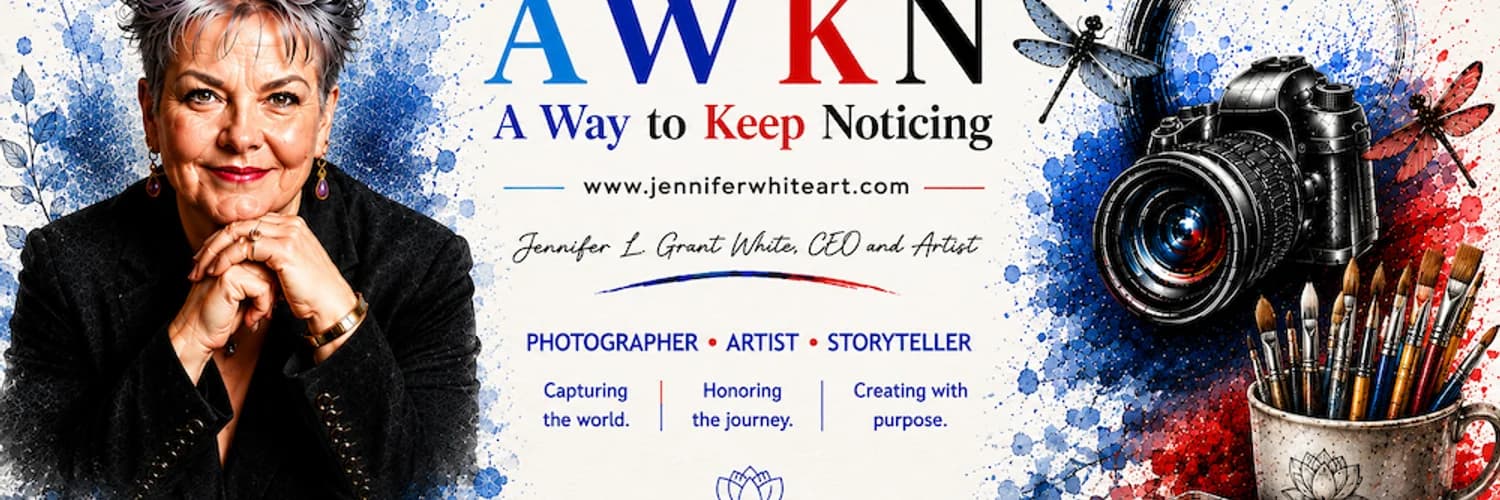
I am Jennifer White, a contemplative photographer and multidisciplinary artist whose work begins with a simple practice: noticing.

I work across photography, graphite, colored pencil, watercolor, ink, painting, urban sketching, portraiture, and botanical art. Although the tools in my hands may change, I do not see these as separate artistic practices. Each offers me a different way to slow down, pay attention, and enter into relationship with what is already here.

Photography first taught me to recognize the moment that already exists. Drawing asks me to stay with what I see long enough to discover what I initially missed. Watercolor teaches me to work with uncertainty and surrender some control. Urban sketching invites me to become part of a place rather than simply pass through it. Portraiture asks me to encounter another person with curiosity and presence.

Together, these practices have shaped my philosophy of A Way to Keep Noticing.

My Buddhist and contemplative practice deeply influences the way I approach both life and art. Presence, awareness, curiosity, impermanence, spaciousness, and non-attachment are not simply ideas that appear in my work; they influence the way I make it. Art has become another form of contemplative practice for me—a way of becoming quiet enough to see what is actually in front of me before judgment, expectation, or the desire to make something beautiful takes over.

The contemplative principle of Heaven, Earth, and Humanity also informs the way I see and compose. Heaven represents openness, spaciousness, and possibility. Earth provides grounding, form, texture, and physical presence. Humanity is the relationship between them—the gesture, path, doorway, person, trace, or point of connection that brings us into the scene.

Across my work, I explore seven recurring Ways of Noticing: Stillness, Spaciousness, Thresholds, Rhythm, Impermanence, Traces, and Wonder. These themes create a common language connecting my landscape, nature, and urban photography with my drawings, portraits, botanicals, paintings, and urban sketches.

A quiet landscape may reveal Stillness. A vast sky can offer Spaciousness. Repeating windows, tree trunks, or rows of corn become Rhythm. A weathered doorway, shoreline, or path can become a Threshold. A fading flower or changing season speaks to Impermanence. An old road, worn step, abandoned structure, or footprint can hold a Trace. And sometimes an unexpected encounter with light, color, form, expression, or the natural world simply stops me in Wonder.

I am particularly drawn to ordinary subjects that are easy to pass without seeing: an aging doorway, the geometry of an urban landscape, weeds growing along the edge of a road, the irregularity of a flower, light moving across a building, a field beneath an enormous sky, or a fleeting expression on someone's face. I am interested not only in what something looks like, but in what happens when I give it sustained attention.

My path to becoming an artist has not been a straight one. My background has taken me through geology, technology, business, entrepreneurship, coaching, photography, contemplative practice, and eventually into a broader multidisciplinary art practice. Each chapter has influenced the way I understand observation, resilience, curiosity, and change.

Life has also taught me intimately that nothing remains unchanged. Loss and profound personal change have altered the way I understand time, beauty, presence, and what it means to truly pay attention. I no longer believe we need to wait for extraordinary circumstances, extraordinary places, or perfect moments before we allow ourselves to be awake to our lives.

That understanding sits quietly beneath much of my work.

I am increasingly interested in what is imperfect, transitional, weathered, unfinished, overlooked, or disappearing. A flower does not become less worthy of attention because its petals are fading. An old building does not lose its beauty because its paint is peeling. An empty field after harvest can hold as much visual meaning as one at the height of summer.

The subject and medium may change, but my practice remains the same:

Slow down. Pay attention. Notice what is here.

For me, a finished artwork is more than a representation of a place, person, or object. It is evidence of an encounter—a moment when I became present enough to notice something and stayed with it long enough for more to become visible.

Through A Way to Keep Noticing, I invite you to do more than look at my work. I invite you to practice seeing.

Notice the quiet.

Notice the space between things.

Notice what is changing and what remains.

Notice pattern, imperfection, color, light, and the extraordinary hiding inside the ordinary.

Because when we learn to pay attention, we may discover that the world was never lacking in beauty or meaning.

We simply needed a way to keep noticing.
Mostrando original