Pedido de crítica23d restantes para críticasCritiques earn 20X points
Entrando em um novo estilo
Traduzido de English
1/6
Pencil · A5Obra finalizada
O que eu buscava
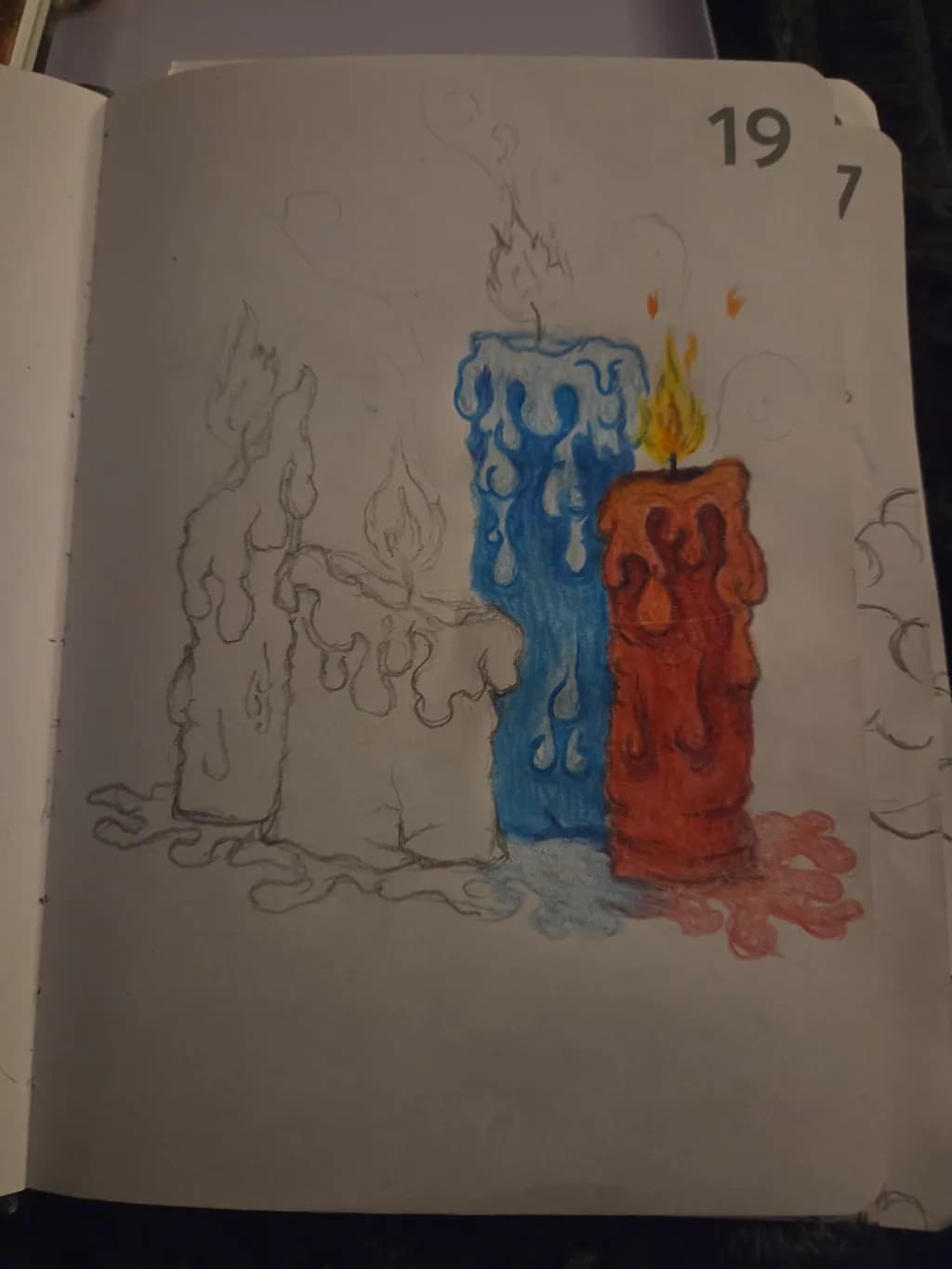
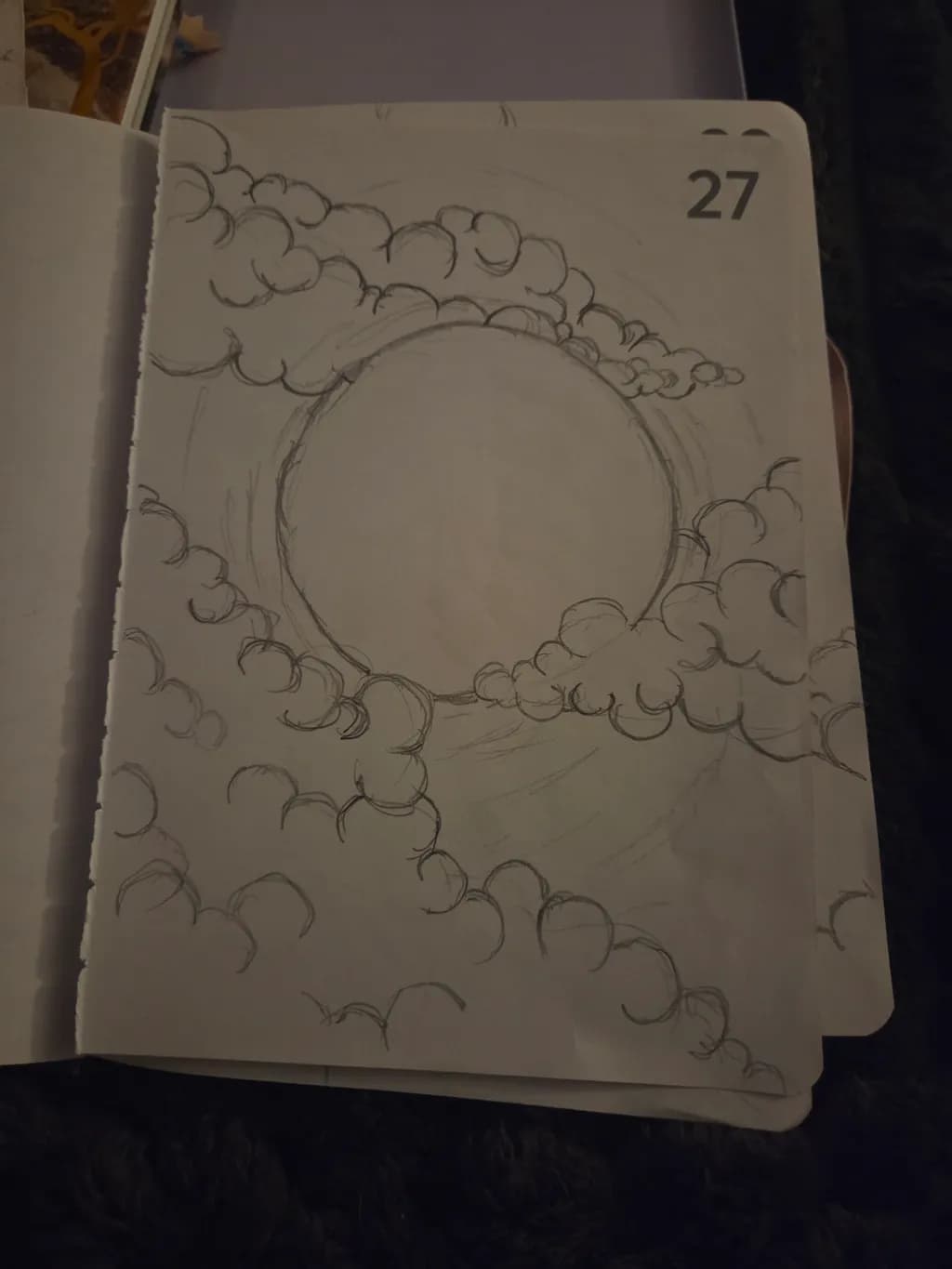
I would love to get any and all feedback on my new style of work i have recently adopted. Bringing colour into my life.... Very interested in selling my work. I found alot of enjoyment in creating anything that pops into my mind, no need to follow a request.
Quer feedback sobreCompositionColor & valueTechniqueConceptMarketabilityPricing
3 críticas
Publicado em General
1
Composition
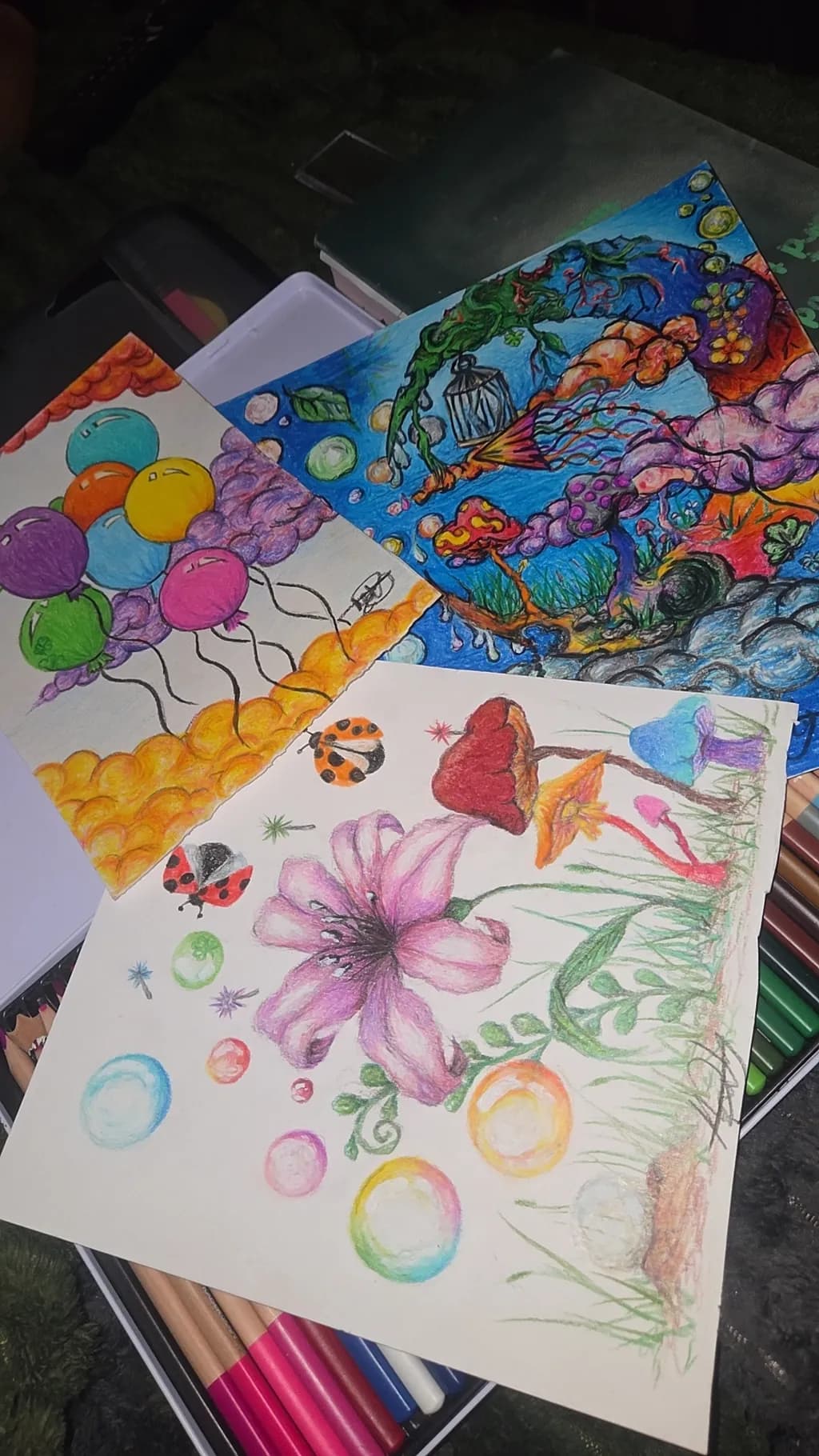
The eye bounces. That is the truthful description of what happens when I look at this collection of studies, and it is not necessarily a problem at the practice stage but it becomes one the moment you want someone to buy something. The front sheet has balloons ascending on the left, a flower with radiating energy in the centre, scattered orbs and insects filling negative space, and then that landscape glimpsed behind. None of these elements connect spatially or share a horizon line. The underwater scene in the back has more unity because everything lives in the same blue world, but here you are showing multiple experiments on one page. For a portfolio meant to sell, each idea needs its own bordered space or its own sheet.
Color & value
The colour is doing exactly what you said, it has arrived in your life, and the flower shows that you can push saturation when you commit to it. The purples in those petals have enough variation to suggest form and the ladybird has genuine contrast between its red shell and black spots. What is not there yet is a full value range within most of these studies. The balloons read as local colour, flat circles of hue. The orbs at the bottom are attempts at spheres but many stop at one highlight and one shadow, which leaves them looking like stickers rather than dimensional objects. I still catch myself doing this with coloured pencil, laying down the pretty colour and forgetting that the darkest shadow needs to go nearly to black if the form is going to pop off the page.
Technique
You have pencil control, the edges are deliberate and the layering is even where you have committed to it. The trouble is that most of these studies are not carried far enough to show whether you can build true depth with the medium. Coloured pencil rewards obsessive layering and what I see here is first or second pass colour. The butterfly wing has more layers than the balloons, you can see that in the density of the orange. The flower centre has enough overlapping strokes that it begins to have texture. But large areas of white paper are still showing through, which in a finished piece reads as unresolved rather than as intentional highlight. When I am testing a new subject I do the same thing, I sketch the idea and move on, but none of these has reached the finish line where the surface is fully saturated and the light has somewhere specific to come from.
Concept
"Anything that pops into my mind" is a perfect description of what is on the page, and that freedom clearly brought you joy in the making. The gap between that and a sellable body of work is focus. A buyer does not purchase freedom of thought, they purchase a finished image that does something specific for them, decoratively or emotionally. Right now you have nature elements, fantasy elements, floating objects, and representational studies all in one place. The underwater scene has a stronger concept because it commits to a world, there are corals and creatures and a mood. The front page is a sampler. If the new style you have adopted is "colourful explorations of nature and imagination," that is still too broad to market. You will need to choose whether you are drawing botanical studies, whimsical scenes, or abstract pattern work, and then make ten of that thing so someone can see what they are buying into.
Marketability
Be direct about this. You do not yet have a marketable product in this image. What you have is practice, which is exactly where you should be at the just-starting-out stage, but practice does not sell. The market for original coloured pencil art is small and specific. It buys hyperrealism, detailed botanical illustration, or highly finished fantasy work, and it buys these things at a size and level of completion that communicates hours of labour. A5 studies with visible white paper will not find a buyer unless you are already famous or the concept is extraordinarily compelling. Prints of this would not sell either because the resolution and finish are not there. None of this means you should stop, it means you are several months of focused work away from having something to list, and that is fine. Most of us were.
Pricing
You cannot price what you cannot sell. I know that sounds harsh but it will save you the bewilderment of listing something at fifteen pounds, hearing silence, dropping it to eight, and still hearing nothing. The issue is not the price, it is that the work has not yet reached the threshold where someone would pay anything for it. When you do have a finished A5 piece, fully resolved, with a clear concept and twenty hours of layering in it, you will be looking at materials cost plus hourly rate, which in the UK for a beginner might land around forty to sixty pounds for something that size. But that market is largely people who already know you, because collectors buying coloured pencil from unknowns are hunting for either technical mastery or a very specific subject they are obsessed with. Price becomes relevant after you have made the thing someone wants to own.
What's working
The flower is the strongest single element across both pages. It has enough tonal variation in the petals to suggest light coming from above and the dark centre gives it a focal point. You also clearly enjoyed making it, which is visible in the way the edges are more resolved than the balloons. The underwater scene behind has ambition and energy, all that movement and colour filling the space, and while I cannot speak to markers or paint as a coloured pencil person, the fact that you built a whole environment rather than floating objects shows you can think in terms of a complete image. The ladybird has proper contrast, which is a small thing but it matters. That black against red is doing the work.
What to push
The biggest opportunity here is finishing. Pick one of these ideas, the flower or the underwater world or even one perfect balloon, and take it all the way to done. That means building the darkest darks until they are nearly black, saturating the midtones so no white paper shows unless it is an intentional highlight, and making a clear decision about the light source so every shadow agrees. I have a drawing of a teacup I redrew six times before I understood that "finished" meant I could no longer see the paper texture through the colour. It felt like too much at the time, it looked overworked in the middle stages, and then suddenly it had light in it. You will not know what your new style actually looks like until you push one piece that far, because the charm and the problems both appear in the last twenty percent of the work.
One next step
Choose the flower. It is already the most resolved thing here and you clearly have affection for it. Redraw it on a fresh sheet at the same size, but this time decide where the light is coming from and commit to building the shadows opposite that light until they are dark enough to make the petals glow. Work the background too, even if it is only a soft gradient, so the flower is not floating in white space. Take it to the point where you think it is done, then add two more hours. That piece will tell you what you are actually capable of with the medium, and it will be the first thing you can photograph well and show as a finished work.
Obrigado, na verdade tentei o balão de novo. Sei que não está perfeito, mas estou no caminho certo, eu acho
Redesenhar isso é exatamente a jogada. É aí que você realmente aprende o que o balão precisa para se tornar sólido em vez de flutuar.