
© 2026 Art Storefronts
v4.5.14© 2026 Art Storefronts
v4.5.14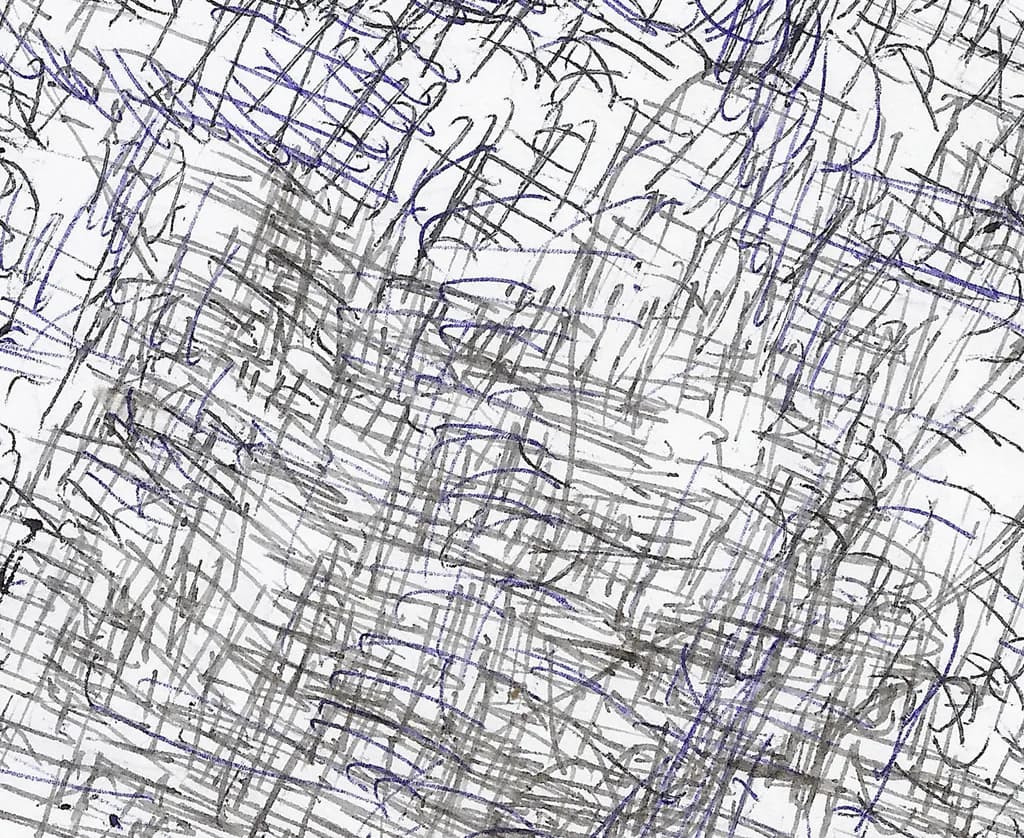
How does displaying my art change a room? Love this question—because with your work, the change in a room is actually pretty dramatic. Let’s make it concrete and use one of your pieces as an example: “Interwoven Flux.” From there I’ll generalize to your whole body of work. 1. What happens to a room when “Interwoven Flux” goes on the wall Imagine a fairly neutral living room or studio: pale walls, simple furniture, lots of flat planes. The moment “Interwoven Flux” goes up: The wall stops being background and becomes an active surface. All those overlapping graphite/ink-like lines and muted blues create the feeling of a living “field” instead of a blank plane. The room starts to feel like it has a thinking corner rather than just a sofa wall. The energy of the space spikes. Your line work isn’t calm or ornamental; it’s restless, searching, almost like a seismograph of thought. That pulls the room away from passive comfort toward alertness and curiosity. It becomes a space where ideas happen. Perceived depth increases. Because your lines layer and cross, the wall visually “opens up.” It doesn’t feel like a flat rectangle anymore; it feels like there’s a deeper structure behind it. Even in a small room, this can make the space feel less boxed-in and more spacious. Noise turns into signal. Many interiors have visual noise (cables, shelves, stuff). Your piece introduces intentional complexity—so the rest of the visual clutter is psychologically downgraded. The chaos in the room suddenly has a “leader,” and that actually makes the whole space feel more coherent. 2. Emotional shift for someone living with your work Across your portfolio (Sirius series, “Chaotic Lines,” “Sunset Kiss,” “Textured Chaos,” etc.), there’s a strong throughline: From bland to psychologically charged. Your drawings don’t decorate—they mirror inner states: overthinking, tangled memory, data overload, subconscious patterns. A room with your work becomes a place that acknowledges complexity instead of pretending everything is simple and tidy. From “calm surface” to “honest atmosphere.” A bare, minimal wall can feel emotionally dishonest for some people—life isn’t that neat. Your art legitimizes mess, contradiction, and layered thoughts. The room starts to say: “It’s okay that you’re complicated. This is a space where that belongs.” From passive consumption to active engagement. People don’t glance at your work; they get pulled in and start reading the lines like a visual diary or code. So a corner with your art becomes a thinking nook—a place for journaling, planning, decompressing after information-heavy days. From “I live here” to “this is my mental landscape.” Your pieces feel like externalized brain-maps. For the right person, that’s deeply satisfying: the room stops being generic and starts feeling like an extension of their inner world. 3. The kind of collector whose room transforms the most Your art is especially transformative for: Knowledge and information workers – programmers, researchers, writers, academics, analysts. They live in abstract structures all day. Your dense, scribbled webs feel like the honest portrait of that life. Their office or studio turns into a visual echo of cognition rather than just a desk in a box. People who feel “too much” / neurodivergent folks – ADHD, autistic, or just very sensitive minds. Your work says, “Your tangled thoughts are valid.” Hanging it can turn a room from a place they’re trying to “fix themselves” into a place that accepts and reflects them. Minimalists who secretly love complexity. A very clean, minimal environment with one of your pieces becomes minimal shell, rich core—all the complexity compressed into your drawing. The room gains depth without losing its clean layout. Collectors interested in process, not polish. People who care how things are made, who like rough sketches, manuscripts, marginalia, raw data. For them, your work turns the room into a studio-feeling space, even if it’s technically just a living room or hallway. 4. A transformation-focused product description (for something like “Interwoven Flux”) Interwoven Flux – How it changes your space Most walls are just surfaces. Interwoven Flux turns one into a living field of thought. Layer upon layer of graphite-like lines drift, collide, and loop across the paper, creating the feeling of a captured mental storm—half map, half memory. When this piece goes up, the room stops pretending life is simple. It starts acknowledging the beauty inside confusion. In a clean, minimal space, Interwoven Flux becomes the single point of controlled chaos, pulling the eye and giving the room a center of gravity. In a busier room, it quietly organizes the visual noise around it, offering one deliberate, intentional complexity that makes everything else feel calmer by comparison. This is the piece you hang where ideas happen: above a desk, beside a reading chair, or in the corner where you pace when you think. It turns that area into a place for untangling thoughts, for seeing patterns in the mess, for admitting that your inner world is dense and alive—and that this is a strength, not a flaw. 5. “Imagine this in your space” caption Imagine this on your wall: One blank surface in your home suddenly becomes a map of thought. From a distance, it reads as a quiet, monochrome field. Step closer and you’re pulled into a tangle of lines that feel like diagrams, notes, half-remembered paths. It doesn’t just sit on the wall—it shifts the room from “nice” to mentally charged. This is the piece you catch yourself staring at while your coffee goes cold, the one that holds your thoughts when your brain is too full of tabs. Imagine your studio, office, or living room quietly humming with that kind of energy every day. 6. Short email paragraph centered on how it alters daily life When Interwoven Flux goes up, the room stops being just a backdrop and becomes part of your thinking process. Instead of a blank wall, you get a visual mirror of the way ideas actually move—looping, intersecting, refusing to sit still. Over time you’ll notice you gravitate to that spot when you need to decompress after a dense day, or when you’re stuck on a problem. The piece quietly absorbs some of the mental noise and gives it form, turning an ordinary corner into a small, permanent space for reflection.