Solicitud de críticaVentana de crítica cerradaCritiques earn 20X points
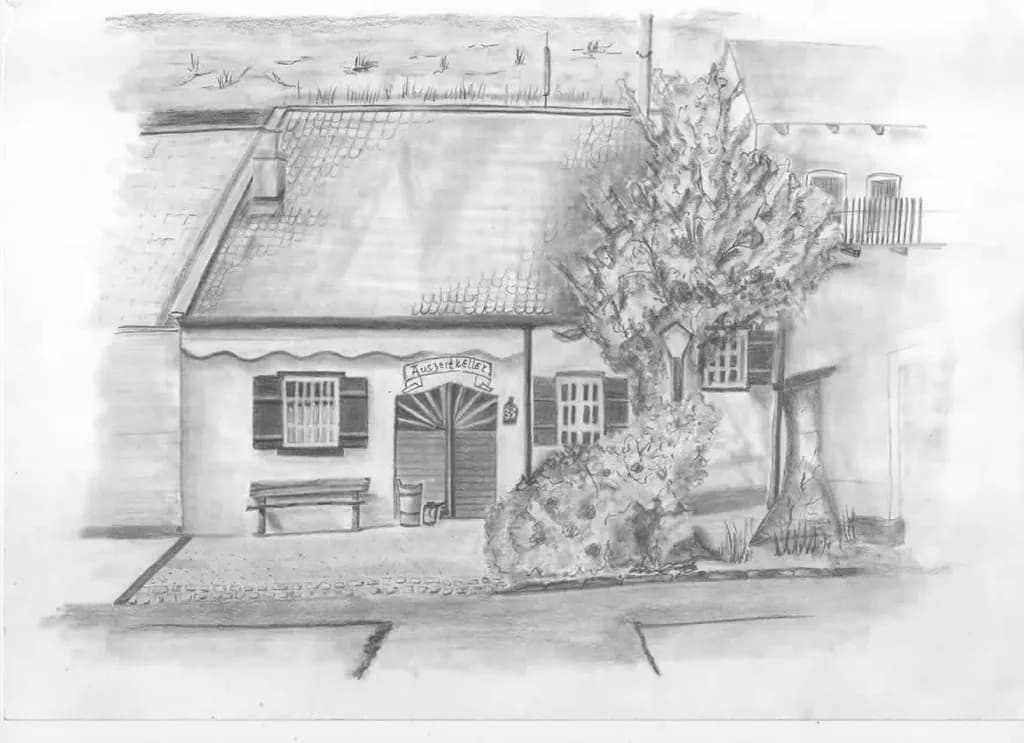
Casa del viticultor en Krems / Danubio
Traducido de Deutsch

1/2
Bleistift · 29,5x21cmPieza terminada
Lo que buscaba
Eine kleine Kellergasse in Krems / Donau (Österreich). Ich wollte die Stimmung dieses kleinen Hauses an ein steilen Straße einfangen. Das Haus passt sich der Straße an, nicht umgekehrt. Auf der Rückseite der Häuser befindet sich eine Löswand (Sandsteinwand). DIese Wand mit den Gräsern darzustellen war sehr schwierig. Wie seht Ihr meine Zeichnung im Vergleich zum Foto? Würdet Ihr das Dach (Die Ziegelstruktur) vollständig durchzeichnen oder nur andeuten?
Busca comentarios sobreTechniqueComposition
3 críticas
Publicado en General
1
Composition
The street rake pulls the eye straight into the door with the sign, and the tree mass acts like a second weight to keep things from sliding right off the picture plane. You've cropped the neighboring building just enough to suggest the row continues without splitting focus. The bench and those two little objects by the door are doing more work than their size suggests, giving the eye a place to rest before it climbs back up the tree. What I keep looking at is the top eighth of the image, that field and sky. It's descriptive, it establishes place, but it's also a lot of soft, even tone for how much energy is packed into the middle and lower two thirds. The house genuinely does fit itself to the steep street, the way you wanted. The left edge of the building leans into the hill in a way that would look wrong if the street were level.
Technique
The pencil range here is confident, especially in the tree and those foreground cobblestones. You've got real darks in the shutters and under the awning, real lights on the stucco, and a middle value that holds the roof without fighting for attention. The loess wall behind the houses is the hardest call you had to make and you committed to a solution: those little vertical grass marks read as texture without turning into a thicket. I'd have panicked and overworked it. The roof tiles land somewhere between fully rendered and suggested, each one hinted at with a curve but not outlined to death. When I'm enameling and a flux starts to flow, I have about eight seconds to decide how far to let it go before I pull the piece. You're in that same zone with the tiles. They're at the edge of enough.
What's working
The material difference between stucco, shutter wood, roof tile and cobblestone is completely clear. I can tell what would be cool to the touch and what would still hold the day's heat. The tree has actual volume, not that flat cutout look that happens when someone draws leaves as an outline and fills it in. You've layered the pencil so the front clusters come forward and the back ones sit in space behind the trunk. The sign over the door stays readable without jumping out of the value structure. Those transitions from sunlit stucco to shadow under the eave are smooth enough that the light feels specific, like a particular time of afternoon. The whole piece has a stillness that matches the subject. It's not trying to yell.
What to push
The biggest opportunity is in that top section, the loess wall and the field above it. Right now it's accurate but it sits at the same intensity as the rest of the image, so the eye wanders up there and doesn't find a reason to come back down to the house. You could push the atmospheric difference harder: less contrast in the grasses up top, a little more air between the viewer and that distant wall, maybe a softer touch overall so it recedes. The roof question you asked is actually about how much detail pulls focus. Fully rendering every tile would drag attention up and away from the door and tree, which are clearly the emotional centre of the piece. Right now the tiles are close to resolved. If anything, you could lose a few more of them in the lightest areas and let the suggestion do the work, but what you've got is already in the neighbourhood of enough.
One next step
On the next drawing, or on this one if you're still working the upper section, take a kneaded eraser and lift some of the contrast out of the distant field. Not enough to lose the information, just enough that it sits back in space the way that far hill would in actual air. Then compare how much the house comes forward without you touching it at all.