When the War Ends, the Battle Remains
Lo que buscaba
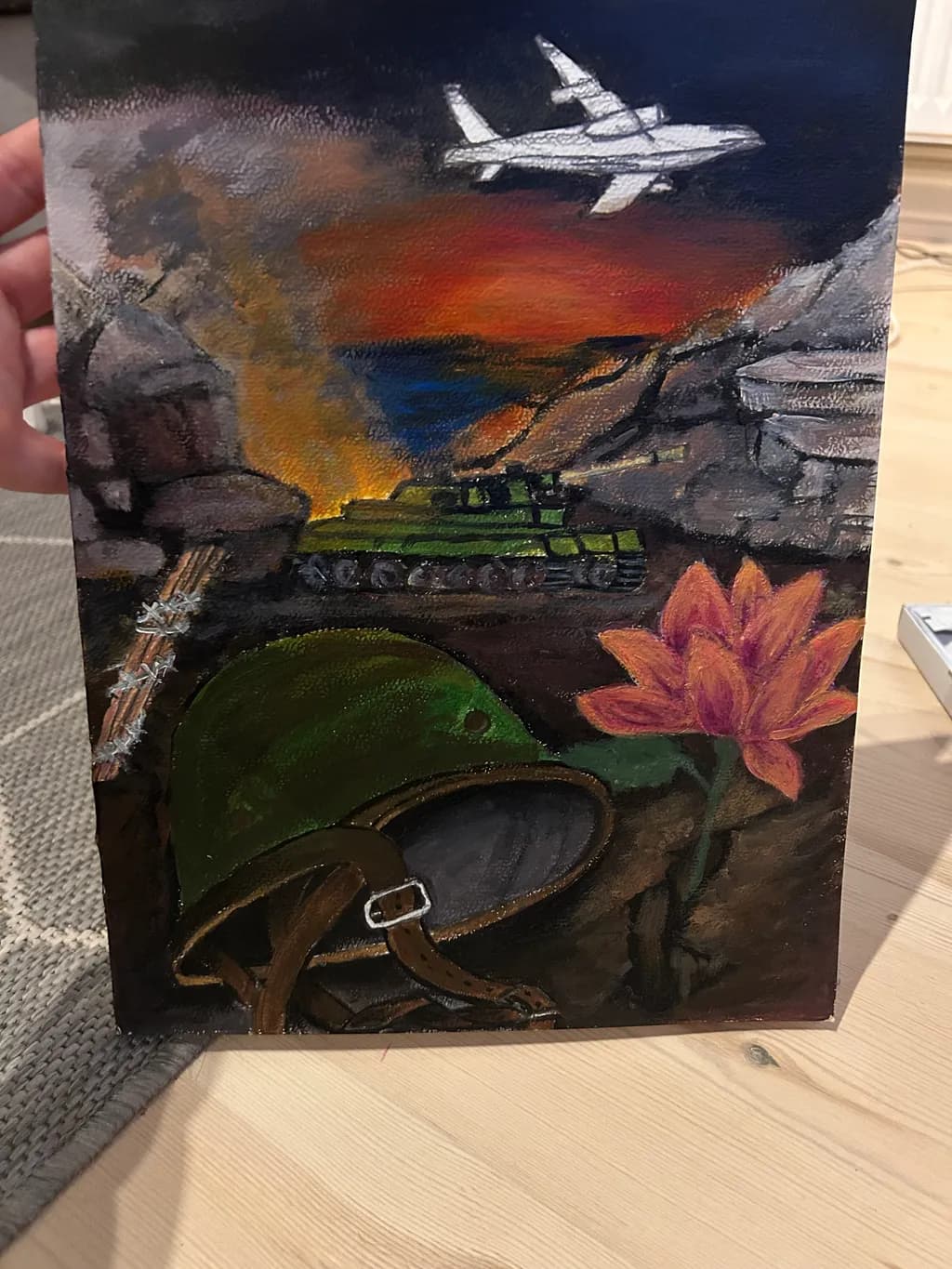
Some battles are fought on the battlefield. Others are fought in silence, behind closed doors, and deep within ourselves. This painting is a reflection of my own journey through a lifetime of physical and psychological abuse, and the ongoing battle with PTSD and the scars left behind. For me, the war did not end when the abuse stopped. The real fight began in the aftermath — learning to feel safe again, finding my way through the darkness, and slowly rebuilding a life that trauma had tried to take from me. The broken landscape represents the devastation that trauma can leave behind. The helmet, the tank, and the aircraft remind us of the wars we see, while the lotus flower represents the quiet strength it takes to heal, to grow, and to find hope in the midst of pain. But this painting is not only about my own battle. There are so many different kinds of battles in this world. Some are fought by veterans returning home from war. Some are fought by survivors of abuse. Others are fought by people living with grief, illness, fear, or wounds that cannot be seen. We may never know what someone else is carrying, or how hard they are fighting just to make it through another day. I created this painting as a reminder that the end of a battle does not always mean the end of the war within us. Healing is not a straight path, and finding peace takes time. But even in the darkest places, something beautiful can still grow. And sometimes, the greatest act of courage is simply choosing to keep going.
Composition
The eye enters at that sunset burst in the middle and then has nowhere to settle, which might be the point given what you said about devastation, but right now it scatters instead of building. The plane, tank, helmet, and lotus are each claiming equal weight, so the viewer reads them as a list rather than a hierarchy of meaning. The helmet in the lower third is the most resolved object but it sits in a corner, not anchoring the composition. The lotus on the right feels like an afterthought in scale and placement when your statement positions it as hope itself, the thing that grows from wreckage. For a piece headed to a gallery wall, the composition needs to decide what the primary subject is and build the rest in service of that, not in competition with it.
Color & value
That orange-to-blue gradient in the sky has real glow, the kind of atmospheric color that pulls you in, and it is doing most of the emotional work right now. The rest of the value structure is murky in a way that reads as unfinished rather than intentionally somber. The foreground, mid-ground, and background all sit in a similar dark register, so the space flattens and the objects feel pasted on instead of inhabiting the same light. The lotus is the warmest, most saturated element, which should make it pop forward as a symbol of resilience, but it is also tiny and gets swallowed by the dark around it. If the broken landscape is devastation and the lotus is hope, the values need more contrast to make that division land. Right now everything is fighting for attention at the same intensity, which dilutes the message instead of sharpening it.
Pricing
This is harder to pin because the medium listed as "paper" does not tell me what you actually used, and that changes the conversation completely. If this is acrylic or oil on canvas board, if it is gouache on watercolor paper, if it is mixed media, each has a different market and a different price floor. For a 21x29 cm work in progress headed to a gallery with a few years of experience behind it, you are likely looking at somewhere between $150 and $400 depending on medium, finish level, and whether the gallery takes commission. A story this personal can add value for the right collector, but the piece has to be technically resolved first or the narrative will not carry it. Right now the unfinished quality of the paint handling, especially in the foreground and the objects, would make it hard to price above the lower end of that range. Finish the lotus, push the contrast, and get the spatial relationships clearer, and the price can climb with the craft.
What's working
The concept is fearless and the lotus specifically is where your hand loosens up, those pink and orange petals have more life in them than anything else on the canvas. That sky gradient has atmosphere, it genuinely reads as a moment of light breaking through, and it is the one area where the paint feels confident instead of cautious. The helmet has enough detail to be recognizable and grounded, which is important when you are mixing symbolic and literal elements. Your willingness to put this much of yourself into an image and then ask for critique on it is not a small thing. I have a hard time even posting the bowls that crack, much less the pieces that carry actual weight.
What to push
The biggest opportunity here is to make the lotus the anchor instead of an accent. Your statement positions it as the heart of the piece, the quiet strength, the thing that grows from pain, but compositionally it is the smallest and least developed element. Scale it up, move it toward the center or lower left where it can hold ground against the machines of war, and paint it with the same care you gave the helmet. Right now the symbols are all the same size and importance, so the painting reads as clutter instead of contrast. If the lotus is hope, it needs to be substantial enough to stand against the wreckage, not tucked into a corner as decoration. That shift alone would clarify the entire message and give the viewer a place to land after the chaos.
One next step
Repaint the lotus twice as large and move it so it overlaps or anchors one of the war objects, then push the value contrast so it genuinely glows against the dark. That will force you to resolve the spatial relationships and give the composition a clear hierarchy, which will make every other decision easier to see.