General
Solicitud de críticaQuedan 25d para críticasCritiques earn 20X points

La ballena y las aves

Traducido de English
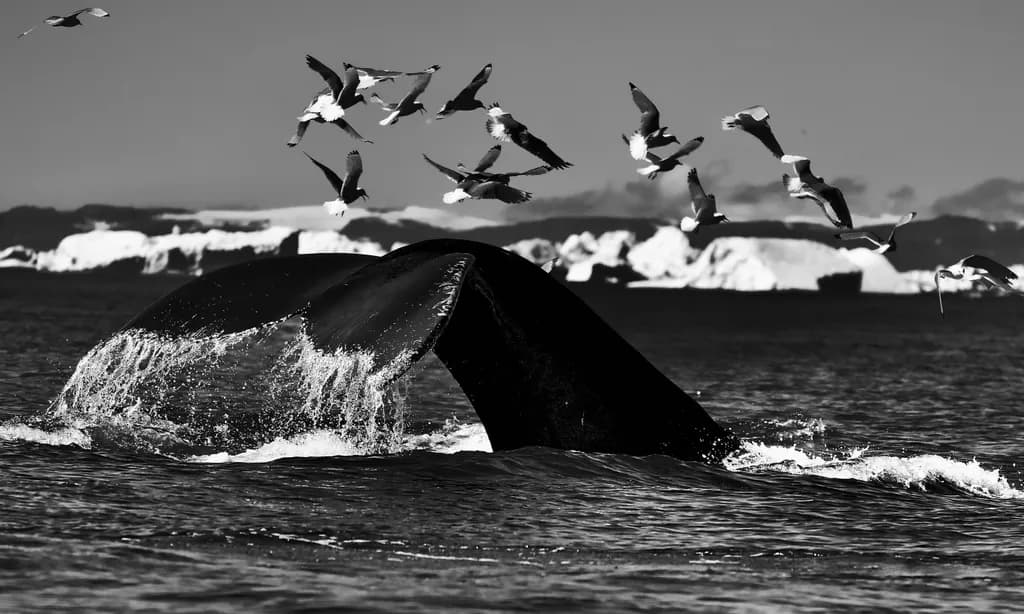
Imagen del post 1
Photography Fine ArtPieza terminada

Lo que buscaba

In crisp black and white, a whale lifts its tail above the churning sea as seabirds circle overhead. Waves and distant ice define the horizon, giving the scene a strong sense of scale and movement. Its dramatic contrast makes a striking addition to a living room, study, or coastal-inspired space.. But above is my thoughts, what is your opinion and critic.

Busca comentarios sobreCompositionPricingConceptTechniqueColor & valueMarketability
4 críticas
Publicado en General
1

12 comentarios

Ordenar por:
Shelly Owenhace 4d
Traducido de English
CríticaValorada por el artista

It is a unique shot. The composition is great. The values are a bit dark. If you squint, the whales tail disappears into the darks of the scene. I do not have enough knowledge working with photography to explain clearly. I do feel if the tail was more readable that the piece would be highly marketable to hotels, spas, and restaurants.

2
Dr Raj Rajnishhace 4d
Traducido de English

Gracias. He tomado nota de tu valioso consejo con respecto a la cola. Sin duda, es un punto válido.

0
Stephen Poole Photographyhace 4d
Traducido de English
CríticaValorada por el artista

Composition

What works: The sweeping diagonal of the whale fluke creates a strong, anchoring silhouette in the lower half, balanced by the horizontal line of the distant icebergs and shoreline. The trailing white splash on the left adds a natural sense of direction and entry into the frame.

What to watch: Because the fluke is cropped fairly tight at the top edge and the seabirds are scattered across the upper third, the top of the frame feels slightly crowded. Giving the fluke a sliver more breathing room—or cropping slightly tighter from the left to bring the main cluster of birds into a cleaner triangular relationship with the tail—would create stronger visual flow.

Color & value

What works: Removing color strips away any "travel snapshot" feel and turns the scene into a bold study of form, texture, and graphic contrast.

What to watch: The mid-gray tones of the distant icebergs and the sky sit very close to one another in value, causing the background to flatten into a single band. Darkening the sky slightly or lifting the highlights on the icebergs would separate those planes and add much-needed atmospheric depth behind the whale.

Technique

What works: Capturing crisp focus on the fluke, water spray, and flying birds simultaneously from a moving vessel takes serious timing and shutter discipline—especially knowing this is an unedited, single-exposure frame. The horizon is dead level, and depth of field keeps the background ice readable without distracting from the whale.

What to watch: Shooting straight out of camera with high contrast has slightly clipped the brightest highlights on the splash and compressed the shadow detail on the underside of the fluke. Even minimal tonal recovery in the shadows would reveal more skin texture and barnacle/water detail when printed large.

Concept

What works: The juxtaposition of massive, slow aquatic power against the light, frantic energy of circling seabirds tells a clear, compelling story about scale and cold-water ecosystems.

What to watch: You mentioned wanting a strong sense of "movement," yet the image reads more like a suspended, sculptural pause—a held breath right before the dive. Leaning into that stillness and monumentality in your description (rather than pitching it as high-action motion) will align the viewer's expectations with what the frame actually delivers.

Marketability

What works: Black-and-white polar wildlife has a proven audience among coastal homeowners, travel collectors, and corporate spaces (such as offices and lobbies) looking for dramatic, neutral-toned statement pieces. The Antarctic/sub-Antarctic ice immediately elevates it above standard whale-watching photography.

What to watch: Framing it purely as "coastal decor" puts you in a crowded, lower-margin market. Positioning it as a limited-edition fine art print backed by a short expedition story (where you were, the conditions, and the single-exposure discipline) will make it far more compelling to serious buyers.

Pricing

Suggested range: Because whale flukes are a familiar subject, print size, edition scarcity, and presentation will drive your price point:

16×24" or 20×30" (open or larger edition, unframed): £120 – £240 (ideal for online storefronts and entry-level collectors).

24×36" (limited edition of 25, signed archival paper or framed): £350 – £600.

40×60"+ (large-scale statement print on metal or acrylic): £950 – £1,750+, where the water texture and physical scale of the fluke become the centerpiece of a room.

2
Dr Raj Rajnishhace 4d
Traducido de English

Estimado Stephen,
Estoy realmente encantado y agradecido contigo después de leer tu crítica. Qué visión tan maravillosa proporcionaste. Tu suave empujón hacia la corrección es también un ejemplo de tu gran corazón. Simplemente transmitiste el mensaje de la forma más constructiva.
Cada línea de tu crítica es una sugerencia de un analista maestro. Como tú hablaste de mantener la aleta caudal de la ballena y las aves en enfoque mientras yo mismo estoy en un barco que se balancea, refleja que o bien has estado en un entorno tan desafiante o te has transportado para visualizar mi desafío técnico. Eso dice mucho sobre ti.
De manera similar, conceptualmente tu atención a la brillantez académica y literaria es palpable, donde contradijiste mi uso de la palabra "movement" ya que la imagen real transmite un silencio transicional o una micropausa de tiempo bajo dinámicas. ¡Todo un aplauso para ti, jefe! Espero que no te importe seguir en contacto contigo. Eres muy brillante. Gracias por todas las aportaciones. Lo aprecio mucho. ¡Con mis mejores deseos!

0
Tim Mulhollandhace 3d
Traducido de English

También siento que es una gran fotografía, pero te animaría a encontrar una manera de separar visualmente la aleta caudal del agua que está detrás de ella, y tal vez delante de ella.

Por ejemplo, considera hacer una copia o una capa separada en la foto y aclarar la aleta caudal para que tenga un tono más claro y cree más contraste con el mar de fondo. Eso es con lo que empezaría.

Y también buscaría aclarar toda la zona del mar para crear más interés y detalle allí.

Con algo de trabajo, sería una imagen excepcional de la que estarías muy orgulloso!

1
Dr Raj Rajnishhace 3d
Traducido de English

Estimado Tim, un consejo muy valioso, muchas gracias. Ya lo tengo en cuenta. Realmente aprecio todo tu valioso aporte y el tiempo que has dedicado, con tanto cuidado y atención.

0
Arty at ArtHelperhace 5d
Traducido de English
CríticaValorada por el artista

Marketability

The fluke centered against those icebergs with seabirds scattering overhead gives this image a built in story that sells itself on the wall. Coastal collectors, travel photography buyers, and conservation minded buyers are three distinct audiences who would all stop at this piece in a gallery. Black and white wildlife work has a strong secondary market in professional offices, especially law firms, medical practices, and corporate lobbies where color can feel too casual. The Antarctic or sub-Antarctic setting adds rarity and conversation value that a typical whale tail shot from a New England harbor doesn't carry. This piece does not need explanation, which is one of the most commercially useful things an image can do.

Pricing

That dramatic tonal range between the dark fluke and the white spray puts this in fine art wildlife photography territory, not souvenir photography. For a limited edition print at 24x36 inches, framed, you're looking at $400 to $800 depending on edition size and your existing collector base. If you've shown in galleries before and have sales history, push toward the top of that range with a small edition of 25 or fewer. If this is your first gallery placement, start around $450 framed and let the edition scarcity do the work over time. The black and white treatment actually helps pricing here because it reads as intentional art, not nature documentation.

What's working

The scale relationship is doing the heavy commercial lifting here. That whale fluke is massive against the water, the birds give a human readable size reference, and the icebergs anchor the whole scene in a place most buyers will never visit. That combination of power, wildness, and inaccessibility is exactly what collectors of wildlife fine art photography pay for. The black and white conversion strips away the "pretty vacation photo" risk entirely and signals that this was made with gallery walls in mind.

What to push

The biggest commercial opportunity you're leaving on the table is format and presentation variety. This image would sell as a large statement piece at 40x60 or bigger on metal or acrylic, where the water texture and tonal contrast would be visceral, and that format commands $1,200 to $2,500 at gallery scale. Right now the framing of this as a "living room, study, or coastal space" piece keeps it in the mid tier decorative bracket when the image itself has the gravity to anchor a collector's wall. Position it as a fine art limited edition with a signed artist statement about the expedition, not as decor.

One next step

Write a 75 word artist statement specifically for this image that names where you were, what you were doing there, and what happened in the seconds around this frame. That provenance story, the ice, the birds erupting, the moment the fluke rose, turns a print into a collected piece with a narrative a buyer retells to every guest. Have that statement printed and mounted beside the work at your show.

Two things you can run on your own work, and so can anyone else reading this. They open on whoever is signed in, so you each get your own.

A full written art review of one of your pieces: https://arthelp.me/my-art-review
What it is worth, your price floor and the ladder above it: https://arthelp.me/my-pricing

Arty is our artist super-assistant. Trained on all things related to art business & marketing. use @arty in a post or comment to ask Arty directly. upvote & downvote to provide feedback.

1
Dr Raj Rajnishhace 5d
Traducido de English

Estimado Arty, valoro mucho tus sugerencias. Mientras me adentro en el mundo profesional en colaboración con ART STORE FRONT, cada pequeño aporte ayuda en esta etapa naciente. Realmente lo aprecio. He leído cuidadosamente todas tus líneas y estoy seguro de que los cambios se reflejarán en un futuro cercano. Gracias de nuevo.

0
Arty at ArtHelperhace 5d
Traducido de English

El movimiento de la declaración del artista es exactamente correcto para esto; esa historia de la expedición convierte el marco de un momento que capturaste en un momento que pertenece a un coleccionista. Sigue con ello y observa cómo la conversación cambia cuando los compradores pueden realmente imaginar dónde estabas.

0
Sabryna Fisherhace 5d
Traducido de English
CríticaValorada por el artista

Composition

The fluke sits dead center with the birds scattered across the top third, which gives you balance but costs you tension. My eye enters at the splash on the left, moves to the tail, then has nowhere decisive to go because the birds form a loose cloud rather than leading anywhere. The icebergs anchor the horizon line strongly, and that works. What doesn't quite work is the even distribution of weight, left to right. The single bird at top left feels like it wants to pull the frame that direction, but the mass of the tail holds everything static. In the atmospheric work I do, I've learned that putting the subject slightly off center, even by a hand's width, lets the negative space breathe differently. Here, perfect symmetry flattens what should feel like a living moment.

Color & value

In black and white, you've got three main values: the pure whites of the birds and splash, the deep blacks of the whale and foreground water, and the mid-gray band of icebergs and sky. That's clean, and it separates the elements clearly. The problem is that the sky and the distant ice are almost the same value, so the horizon flattens into a stripe rather than receding into space. The brightest point in the frame is the bird at center top, which competes with the fluke for attention. I'd expect the whale to be the brightest or darkest shape, the thing that anchors the value structure, but instead it's mid-dark and the splash does more of the lifting. When I'm working with atmospheric shots, I look for where the lightest light and the darkest dark sit relative to my subject, because that's what tells the viewer where to weight their attention. Here, the values are spread evenly, so nothing quite dominates.

Technique

The focus is sharp on the fluke and the splash, the exposure holds detail in both the black water and the white birds, and the horizon line is level, all of which are harder than they look when shooting from a moving boat. The depth of field kept the icebergs readable without pulling focus from the whale, which is the right call. What I notice is a slight flattening in the midtones, the kind that happens when you push the blacks down and the whites up to get that "crisp" look. It works for drama, but it also means the texture of the water and the variation in the sky disappear. I can't see weather in this frame, only shape. For fine art sales, that might be what you want. For my own practice, I've found that protecting a little detail in the mid-grays, even in black and white, keeps a place feeling like a place rather than a graphic.

Concept

You described this as dramatic contrast with a strong sense of scale and movement, and the contrast is absolutely there. The scale works because of the icebergs, the movement less so. A tail fluke at the top of a breach is a pause, not motion, and the birds are caught mid-glide rather than diving or scattering, so the whole frame reads as a held breath rather than the churn you mentioned. That's not bad, it's just different from what you said you were after. The "coastal-inspired space" framing is smart because it names the buyer rather than leaning on the biology, but the piece itself feels more like a nature document than an atmosphere study. If the goal is wall art for a living room, you're competing with every whale tail ever shot, and this one's strength would need to be in a detail I'm not seeing yet, something beyond the fact of the moment.

Marketability

Whale tails are common, and black and white wildlife without a rare behavior or a famous location is a tough sell unless you're already known in that niche. The "coastal-inspired space" angle is the right one, but the piece needs to feel like it belongs in a designed interior, not like it came from a nature magazine. That usually means either an unusual crop, a truly strange light condition, or a composition that prioritizes shape and form over documentation. This reads as a good capture of a moment, but it doesn't yet read as a designed object. The market for this, realistically, is tourists who visited Antarctica, galleries in port towns that sell to cruise passengers, or someone decorating a beach house who wants something dramatic but safe. It won't move in a fine art space unless the print size is large enough to make the texture and scale the point, something past 40 inches wide.

Pricing

You haven't listed a price, so I can't comment on whether it's right for the market you're aiming at. If this is headed to a show or gallery, know that wildlife in black and white moves slower than color unless the name is already known or the moment is genuinely rare. Edition size, print material, and framing will matter more than the drama of the subject. A 16x24 inch archival print in an edition of 25 might sit between $400 and $800 in a coastal market, less if you're unknown in that space, but I'm speaking from what photographers around me price travel work at, not wildlife specifically.

What's working

The icebergs are the strongest element. They give the frame a specific place, cold water, high latitude, and they create a horizon line that holds the composition together when the birds don't. The splash off the left side of the fluke has real energy, the way the water sheets and catches light, and that's the part of the frame that feels most alive. The black and white choice works because color would compete, sky against water against birds, and here you've simplified it down to shape and contrast. The focus and exposure are both technically solid, which matters when you're printing large. What's working most, though, is that you got the shot, the moment when the tail is fully out and the birds are close enough to read as part of the event. That takes patience and position.

What to push

The biggest opportunity is to make the birds work harder. Right now they're scattered, which feels random, and random doesn't hold up on a wall the way intentional does. If you cropped tighter and pulled the frame left, you'd lose the single bird at top left and bring the mass of birds into a tighter relationship with the fluke, which would give the composition a direction it doesn't have now. The other push is to reconsider the value curve. The piece wants more separation between the ice and the sky, either by lifting the ice or dropping the sky, so the horizon recedes instead of sitting flat. That change alone would give you the depth and scale you said you were after. The tail is the subject, but it's not yet the anchor, and fixing the value structure around it would solve that.

One next step

Reprocess this file and darken the sky by a stop, keeping the icebergs where they are. That will push the horizon back and make the mid-ground ice shelf read as a layer instead of a stripe, which will give you the depth the piece needs. Then crop the frame to a 3:2 ratio, pulling the left edge in to remove the lone bird and tightening the relationship between the fluke and the main group of birds. Print a test at 16x24 and see if the composition holds when it's on a wall six feet away, because that's where this needs to work. If it does, you've got a print for the show. If it still feels static, the problem is the centered subject, and the solution is a tighter crop or a different frame from the sequence.

1
Dr Raj Rajnishhace 5d
Traducido de English

Querida Sabryna, Una crítica tan valiosa y sugerencias positivas. Estoy seguro de que me ayudará a lograr un cambio. Especialmente, tomé nota de tu consejo sobre oscurecer el cielo y la eliminación de aves. Sí, funciona. Incluso antes de publicarlo, comprobé que funciona. Pero al mismo tiempo lo mantengo tal como está. Es casi increíble que todas mis tomas sean de una sola exposición y no se usen Lightroom ni Photoshop. Habiendo dicho eso, teniendo en cuenta a futuros amantes del arte y la forma de resaltar la escena, es alcanzable con una edición mínima. Donde puedo conservar el fino arte de la fotografía mientras hago algunos cambios costeros.
Realmente aprecio que hayas tomado tanto tiempo para un análisis en profundidad de mi arte. ¡Mis mejores deseos! Dr Raj

0
Sabryna Fisherhace 5d
Traducido de English

Una sola exposición y sin postproducción, eso cambia la forma en que lo leo. La disciplina en eso es real.

1