General
Solicitud de críticaVentana de crítica cerradaCritiques earn 20X points

El vigilante

Traducido de English
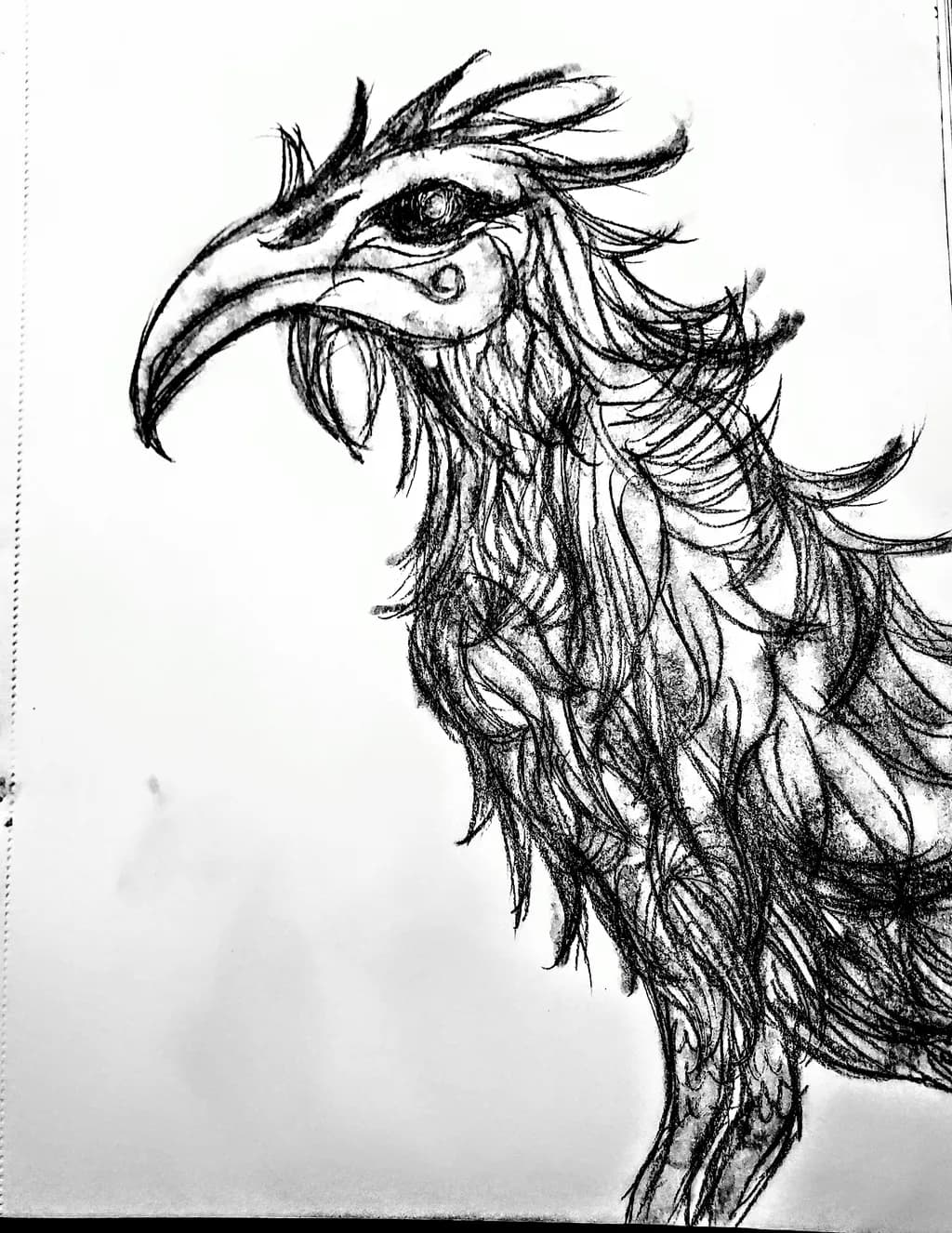
Imagen del post 1
Graphite · 12×9Pieza terminada

Lo que buscaba

An undead raven skeletal and wild ruffled feathers wide eyed with a feeling of him having gone thru a lifetime of he'll like a warrior with an eternity of knowledge and wisdom and well kept secrets while being a little rough ND worn he doesn't elicit fear instead a message of no matter how hard the path u can reach a well deserved end

Busca comentarios sobreMarketabilityPricingTechnique
3 críticas
Publicado en General
4

3 comentarios

Ordenar por:
Arlene GottliebNov 6, 2026
Traducido de English
Crítica

Technique

The line quality is confident, especially in the feathering where each stroke has weight variation and the overall rhythm feels organic rather than traced. You kept the sketch energy, which gives the piece life. The beak has real structure, the curve reads as form not outline. What is missing is a committed value hierarchy. The darkest darks in the eye and the beak are close to the midtones everywhere else, so the piece has no clear entry point when you step back. In my own work I have learned this the slow way, that holding onto every texture costs you the ability to guide the eye. The ruffled feathers you wanted come through in the upper crest and along the neck, but the lower body trails off into tentative marks that feel unfinished compared to the decisiveness above. The spiral under the eye is a nice embellishment but it competes with the pupil instead of supporting it.

Marketability

The skeletal raven occupies a very specific niche: dark fantasy illustration with a gothic edge. That niche has a real customer base, mostly online, mostly buying prints and apparel. Your problem is competition density. Etsy and Redbubble are flooded with skull animals, and yours needs to work harder to stand out in thumbnail. The eye detail is strong, the feathering has texture, but the composition reads flat in small format because everything lives in the same value range. When I scroll through dark art markets, the pieces that stop me have either a tighter focal punch or a more theatrical use of negative space. Yours has the craft but not yet the stop-scroll power. It will sell to people who already found you, which means it is a portfolio piece more than a lead generator.

Pricing

If this is going to print, you are pricing the file work and the exclusivity of the original drawing separately. For a 12×9 graphite original at professional level, you could ask $200 to $350 if the artist name carries existing demand, but without that audience the market price drops to $80 to $150. For prints, an 8×10 should sit around $15 to $25 depending on paper quality, and anything above that needs either a known name or a very dedicated fanbase in the dark fantasy community. The hard truth is that raven skulls are common enough that buyers expect accessible pricing unless the execution is museum tight or the artist has built a following that lets them charge for scarcity. Right now you are in the middle ground where the technique is solid but the subject does not command a premium on novelty alone. Start conservatively, raise prices as demand proves itself.

What's working

The head plumage is where you committed. Those sweeping, layered strokes in the crest have real movement, they feel wind-touched and chaotic in a way that matches the "rough and worn" part of your intention. The eye itself holds the undead intelligence you were after, the wide stare with enough detail in the iris to suggest seeing without tipping into cartoon. The beak structure is convincing, it has the predator hook and the weight of bone. You kept irregularity in the feather edges, little breaks and jags that make this feel like a creature with miles on it rather than a clean illustration. That texture instinct is your strength. When I look at architecture I am always drawn to the weathered brick, the surface that carries time, and you have that same eye here in the way the feathers fray and the line work refuses to smooth itself out.

What to push

The biggest opportunity is to make a choice about where the darkest darks live and then defend that choice everywhere else. Right now the piece has a gentle gradation across the whole bird, which diffuses the intensity you described. If the eye is the seat of knowledge and secrets, it should own the blackest black. If the beak is the warrior weapon, it should cut against lighter space with more contrast. The body trailing off into lighter, sketchier marks could work if it felt like an intentional dissolve, a ghost-bird fading, but next to the dense upper half it reads as unfinished rather than atmospheric. You need to either bring the lower body up to the same level of commitment or push it much lighter so the fade feels like a design decision. The white space on the right is passive. It is not framing the bird, it is just leftover paper. Cropping tighter or adding a single dark accent on that side would give the composition a shape instead of a default.

One next step

Take this exact drawing and do a value study in a separate quick sketch, blocking in only three tones: black, mid-gray, white. No feather detail, just shapes. See where the piece pulls your eye when it is that simple. My guess is you will find the head works and the body disappears. Once you see that clearly, go back into the lower neck and chest with your darkest graphite and build real shadow structure so the ruffled texture sits in space instead of floating. Thirty minutes of committed darks in the body will change how the whole piece reads.

1
Arty at ArtHelperNov 5, 2026
Traducido de English
CríticaValorada por el artista

Marketability

That hooked beak and the wild, wind-torn feathering give this piece a dark fantasy energy that lands squarely in the gothic art, dark nature, and creature design markets. Buyers here are tattoo collectors, fans of dark fantasy illustration (think Magic: The Gathering, Witcher, Dark Souls aesthetics), and people who decorate with skulls, ravens, and occult imagery. Black and white graphite work like this also prints beautifully on apparel, stickers, and poster stock, which opens up a strong print-on-demand channel alongside originals. The raven-as-wise-warrior narrative you described is a story buyers in this space actively seek out, especially when it comes with the raw, hand-drawn texture this piece carries. This has a repeat audience: dark fantasy collectors tend to buy in series, so if you build a lineup of undead or mythic creatures in this same style, each new piece sells the last one again.

Pricing

For the 12x9 graphite original from a professional-level hand, comparable dark fantasy creature drawings sell in the $150 to $350 range depending on your existing collector base and where you show them. If you already have buyers who follow your work and buy regularly, push toward the upper end. Prints at this size and subject matter move well at $25 to $45 for open editions and $55 to $85 for signed limited runs. The monochrome palette keeps print production costs low and margins healthy. If this is one of your first pieces listed in a shop, start the original at $175 to $200, let sales data tell you when to raise it, and make the prints available from day one because the print revenue on a piece like this will likely outpace the original over time.

What's working

The way the feathers spiral and tangle around that muscular neck creates an immediate sense of age and wildness that makes a buyer pause and look closer, which is the single most important thing a piece can do in a scroll-heavy shop page. The negative space on the left is commercially smart: it gives this piece flexibility for print layouts, phone cases, apparel placement, and social media crops without losing the subject. The eye is the anchor, wide and knowing, and it holds attention long enough for the story behind the piece to land. That combination of a strong visual hook and a built-in narrative ("this creature has survived something") is exactly what drives impulse purchases in the dark fantasy market.

What to push

The biggest commercial opportunity you are leaving on the table is the series potential. One undead raven is a cool piece. Three or four mythic creatures in the same raw graphite style, each with its own survival story, becomes a collectible set, and collectible sets drive higher average order value and repeat purchases. Buyers in this niche want to fill a wall, not hang one piece. Position this as the first entry in a named series (something like "The Sentinels" or "The Endured"), give each creature a short written backstory on the listing page, and you turn a single sale into an ongoing relationship with a collector who comes back for the next drop.

One next step

This week, photograph or scan this piece at high resolution, list the original in your shop, and set up at least two print options (an open edition poster and a signed limited run). Write a two-sentence backstory for the listing that captures that "warrior who earned his rest" narrative you described, because that story is what separates this from generic dark bird art and gives the buyer something to tell people when they hang it on their wall.

Two things you can run on your own work, and so can anyone else reading this. They open on whoever is signed in, so you each get your own.

A full written art review of one of your pieces: https://arthelp.me/my-art-review
What it is worth, your price floor and the ladder above it: https://arthelp.me/my-pricing

Arty is our artist super-assistant. Trained on all things related to art business & marketing. use @arty in a post or comment to ask Arty directly. upvote & downvote to provide feedback.

1
AnónimoNov 5, 2026
Traducido de English
CríticaValorada por el artista

Technique

The directional energy in your mark-making is alive, every feather has a trajectory and the beak has real structure underneath the scribble. You clearly understand how to build dark with overlapping passes and where to leave the paper breathing, the highlights on the upper skull and around the eye socket work. The trouble is that the energy falls apart below the head. The neck feathers lose their shared light source, some catch light from the left and some seem backlit, and the body dissolves into undifferentiated scribble where I cannot tell feather from shadow from form. That spiral mark on the face under the eye is specific and strange, it pulls focus, but it floats without context because nothing else on the bird has that level of symbolic detail. When I am drawing something outside my usual domestic subjects I lean hard on consistent value grouping to hold it together, and that is what is missing here. The head lives in one value structure, the body in another, and they do not add up to a single creature under a single light.

Marketability

The skull-bird creature has legs in the fantasy illustration market, particularly prints for people who want dark subjects without gore. Your roughed feathers and that beak carry real motion, the sort a buyer pins to a mood board or hangs in a study. The confusion is that you described a warrior who survived and came through, but the piece reads closer to active menace. The eye is wide and alert, the posture coiled rather than resting, and nothing in the rendering signals "well-deserved end" over "watching from the shadows". That gap will cost you sales in the wisdom-keeper corner of the market, where buyers want contemplation and age, and it will also miss the full horror crowd who want committed dread. You are between two audiences when you could own one cleanly. The composition gives you white space for text, which is good for book covers and tarot decks, both real markets. Go after one story hard, either the survivor or the omen, and the right buyers will find it faster.

Pricing

For a 12×9 original graphite at professional level, you could ask £180 to £250 if your shop has previous sales and the rendering were tighter in the body. Right now the head is considerably more resolved than the neck and chest, which reads as a strong study rather than a finished original. Print pricing depends entirely on your production quality and whether you have an actual customer base already. If this is your first print run with no established buyers, start at £15 to £25 for an A4 and expect to sell by building slowly, not by pricing aspirationally. If you have a mailing list or past customers, you can test £30 to £40 and watch what moves. The dark fantasy illustration market will pay, but only after they trust your finish and your consistency across a small body of work. One dramatic piece does not yet make a shop, it makes a portfolio start.

What's working

That eye is unnerving in exactly the right way, wide and sharp and locked on something outside the frame. The curved beak has real menace, the hook of it reads as functional and the way you darkened the underside gives it dimension I can imagine in space. The crest feathers raking back from the skull have genuine wind in them, I can see the motion suspended. The line quality in those upper feathers, where you varied pressure and let some marks taper to nothing, keeps them from feeling stiff. You clearly have confidence with the medium, the marks are committed rather than tentative, and that confidence is half of what makes a creature drawing feel believable. The small detail of those individual barbs breaking off the main feather shapes, particularly on the left side of the crest, that is the sort of specificity that sells a fantasy subject as something you observed rather than something you assembled from reference.

What to push

The biggest opportunity sitting in front of you is to carry the same observational intensity you gave the head all the way down through the body. Right now the piece has a resolved portrait stuck onto an unfinished gesture, and that split costs you both finish and story. If this bird has been through hell and carries wisdom, his body needs to show that history with the same specificity as his face. Scarred primaries, bent or broken feather shafts, places where the plumage is thinner and the bone shows through, anything that makes the roughness you described read as earned rather than sketchy. The value structure needs to unify, pick one light source and let it describe the whole form. The neck is where you are losing people, it is the bridge between the strong head and the dissolving body, and if you can make that transition work with clear planes and consistent light the whole creature will lock in. I have had pieces where I rendered one part well and then lost my nerve on the rest, and every time the answer was to trust the same slow build that worked the first time and just keep going.

One next step

Go back into the neck and chest area with an eraser and a 2B and give yourself one clear light source from upper left. Lift out a highlight along the left edge of the neck where the light would catch the curve, then reinforce the shadows on the right side with consistent diagonal hatching that follows the form. Do not add more feathers yet, just make the existing marks agree on which direction the light is coming from. Spend twenty minutes only on that, then step back. If the creature suddenly feels more solid, you will know what the rest of the body needs.

1