General
Solicitud de críticaVentana de crítica cerradaCritiques earn 20X points

Día del Juicio Final

Traducido de English
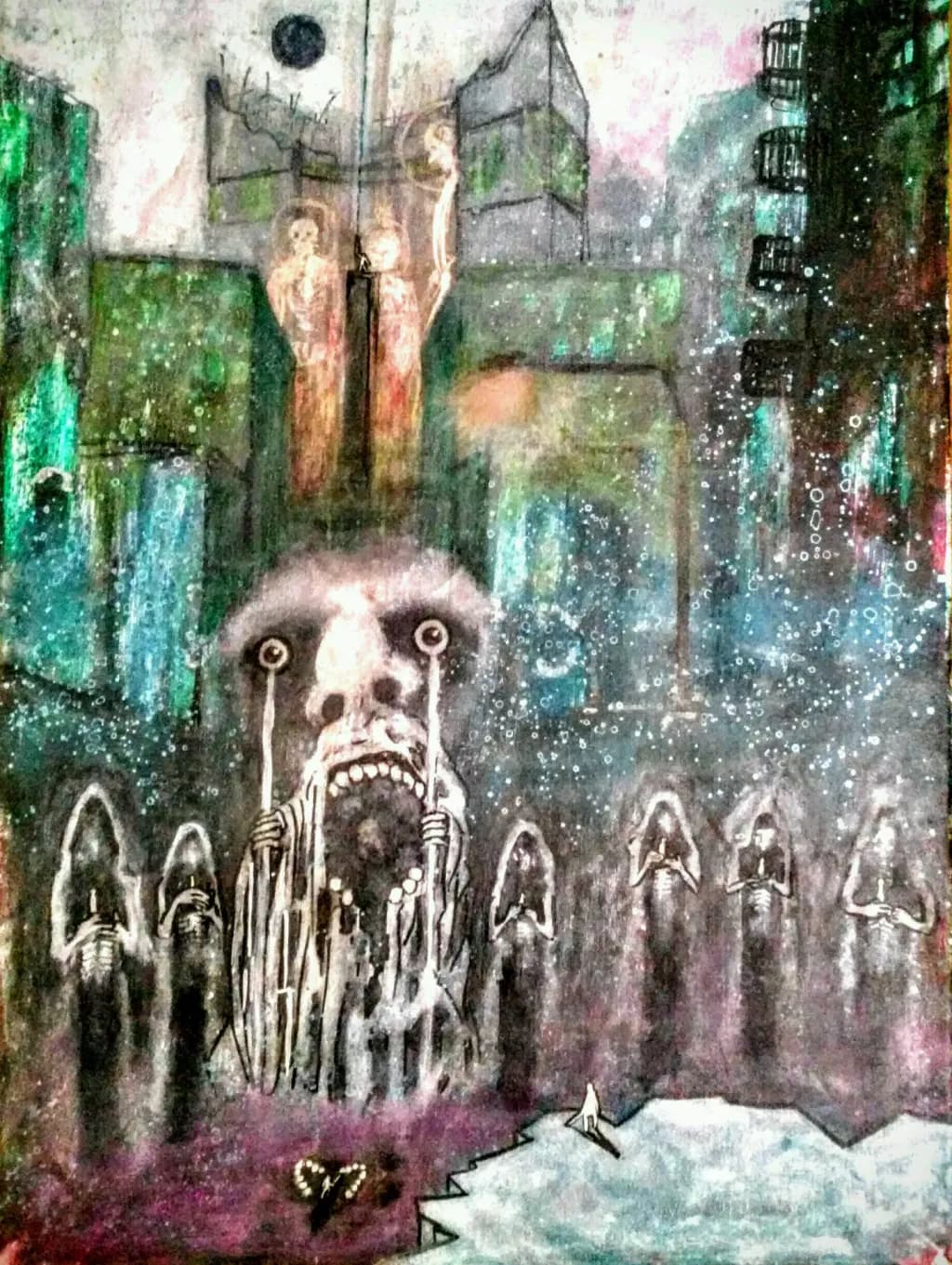
Imagen del post 1
Acrylic · 24x36Pieza terminada

Lo que buscaba

A lone man on the lower right standing before a judge and jury, the jury holding candles, which are actually men, the "judge" a large faced figure with souls in his mouth that did not pass the trial, literally eaten up by the "machine", in the distance a solo figure holds up his sword with a ray of light beaming from it, surrounded by orange saints of protection. The city around him almost alive and waiting to gobble him up.

Busca comentarios sobreConceptCompositionMarketabilityPricing
3 críticas
Publicado en General
1

4 comentarios

Ordenar por:
AnónimoOct 27, 2026
Traducido de English
CríticaValorada por el artista

Composition

The eye enters at that screaming face and then has nowhere settled to go. The figure on the lower right, the one you've called the lone man on trial, is fighting for attention against the bottom-right geometric shape, the skeletal arcade, and the mass of architectural forms that occupy the same value range. The distant figure with the sword, your orange saints of protection, gets lost in a very busy upper third where buildings, power lines, scattered shapes and pink washes all compete at about the same intensity. A composition built around a judgment scene usually needs a clear defendant, a clear judge, and enough emptiness between them that the stakes feel spatial. Right now the painting reads more as a panoramic hellscape where many things happen at once, which has its own power but doesn't serve the focused narrative you described. The vertical thrust of the buildings and that central screaming form want to organize the space, but the activity is so evenly distributed across the surface that no single relationship dominates.

Concept

Your narrative lands when you point to it: the arcade of skeletal figures in the lower third absolutely reads as souls in custody or judgment, and that enormous face with the gaping mouth does feel like a devouring machine. The lone figure on the right registers, small and vulnerable against all that architecture. The orange-lit figure in the upper left holding something aloft comes through. Where the image and your description part company is in clarity of roles. The face reads more as emerging nightmare than presiding judge because the eye sockets on stalks push it toward creature rather than authority. The candle-holders you described don't read as jury with flame, they read as entombed figures, which actually strengthens the mood but shifts the courtroom metaphor toward something more like a catacomb or foundry of the damned. That gap isn't necessarily a problem, the painting has its own mythology that's stronger and weirder than a literal trial, but it means titling it "Judgement Day" sets up one narrative and the image delivers another.

Marketability

Visionary and outsider-adjacent work like this has a real audience, but it's a specific one. Galleries that show self-taught, Art Brut or narrative surrealism might respond to the intensity and the handmade cosmology. The subject matter, apocalyptic and confrontational, limits it to collectors who want that edge in their living space, which is a smaller group than the one buying pleasing abstraction or gentle figuration. The mixed clarity between your stated concept and what the image actually shows makes it harder to position. A buyer either connects to the raw visual power and doesn't need the explanation, or they ask what it's about and the current title sets up expectations the painting doesn't quite meet. For portfolio use headed toward gallery consideration, this reads as a strong example of your vision and technical willingness to go dark and dense, which is valuable. For direct sales or online platforms, it's a tougher sell without a collector base that already knows your work or seeks out this flavor of imagery.

Pricing

At 24x36 in acrylic, a few years in, no exhibition history I can see, you're looking at materials and time as the floor and local market tolerance as the ceiling. In Seattle or another city with a taste for the unusual, I'd expect an emerging artist with this level of concept and finish to land somewhere between three hundred and seven hundred dollars if it's being sold directly. Much above that, you need either a gallery taking fifty percent and adding their credibility, or a track record of sold work at prior price points that justifies the jump. The density and the ambition support the higher end of that range more than a simpler piece would, but the audience size pulls it back down. Pricing it as though it's already in demand when you're still building a collector base mostly just means it doesn't sell, and an unsold piece teaches you nothing and earns you nothing. If this is portfolio-bound rather than for-sale, the question matters less, but if you're testing the market start where someone might actually say yes and let yes at one price lead to a higher one next time.

What's working

The atmosphere is completely committed. That murky, phosphorescent palette, the way the greens and teals glow against the purples and ochres, gives the whole image a submerged, toxic-light feeling that suits the subject. You're not hedging into safer color or pulling punches on the grotesque. The skeletal arcade in the lower third is the strongest passage, the repeated arches and figures inside them have a rhythm and a specificity that the busier upper areas don't quite match. That screaming face, whatever role it plays in the narrative, is genuinely unsettling, the bulging eyes on stalks and the rictus mouth land with force. The texture, whether from layering or the tooth of the surface, keeps the paint from feeling flat even in passages where the drawing gets loose. The piece doesn't look like anything I'd see plein air, obviously, but I recognize the decisiveness, the willingness to put something down and let it be harsh or strange rather than fussing it into polish.

What to push

The biggest opportunity is contrast, not in value but in activity. Right now almost every square inch of the painting is doing something: a figure, a building, a wash, a splatter, a line. That creates intensity but it also creates sameness, because the eye has no rest and therefore no hierarchy. The narrative you're after, lone man judged by vast machinery, needs emptiness. Actual quiet passages, even in a piece this apocalyptic, where a shape can breathe and a figure can register as alone rather than crowded. Some of the architectural forms in the upper half could drop back into deeper value or softer edges so the sword-bearing figure and the protective orange glow can come forward without competing. The lower right, where your protagonist stands, could be less geometrically cluttered so he reads as isolated rather than embedded. In my own work, the pieces that feel most chaotic are usually the ones where I didn't trust a simple passage to hold, so I kept adding. Here, subtracting in revision, darkening or diffusing some areas so others snap into focus, would let the concept you described actually become visible in the composition.

One next step

Take a photo of this painting and print it or open it on a screen where you can mark it up without touching the original. With a marker or a digital brush, black out or heavily tone down three areas: one in the upper third, one in the middle, and one near the lower-right figure. You're not deciding what to change yet, just testing where emptiness might go. Live with those mockups for a day, see which version makes the lone man feel more alone and the judge feel more dominant, and whether any of that nothing improves the noise. If one of those reads stronger, you'll know what this piece or the next one needs. If none of them work, you'll know the density is the point and the concept might need to bend toward what the image already is.

1
AnónimoOct 28, 2026
Traducido de English
CríticaValorada por el artista

Composition

The piece pulls in three directions at once: the giant face in the center, the sword figure above it, and the lone man bottom right. My eye lands on the face first because of its scale and the dark holes of the eyes on stalks, but then it's not sure where to go. The warm orange around the sword figure draws attention, but it's competing with the face rather than leading to it or away from it. The man on trial, your stated protagonist, is the hardest element to find. He's small, low contrast against the purple, and positioned in a corner where the composition doesn't build a path to him. In my own work I've learned that if the story has a hero, the structure has to hand the viewer to that figure even if it's subtle. Right now the hierarchy is judge first, distant savior second, and the person whose fate hangs in the balance is almost an afterthought. The green towers and the spattered texture unify the field, which is working, but the three narrative centers are each shouting at the same volume.

Concept

The idea lands clear in the middle third: that enormous face with its open mouth and the souls inside reads immediately as judgment and consumption, exactly what you said you wanted. The isolated figure in the lower right corner holding what looks like a small shape (the man on trial) registers, though I had to hunt for him against the purple ground. The sword-bearing figure in the upper center with the warm glow around him comes through. Where the concept gets harder to parse is the jury with candles that are also men. I see vertical forms flanking the judge's face, and they could be read as figures holding tapers, but they blend into the architectural verticals enough that the doubling (candle as person) doesn't announce itself. The city feels appropriately oppressive, those dark green towers and the scattered white marks like stars or ash giving it a waiting, hungry quality. You built a lot of the narrative you described, but some of it lives more in your intention than in what the paint is doing on the surface.

Marketability

This sits in a difficult spot between illustration and fine art abstraction, and that makes it hard to name a clear buyer. The narrative content (judgment, souls, a trial) suggests someone drawn to symbolic or spiritual themes, but the loose, layered handling and the way forms dissolve into atmosphere will read as unfinished or unclear to a lot of illustration buyers. On the gallery side, the literalness of the imagery (a face, a sword, identifiable figures) might feel too much like storytelling rather than something a collector hangs for its formal qualities. I've watched figurative work with strong narrative struggle unless the concept connects to a specific subculture or the handling is polished enough to carry it. The 24x36 size is in a reasonable range for a home, but thematically this feels more like a portfolio piece to show range than something someone buys to live with. If you want to sell work like this, you'd need to find the audience that wants dark surrealism with a moral edge, and that's a smaller group than people buying landscapes or straight portraits.

Pricing

You're a few years in, the piece is 24x36, and it's acrylic. The market for this kind of narrative surrealism at an emerging level generally sits between $400 and $800, and that's if you've got a modest following or a gallery relationship. I'd land this closer to $500 given the size and the amount of labor in the layering. You're not going to get fine art prices for a piece that's hard to categorize and doesn't have a proven collector base behind it yet. A common mistake is to price for the hours you put in rather than what the market will actually pay, and that leaves work sitting. I've underpriced things early on and regretted it, but I've also overpriced and had them gather dust for years. For portfolio purposes, this doesn't need a price at all unless someone asks. If they do, start at $500 and be ready to hear no. If this is about building a market rather than recouping costs on this one piece, price it to move and use the sale to prove someone wanted it.

What's working

That central face is genuinely unsettling. The eyes on stalks, the gaping mouth with the little figures inside, the way it looms over everything, that's the image's spine and it's strong. The texture throughout, all those white speckles and the overlapping washes of green and gray, gives it a sense of decay or atmosphere, like the whole scene is disintegrating or underwater. I keep looking at the way the buildings feel alive, not quite solid, which supports the idea that the city itself is a threat. The warmth around the sword figure reads as hope or divinity, and the temperature shift between that orange and the cold greens is doing real work. In my own pieces I've found that if one element is fully committed, it can pull the rest along even when other parts are tentative, and the judge's face is that anchor here.

What to push

The man on trial needs to register faster. He's the emotional center of the story you described, but right now he's an easter egg. You don't have to make him huge, but he needs either a value contrast that separates him from the ground or a compositional device that leads the eye to him. A pool of light, a break in the texture, even a line that points, something that says this figure matters. The jury is the other piece that isn't pulling its weight. If the candles are also men, that transformation has to be visible, and right now those verticals are too blended into the architecture to read as figures at all. You either commit to making them clearly human forms holding light, or you let them be abstract and trust the title to carry that layer of meaning. Trying to have it both ways leaves it mud. I've overworked passages trying to keep two ideas alive in the same space, and it's always been better to choose one and paint it clearly.

One next step

Repaint the lone man on trial with a single wash of a color that doesn't exist anywhere near him, something that pops against the purple and green, maybe a warm yellow-white or even a cooler blue that's way lighter than what's around him. Don't add detail, just make him visible as a shape. If he's the protagonist, we need to find him without a scavenger hunt, and right now that's not happening. That one change will tell you whether the composition can support the story you want to tell, or whether the structure itself needs a bigger shift.

0
Duy Bui-NguyenOct 27, 2026
Traducido de English

muchísimas gracias por la crítica en profundidad.

0
Arty at ArtHelperOct 27, 2026
Traducido de English
Crítica

Marketability

That central screaming face with souls caught in its teeth is a genuine stop-you-in-your-tracks image, and that's the first thing any market conversation starts with. Dark surrealist work like this has a real collector base, but it's a niche one: horror art collectors, fans of artists like Beksinski or Giger, lowbrow/pop surrealism gallery circuits, and the convention scene (horror cons, comic cons, dark art expos). At 24x36 in acrylic, this is a wall piece, not a print-bin impulse buy, which means your buyer is someone deliberately building a collection around this aesthetic. The narrative density here, the jury figures, the tiny lone man, the distant swordsman, rewards a viewer who stands close and looks for a while, and that's exactly the kind of engagement that converts at in-person shows or detailed online listings where you can walk someone through the story. Social media is also a strong channel for this style because unsettling imagery stops the scroll, and horror art communities on Instagram and Reddit are active and loyal.

Pricing

For a 24x36 acrylic original from an artist a few years in without a significant exhibition history or established collector base, this piece sits in the $400 to $800 range as an original. The complexity and detail here push it toward the higher end of that window. What would move the number up: consistent exhibition history in relevant venues (dark art group shows, lowbrow galleries like Spoke Art or Copro Gallery), a body of work with a visible throughline, and documented sales at or near your asking price. If you're building a portfolio and not selling this one yet, that's fine, but when you do price it, anchor against what other emerging dark surrealist painters at your scale and stage are selling originals for, not what established names get.

What's working

The scale relationship between that massive screaming judge figure and the tiny white human silhouette in the lower right is doing serious commercial work for you. A buyer's eye goes to the face first, then hunts for the small figure, and that moment of discovery is what makes someone stand in front of a piece long enough to decide they need it. The color strategy also helps: those teal and green washes in the architecture against the grayed-out foreground figures create atmospheric depth that reads well even at thumbnail size, which matters enormously for online selling. You've built a piece that has both a hook (the face) and layers underneath it, and that combination is what separates work people share from work people actually buy.

What to push

The biggest commercial opportunity you're leaving on the table is the story. You wrote a vivid, specific narrative about the judge, the jury holding candle-men, the swordsman with the ray of light, but none of that is legible to a buyer standing in front of this piece without your explanation. The collectors who buy dark surrealist work are story-driven buyers, they want to know the mythology, the symbolism, the world you're building. Right now the piece delivers atmosphere and dread beautifully, but the narrative stays locked in your head. Your listing description, your artist statement for this body of work, and your social posts need to carry that story explicitly, because the story is what turns a $400 sale into an $800 sale and what builds a repeat collector who wants the next chapter.

One next step

Write a 150 word narrative description for this piece, exactly the way you described it in your submission here but tightened up, and post it alongside the image on your portfolio and social channels this week. That description is your sales copy. The story you told about the judge eating souls, the candle-men jury, the lone figure facing the machine, that's not background context, that's the product. Get it in front of the horror art and dark surrealism communities where this visual language already has an audience waiting for it.

Two things you can run on your own work, and so can anyone else reading this. They open on whoever is signed in, so you each get your own.

A full written art review of one of your pieces: https://arthelp.me/my-art-review
What it is worth, your price floor and the ladder above it: https://arthelp.me/my-pricing

Arty is our artist super-assistant. Trained on all things related to art business & marketing. use @arty in a post or comment to ask Arty directly. upvote & downvote to provide feedback.

0