Godspower Ignatus Okoro
Bildender Künstler
Godspower Ignatus Okoro ist ein Künstler, der in Sculpture arbeitet, mit Sitz in City of Edinburgh, Scotland.
Godspower Okoro ist ein multidisziplinärer Künstler. Seine Praxis erforscht Identität, Erinnerung, Spiritualität, kulturelles Erbe und Umweltnachhaltigkeit durch Malerei, Mischmedien, Fotografie und Skulptur. Okoros Praxis ist von gelebten Erfahrungen geprägt.
Übersetzt aus English
City of Edinburgh, Scotland, United Kingdom
Beigetreten am August 2026

My practice explores the fragile relationship between identity, memory, belonging, environment and human experience. Working across painting, drawing, printmaking, photography, sculpture and mixed-media installation, I create layered visual narratives that move between the visible and the unseen. My work is concerned with what remains beneath personal and collective histories, memories, cultural inheritance, displacement, loss, transformation and the forces that shape how we understand ourselves and the world around us.

I draw inspiration from African cosmologies, Yoruba and Igbo philosophies, personal experience, environmental change and contemporary social realities. Ideas surrounding the spirit world, ancestral memory, the cycles of life and the relationship between humanity and nature often inform my imagery. Rather than presenting these influences literally, I translate them through abstraction, fragmented forms, silhouettes and symbolic imagery, allowing different cultural and personal readings to coexist.

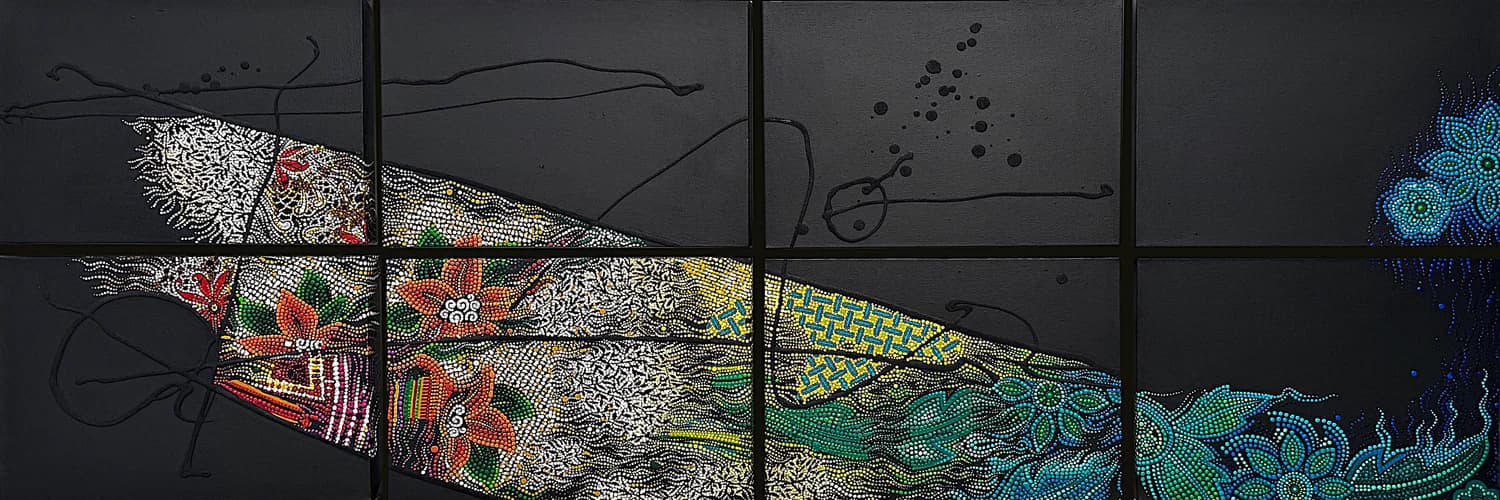
Materials are central to this process. I work intuitively with paint, ink, photographic imagery, printmaking processes, found and recycled materials, fabric and constructed surfaces. I am particularly interested in layering, fragmentation and the physical transformation of materials. Surfaces become records of time: marks are added, obscured, removed and reintroduced, creating a sense of accumulated memory. This process reflects my belief that identity and history are never fixed; they are continually rewritten through experience.

The human figure frequently appears in my work as an abstract silhouette rather than a fully defined individual. This allows the figure to function simultaneously as a specific person and as a universal presence. I use absence, ambiguity and fragmentation to invite viewers to consider what may exist beyond what can immediately be seen.

Ultimately, I want my work to create a space for reflection, emotional encounter and conversation. I do not seek to provide a single interpretation. Instead, I invite viewers to bring their own memories, experiences and questions to the work. Through this dialogue between material, culture, memory and imagination, my practice asks how we carry the past, negotiate the present and imagine what might remain for the future.
Original wird angezeigt