I've had two works selected for an exhibition/installation at the Ryan Observatory at Muddy Run in Holtwood, Pennsylvania. The call for art asked for work that could connect in some way with the mission of the observatory and the Rittenhouse Astronomical Society's mission to provide programming designed for S.T.E.A.M. (Science, Technology, Engineering, Art, Mathematics) outreach and featuring astronomical sciences. I'm looking forward to connecting with a new audience that I may never have considered without the invitation from Ophelia M. Chambliss to submit work for consideration by a committee of the Rittenhouse Astronomical Society.
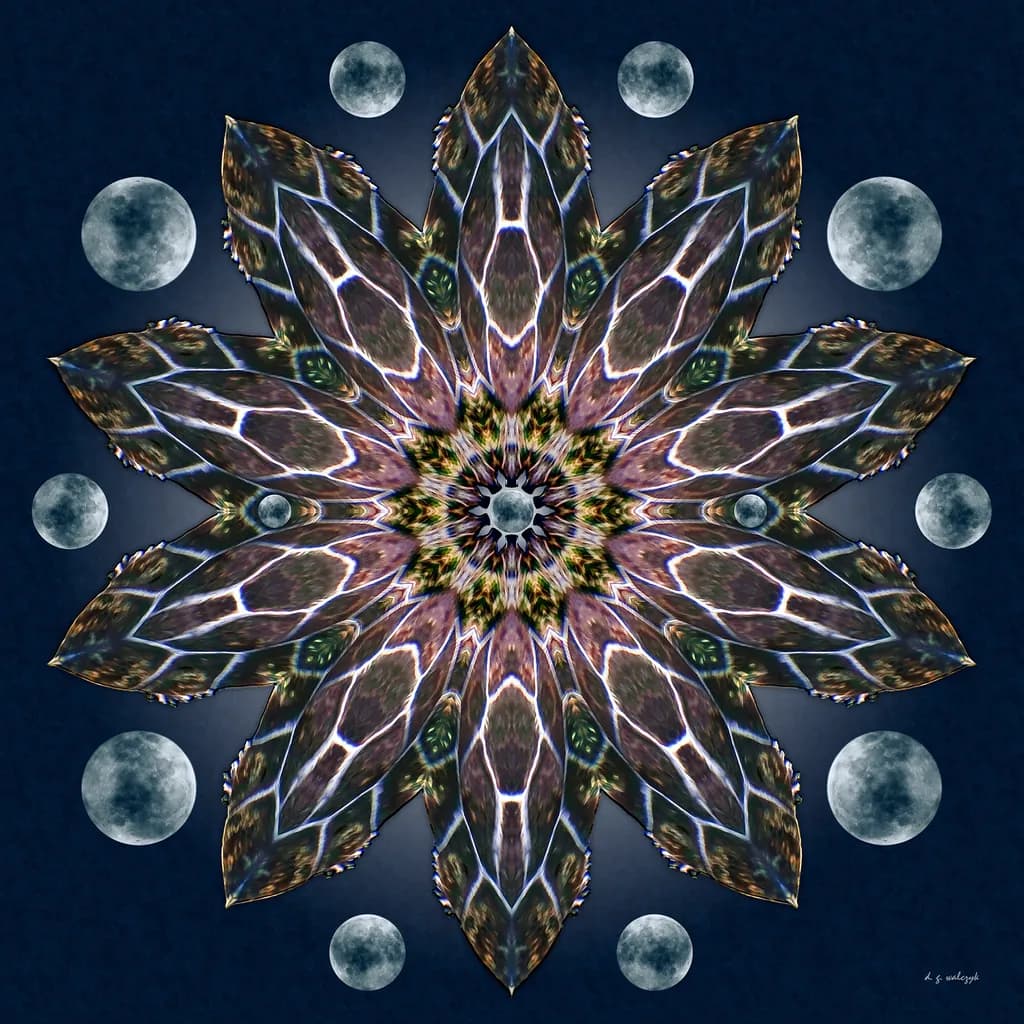
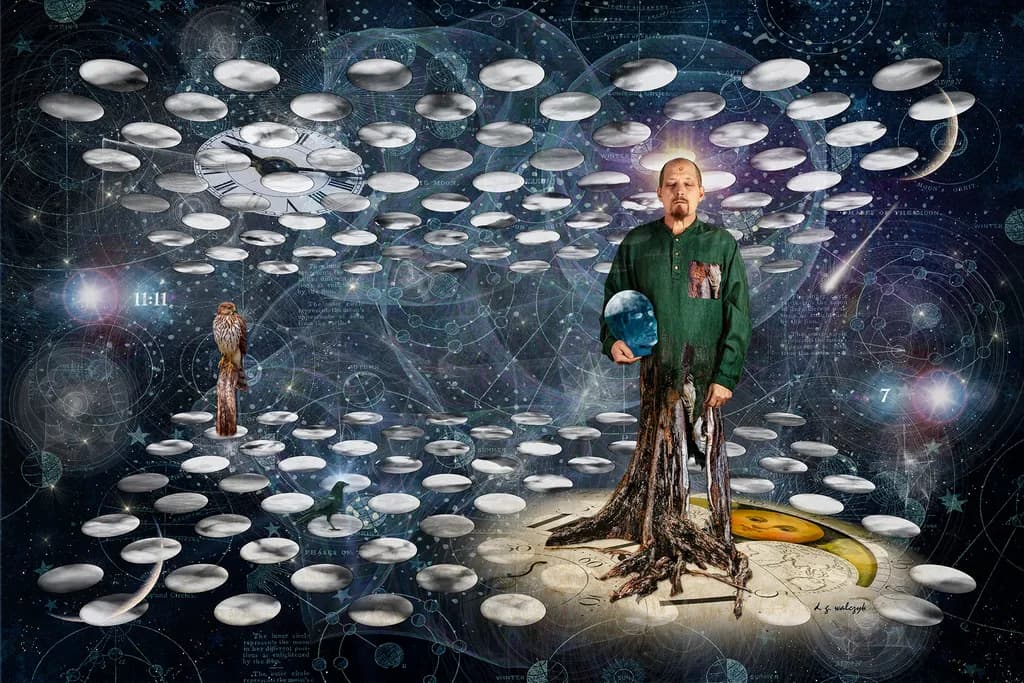
The two works are Cosmic Roots and 13 Moons. The statements I prepared for the submission:
13 Moons was originally created as a response to a prose and poetry prompt for an exhibition at York Art Association. The prompt was for work that was in response to a poem or piece of prose. The book I selected was Thirteen Moons on Turtles Back, a children’s book by Joseph Bruchac and Jonathan London which brings together 13 poems that share legends from different Native/Indigenous American tribes to explain the passing of the seasons. The underlying “science” behind the concept is a sort of rational of the traditional Native American belief that the 13 major divisions (scutes or scales) of the sea turtle’s shell match the 13 lunar cycles in a year. The 28 smaller plates along the bottom edge of the shell represent the 28 days of each lunar cycle. Each tribe then has specific names for the 13 moons that describe seasonal changes or animal behavior, interestingly with some overlap of the names among the tribes. The background mandala shape was created from one of my photographs of a sea turtle at the Baltimore Aquarium using a plug-in script for Photoshop called radial kaleidoscope that allows me to select the angle, vertical and horizontal base points, and direction of the kaleidoscope (all higher mathematics which I can’t even begin to understand). So working intuitively and experimentally with the script, I choose when what appears is compositionally appropriate for my for my vision. The moon is a single shot of the same moon copied and then sized for the place it occupies in the composition. The actual background of the work is a simple color gradient layer upon which to settle the composition. After printing the image, I finished with some selective hand painting with clear acrylic gloss medium with an iridescent additive on the moons and parts of the mandala. 13 Moons is the combination of science, technology, mathematics, an nature to create art that honors the legacy and culture of our Indigenous American brothers and sisters.
Cosmic Roots is a self portrait that explores and attempts to reconcile our place in the universe with that place from which originate. It is a philosophical and spiritual meditation about the interconnectedness of humanity and our natural world with our origins in this vast, awesome, miraculous cosmos and the planet and nature that sustains us.
About the Ryan Observatory at Muddy Run
Ryan Observatory at Muddy Run is a public outreach facility with programming designed for S.T.E.A.M. outreach and featuring astronomical sciences. Located at Muddy Run Park, It is a Constellation Energy Generation LLC property located in Holtwood, Pennsylvania just south of Lancaster.
Ryan Observatory and educational programs are provided by Rittenhouse Astronomical Society under contract with Constellation Energy.
The observatory is open to the public for monthly stargazing and presentations and are open on scheduled private nights for members of Rittenhouse Astronomical Society and others from around the region whose volunteering make programming possible.
Artist Laureate
Ophelia M. Chambliss, one of a handful of artists selected by NASA to commemorate the James Webb Space Telescope, her multi-canvas acrylic work is just off an exhibition tour and will be on display at the observatory in an exhibition in 2026 to celebrate Ms. Chambliss as the next artist to hold the Laureate position at Ryan Observatory. As JWST Project Manager Bill Ochs said, “There is an inherent connection between artist and engineers. We both start with a blank sheet of paper and use the tools of our trades and vision to create.”
Affiliation
Rittenhouse Astronomical Society: Rooted in history.
Founded in 1888, the Rittenhouse Astronomical Society is one of the oldest astronomical societies in the United States. Named in honor of America’s pioneer astronomer, David Rittehouse, RAS has held regular events in the greater Philadelphia region for 135 years.
Ryan Observatory at Muddy Run.
172 Bethesda Church Rd W Holtwood, PA 17532 (717) 284-5856
The Thirteen Moons piece sounds like exactly the kind of layering I love, when the tech serves the story instead of just being pretty math. I've never thought about turtle shell scutes mapping lunar cycles, but now I can't unsee it. Congrats on the Ryan Observatory selection, that's a beautiful venue for work that actually earns the STEAM label.