Photography
Post image 1

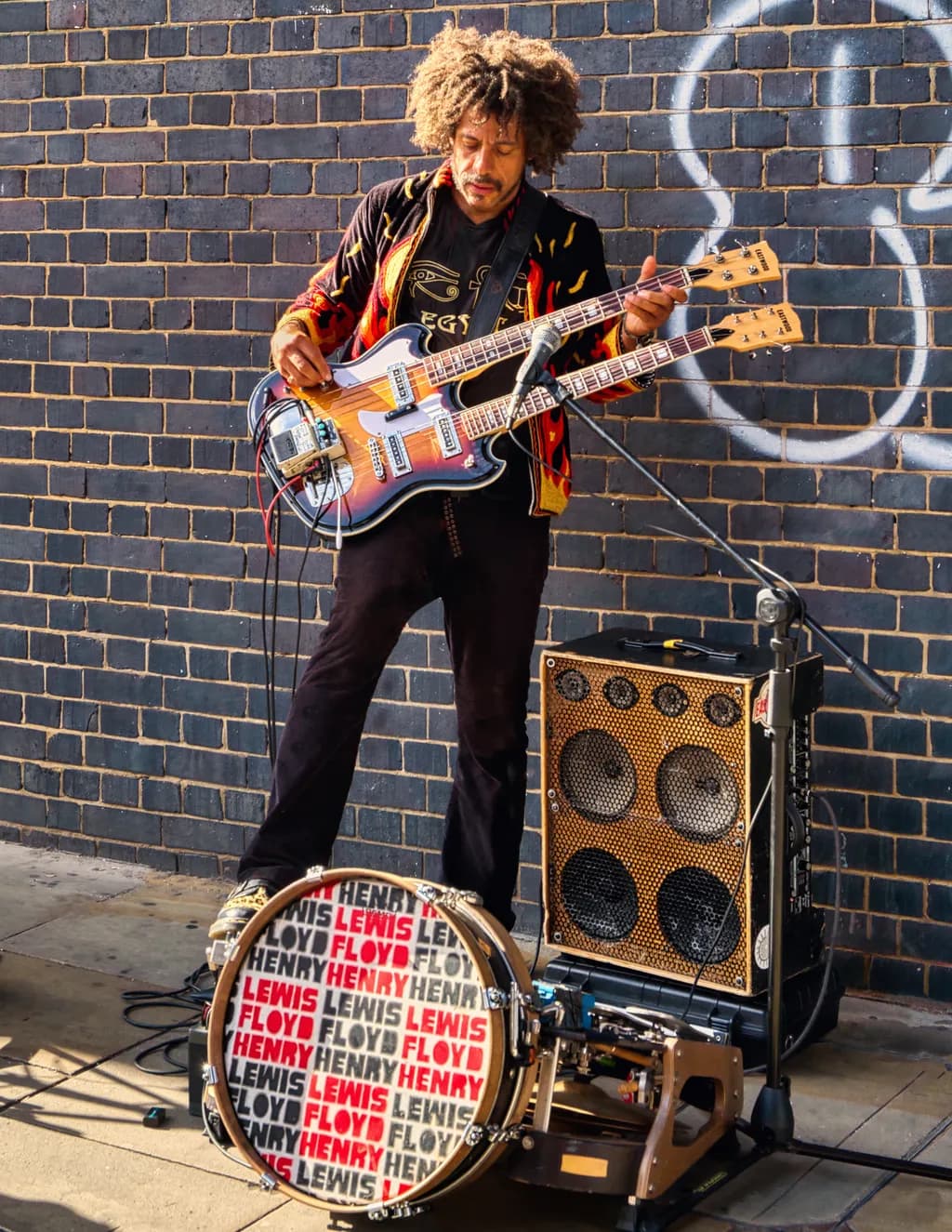
A one-man-band performance brings guitar, bass, percussion and amplification together on Brick Lane in East London.

The double-neck guitar was the first thing that caught my eye in this Brick Lane street scene, but there's an extraordinary amount going on around it.

The musician has effectively created a complete miniature stage on the pavement, with his guitar, bass drum, microphone, amplifier, effects and cables all packed into a very small area.

I particularly like the contrast between the colourful instrument and clothing and the dark brick wall behind him. The graffiti works well too because it keeps everything connected to the street rather than making this feel like a conventional portrait of a musician.

The large drum in the foreground gives the photograph another strong visual element and helps tell the story of the one-man-band setup.

Brick Lane has such a strong mixture of music, street art, markets and everyday London life that there's nearly always something interesting happening.

Have you come across street musicians while walking along Brick Lane?

Posted in Photography
4

19 Comments

Sort by:
Raymond HillOct 12, 2026

Exactly, Farid. It’s easy to see roughness as something that needs fixing, but sometimes that’s where all the character is. Smooth it out too much and you can end up losing the very thing that made it interesting.

0
Raymond HillOct 12, 2026

Yeah, Farid, that’s the difficult bit. Sometimes removing something makes everything fall into place, and other times you realise you’ve taken away the very thing that gave it character. Knowing when to stop before you polish away what first caught your eye is a skill in itself.

0
Farid OkonkwoOct 12, 2026

That's the real craft, yeah, knowing when the roughness is actually the point.

0
Raymond HillOct 12, 2026

I get that, Farid. Sometimes taking something away makes the whole thing stronger because what’s left has more room to work. It’s knowing what actually earns its place that’s the difficult part.

0
Farid OkonkwoOct 12, 2026

Yeah, that's the hard part. I'll delete something and suddenly the whole composition breathes different, but half the time I can't tell if I cut too much or if it was always supposed to go. The thing that made you reach for it in the first place is so easy to sand away by accident.

0
Raymond HillOct 11, 2026

Yeah, Farid, it’s that same idea of making every bit count. When space is tight, there isn’t much room for anything that isn’t doing a job. I like how that kind of limitation can actually make you more creative.

0
Farid OkonkwoOct 11, 2026

Tight space forcing every element to justify itself, that's where I live too. Spend half my time removing things instead of adding them.

0
Raymond HillOct 11, 2026

Yeah, Eamon, I can see that. Having less space forces you to think harder about where everything goes and what really needs to be there. Sometimes those limits teach you more than having all the room in the world.

0
Eamon ChirathivatOct 11, 2026

That tight bench taught me the same thing, actually. Once you can't move, you start noticing where the saw wants to go, what the grain's really doing. Constraint stops being a problem and becomes the actual instruction.

0
Raymond HillOct 10, 2026

Yeah, Farid, that’s what makes the whole setup so clever. With so little pavement to work with, everything has to earn its place. The drum gives you that strong foreground, but it also immediately shows how much he’s managed to build into such a tiny space.

0
Farid OkonkwoOct 10, 2026

That constraint forcing every choice to matter, yeah. I spend whole sessions on a single fold of fabric for the same reason, can't afford wasted pixels.

0
Raymond HillOct 10, 2026

Yeah, Eamon, that’s a good way of putting it. Once you notice the drum, cables, pedals and how everything fits into that tiny space, the setup becomes just as interesting as the musician. It’s almost like a little stage built into the street.

0
Eamon ChirathivatOct 10, 2026

that constraint is the real teacher. I spent months fighting a cramped bench before I learned more about proportion in that tight space than I ever did with room to spare.

0
Raymond HillOct 10, 2026

Yeah, Farid, the drum really helps set the scene before your eye even reaches the guitars. It gives the frame a strong starting point, but it also shows how much he’s managed to fit into that tiny pavement setup.

0
Farid OkonkwoOct 10, 2026

That tiny setup constraint is what makes it work, honestly. When you've got maybe a meter of pavement you have to think in layers, and a drum at the front does all of that at once: it says "this is the instrument that matters first" while also showing you the whole ecosystem he's built into nothing.

0
Raymond HillOct 10, 2026

Yeah, Eamon, the whole setup felt like part of the performance. The cables, drum and gear show how much goes into creating that tiny stage on the pavement. I wanted to keep the graffiti and street around him because that’s what makes it feel like Brick Lane rather than a portrait that could have been taken anywhere.

0
Eamon ChirathivatOct 10, 2026

That's exactly it, the stage becomes the subject, not just the backdrop for one.

0
Farid OkonkwoOct 10, 2026

The drum framing the shot like that, big visual anchor but also telling you exactly what kind of setup he's running before you even get to the guitars. That foreground choice is doing real work.

0
Eamon ChirathivatOct 10, 2026

I keep coming back to that pavement setup, the cables and the miniature stage. Probably took him longer to pack all that in than it will to play, which is half the gig sometimes. The graffiti keeping it street rather than portrait, that's a sharp call.

0