Critique requestCritique window closedCritiques earn 20X points
Moments of stillness No 8
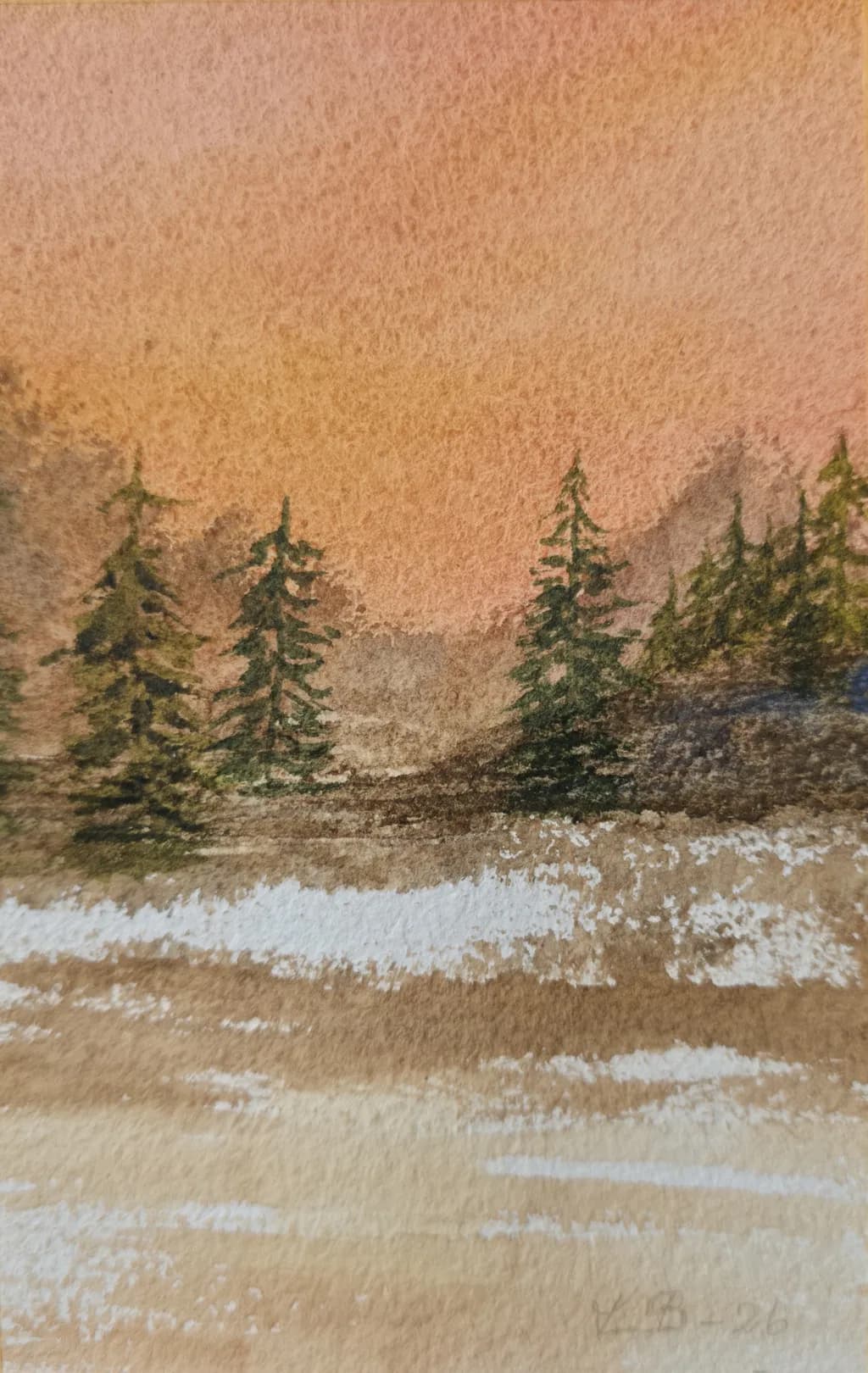
Watercolor · 10x15 cmFinished piece
What I was going for
I want to capture the moment when the sunset turned the sky into magic. A moment of quiet reflection as day gives way to night, while the landscape still pulses with energy. One of those moments just waiting to be immortalized.
Wants feedback onCompositionTechniqueColor & value
3 critiques
Posted in Painting
8
Composition
The trees anchor the middle third, five of them spaced unevenly, which keeps the rhythm from going mechanical. Your eye enters left and travels right through their silhouettes, then drops to the snow bands. What you cropped out matters here: no sky detail, no foreground objects, just the horizontal slice where light changes the air. That's a deliberate reduction, the same instinct that makes a good opening move in chess, clearing lines rather than crowding them. The trees sit slightly below center, which gives the warm sky room to breathe without floating away from the ground plane. One thing I notice is the left edge, where the leftmost tree gets cut by the frame. That crop feels accidental rather than chosen, like the composition wanted one more centimeter of breathing room before the frame closed.
Color & value
The warmth is doing the work you described, that sunset turning the sky into something. The peachy-tan gradient holds the top two-thirds in a single temperature, which makes the greens feel cooler by contrast even though they're fairly warm greens themselves. The value structure is simple: dark trees, mid-value ground, light sky. That reads clearly at a glance. What I'm missing is the magic you mentioned. The sky is warm, but it's also flat. No variation in that wash, no hint of a light source, no glow behind the trees or color shift near the horizon line. Sunsets do strange things to value relationships, they blow out areas and saturate others, and this piece stays even across the entire upper field. It's pleasant, but pleasant isn't the same as that pulsing moment before night.
Technique
The trees show confident brushwork, especially the center evergreen where the branches splay outward with individual needle clumps visible. You kept the strokes loose enough that they read as living shapes, not stencils. The snow in the foreground uses a drybrush pull that lets the paper texture do half the work, those broken whites where pigment skips across the grain. That technique matches the statement about energy in the landscape. What's less resolved is the sky. The wash up top has a mottled, uneven quality that could be atmospheric texture or could be the paper buckling under too much water. I can't tell which you intended. When I'm working in watercolor, even a small piece like this, I stretch the paper or tape it down tight, because that top-third wash is where control usually breaks first if the surface moves.
What's working
The trees. Specifically, the way you varied their heights and densities so they feel like individuals rather than a repeated shape. The second tree from the left has that nice opacity where the branches layer over each other, and the rightmost one stays lighter, almost translucent. That range tells me you were looking at how light passes through evergreens differently depending on their angle and thickness. The snow bands also work because you resisted the urge to make them solid white. They're broken, textured, they have the brown ground showing through, which is what early or melting snow actually does. That restraint keeps the piece grounded in observation rather than sliding into decoration.
What to push
The sky is the opportunity. Right now it's a single wash doing one job, filling the space with warmth, and the piece you described needs it to do more. Sunset skies have structure, even in their softest moments: a lighter band near the horizon where the sun just dropped, maybe a shift from peach to pale yellow to something with a little rose in it as you move up. Or a glow behind the treeline that makes the silhouettes pop forward. You have the color temperature right, but temperature alone doesn't make magic. What would unlock this for me, when I'm after that specific quality of light, is working wet-into-wet with two or three related colors in the same family, letting them bleed and separate on the paper so the sky has movement inside it. The current wash feels like it was painted in one pass and left alone. A sunset worth immortalizing usually needs at least two layers, the second one while the first is still damp, so the edges blur but the colors intensify where they overlap.
One next step
Paint this exact composition again, same size, same trees, but this time do the sky in two stages. First wash: pale yellow at the horizon line, fading up into your peach tone. Let it dry completely. Second wash: diluted rose or burnt sienna, dropped into the upper third while it's still wet, and let it drift down toward the treeline without forcing it. You're not repainting the whole sky, just adding one layer of complexity where the light would concentrate. Then see if that gets you closer to the moment you were after.
Many thanks for taking the time to analyze my painting. A detailed critique with a clear line of reasoning.
The specificity is what matters. You painted something real enough that the gaps show, and that's where the next work lives.