The Architecture of Opposites
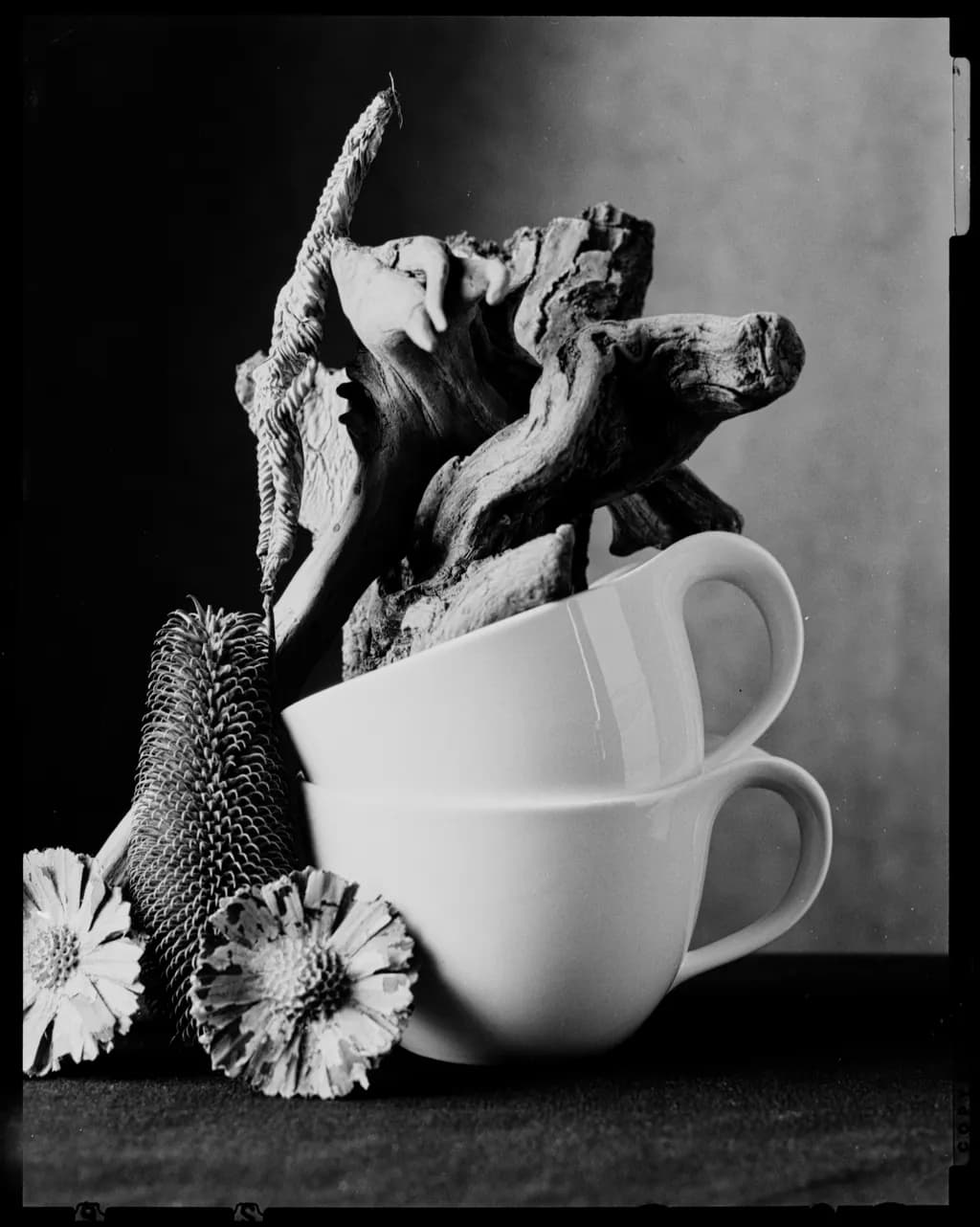
A gentle gradient of light breaks through the darkness of the background and envelops the composition in a multi-layered interplay of shadows and depth. At the center rest two ceramic cups stacked one inside the other—smooth, pure, and almost timeless in their geometry. Yet instead of a hot beverage, the upper cup holds the rough, furrowed texture of weathered driftwood. Flanked by the mathematical precision of the Banksia cone and dried flower heads, a visual tension emerges that instantly slows the viewer’s gaze.
The large-format analog photograph captures this still life with uncompromising precision. Every fiber of the furrowed wood and the fine glaze of the ceramic are rendered tangibly close through the chemical emulsion of the flat film. At the edge, the characteristic notches of the film cassette reveal the tactile process of creation—a quiet homage to craftsmanship and to a conscious slowing down in the act of photography.
In this scene lies a subtle philosophy of transformation. The everyday vessel becomes a vessel of natural history; the ephemeral takes on a lasting form through light. It is the symbiosis of human order and organic wildness that reminds us: Nothing remains static, and it is precisely in the encounter between opposing worlds that the deepest harmony is revealed. On film and Handmade!
That driftwood in the cup stopped me cold. I spent years shooting flowers like they were catalog images before I learned to let the negative space and the odd pairings do the work. You've done that here, the tension between the smooth ceramic and the furrowed wood is what makes it breathe. The film notches at the edge are a nice touch, too.
Hello Linnie, many, many thanks for your comment. It simply fits. The edge is the proof of the entire negative.