Amoako Boafo Didn't Have to Sign. He Did Anyway.
Amoako Boafo is one of the most acclaimed painters working today. His portraits hang in the Guggenheim, the Hirshhorn, and LACMA. A single canvas sold for $3.4 million at Christie's Hong Kong. He has nothing to prove and nothing to gain from controversy. Yet in October 2024, he added his name to a single sentence that 25,000 other creators also signed.
The Statement
On October 22, 2024, Ed Newton-Rex released what became known as the Statement on AI Training. Newton-Rex had resigned from his position as head of audio at Stability AI the previous year, citing the company's position that training on copyrighted works without consent was "fair use." He went on to found Fairly Trained, a nonprofit certifying AI companies that train their models with creator consent.
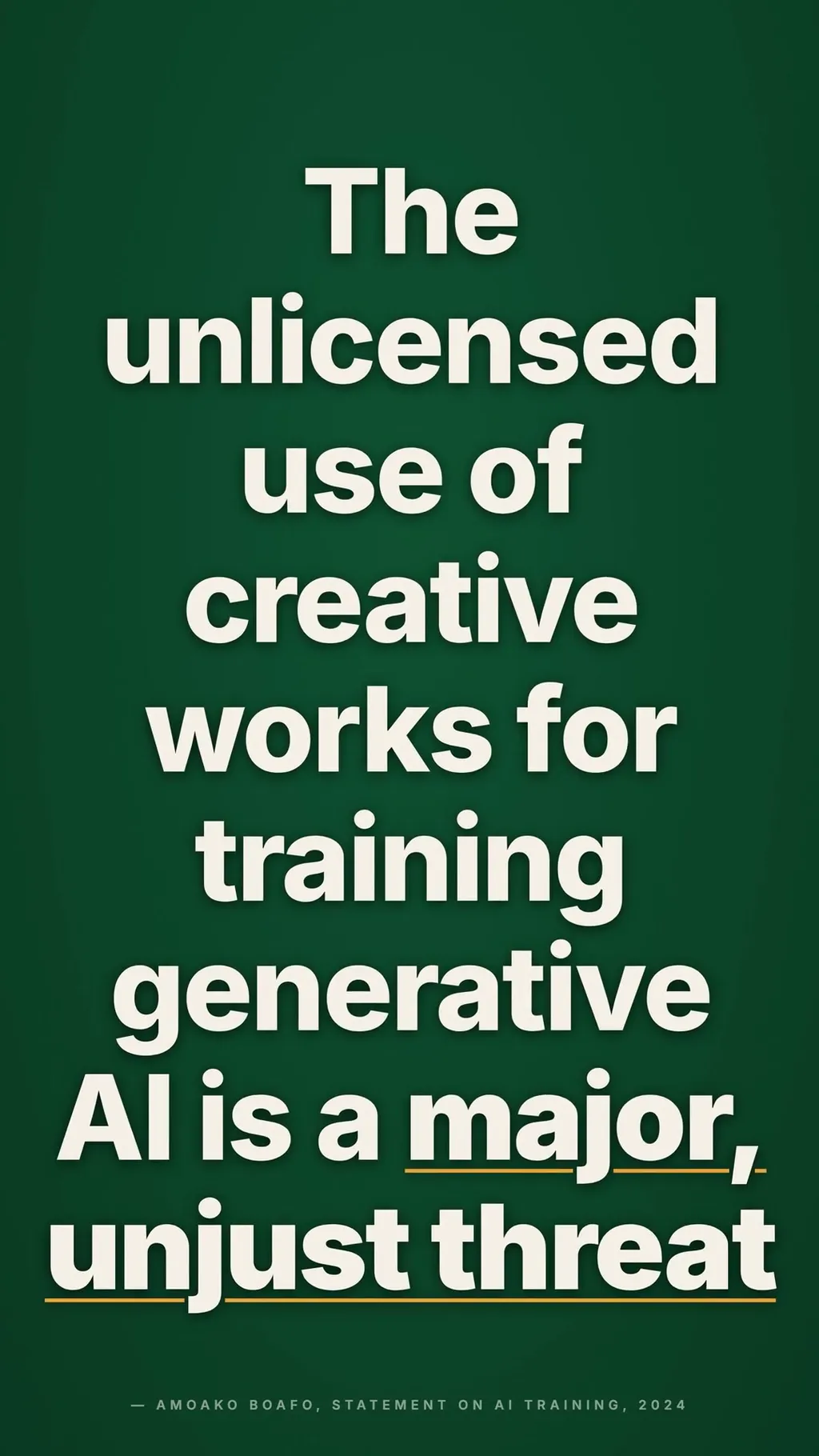
The statement itself is just one sentence: "The unlicensed use of creative works for training generative AI is a major, unjust threat to the livelihoods of the people behind those works, and must not be permitted."
Major. Unjust. Must not be permitted.
No hedging. No "interesting questions to consider." A verdict. Boafo signed alongside Radiohead's Thom Yorke, novelist Kazuo Ishiguro, actor Julianne Moore, and thousands of working artists across every medium.
What's Changed Since October 2024
Twenty months have passed. The courts are finally catching up.
Andersen v. Stability AI, the class action brought by artists Sarah Andersen, Kelly McKernan, and Karla Ortiz, survived motions to dismiss. Judge William Orrick ruled the copyright infringement claims could proceed. Trial is set for September 2026, three months from now.
Disney and Universal filed suit against Midjourney this year, alleging the company scraped "countless" copyrighted works to train its models. The New York Times is suing OpenAI. Sony Music is going after Suno and Udio. Getty Images has its own case against Stability AI.
What looked like a protest letter in October 2024 now looks like a preview of where the law is heading. The 25,000 signatories weren't being dramatic. They were being precise.
Why Someone at the Top Signed
Here's what stops me every time I think about Boafo's signature: he didn't need to.
His market is established. His collectors aren't going anywhere. He could have stayed silent, let younger artists fight this battle, and continued painting. Instead, he put his name on a public document alongside thousands of creators who have far less security than he does.
That's the difference between someone who made it and someone who remembers where they came from. The threat to working artists isn't abstract to him. It's the water everyone coming up behind him is swimming in.
The Question for This Community
Every member of the Human-Made Art Society has thought about this. You've seen AI slop in your feeds. You've watched clients ask about "AI options." You've had the conversation with yourself about what you believe and why.
What I want to know: What's the line, the quote, or the moment from another artist, writer, or creator that crystallized your own stance on AI in creative work? Was it something someone said publicly, or something you read that finally made it click?
Drop it in the comments. I want to see whose words landed for you the way Boafo's signature landed for me.
I wrote an essay on some of my thoughts around how important it is that we do not so narrowly define any use of AI as unethical, or as “non-human” when it comes artist’s using AI as a tool within the creation of their own art.
Within all of that I still think how the AI models themselves were trained on scraped data is extremely unethical and I welcome AI companies being taken to task and sued over that.
I also welcome scrutiny, limits, and laws on what we as a global society allow AI companies, CEOs, etc working on AI to do.
I genuinely think the moment we are in globally w regards to AI is akin to the Cold War where everyone who has the ability to is stacking the AI version of nuclear bombs.
I think use of AI in the arts are obviously very important to carefully consider, esp considering how AIs were trained in such unethical ways, but I also think AI use in the arts are the least of our global concern when considering all the big AI issues— like how uncontrollable they’re proving to be on a larger scale when it comes to the safety and security of humanity in general. I think there needs to be some sort of global regulations that the world agrees to though obv that’s not going to ever happen so I’m gonna just keep making art until we all fall off the cliff 😅