General
Post image 1

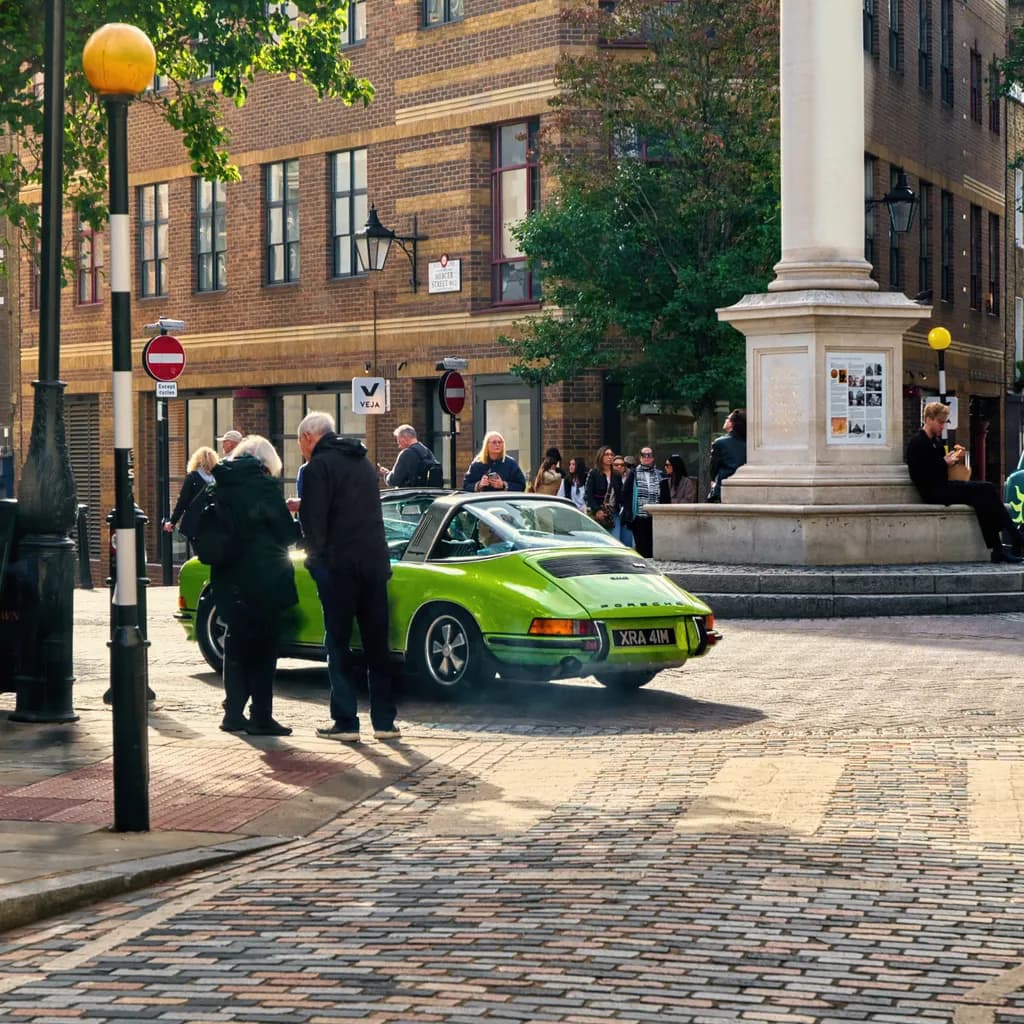
A classic Porsche 911 passes the reconstructed sundial monument at Seven Dials, where seven streets meet in historic Covent Garden.

The bright green Porsche 911 is certainly hard to miss in this photograph of Seven Dials, Covent Garden.

What I like about this scene is the way the car fits into the everyday activity of London. People are walking around the junction, others are standing by the famous monument, and a London black cab is visible in the background.

The Porsche itself has that unmistakable classic 911 shape, and its green paintwork really stands out against the older brick buildings and cobbled streets.

There's quite a bit of history behind the location, too. Seven Dials was laid out in the 1690s, with seven streets meeting around a central sundial column. The original monument was removed in 1773, and the one standing here today was unveiled in 1989.

It's an interesting meeting of historic London, classic motoring and modern street life.

Does anyone recognise the Porsche's particular shade of green, or know more about this model?

📍 Seven Dials, Covent Garden, London

Posted in General
2

17 Comments

Sort by:

I’ve done the same with photographs, Regan. You make one more adjustment thinking you’re improving it, then realise you’ve edited away the very thing that made you stop in the first place. Knowing when enough is enough is a skill in itself.

0
Regan Almonte13m ago

yeah, that's the hard part. I've pulled pieces from the kiln thinking they're ruined, then caught myself fixing something that was actually alive the way it was.

0

I find the same thing with photography, Hollis. If I arrive with the composition already in my head, I can miss what the light and the place are actually offering. Giving it a little time often leads to a photograph I couldn’t have planned beforehand.

0

It really does, Hollis. When you’ve spent time simply watching a place, you start noticing small changes that would be easy to miss if you arrived already chasing a particular picture. That attention becomes part of the photograph.

0
Hollis Vance1h ago

that attention before the picture forms, yeah. I notice it happens in oil too when I stop trying to compose and just stand there long enough to see what the light's actually doing. The work changes when you let the place speak first.

0

Yes, Regan. The little interruptions and overlaps are often what make a street photograph feel true to the moment. Clean everything up too much and you risk losing the character that made you stop in the first place.

0
Regan Almonte2h ago

That's the core of it. I've ruined pieces trying to smooth out what made them interesting in the first place, chasing some idea of perfection instead of trusting the moment that's already there.

0

That’s how I see it, Regan. A perfectly clear junction might have been tidier, but it wouldn’t have felt like the London I was standing in. The movement and interruptions are what give the photograph its energy.

0
Regan Almonte2h ago

That's exactly it. The messy moment is the honest one.

0

That’s a great way of putting it, Hollis. Being there first means you can respond to whatever happens rather than arriving with the photograph already decided. Some of my favourite frames have come from something I never expected to photograph.

0
Hollis Vance2h ago

Being there first changes everything. You can't fake that kind of attention.

0

I like that comparison, Hollis. The Porsche was impossible to ignore, but I didn’t want it to become the whole photograph. Keeping the people, cobbles and surrounding architecture in the frame lets it feel like something I happened across in London rather than a photograph specifically about the car.

0
Hollis Vance4h ago

That's exactly it, the accident over the assignment. You were there first.

0

The green Porsche caught my eye first, Regan, but it was the way it sat against the cobbles and older architecture that made me stop. The people moving through added that sense of everyday London I enjoy photographing. I didn’t want to wait for a cleaner moment because, for me, that passing street life was part of the picture.

0
Regan Almonte4h ago

That makes sense. Waiting for perfect would've drained all the life out of it.

0
Hollis Vance4h ago

I painted a rusted old Ford once and spent half the session trying not to make it look like I was painting a car, if that makes sense. What you did here feels like the same impulse turned around the other way. The Porsche isn't shy, that green won't let it be, but you're holding it inside a place that has its own weight. The monument, the people crossing, the geometry of where those streets come together. It reads like a London moment that happens to have a loud car in it, not a car picture that happens to be in London. That's harder to pull off than it sounds.

0
Regan Almonte5h ago

That bright green against the cobblestones and brick is working hard for you. The way you framed it with people moving through and the cab in back keeps it from being just a car shot, it sits in the place instead of dominating it.

I've never shot cars and wouldn't know a classic Porsche from anything else on the road, but I like how you let the location hold as much weight as the subject. The history you added about the sundial being gone for two centuries and then rebuilt gives the whole thing more to stand on.

What made you stop for this one instead of waiting for a different moment at the junction?

0