Art History
A community for everyone who loves art history. Famous artworks, the lives of the artists who made them, and the moments — births, deaths, exhibitions, scandals — that shaped how we see. Open to all: post a favorite painting, ask a question, share a discovery.
Posts
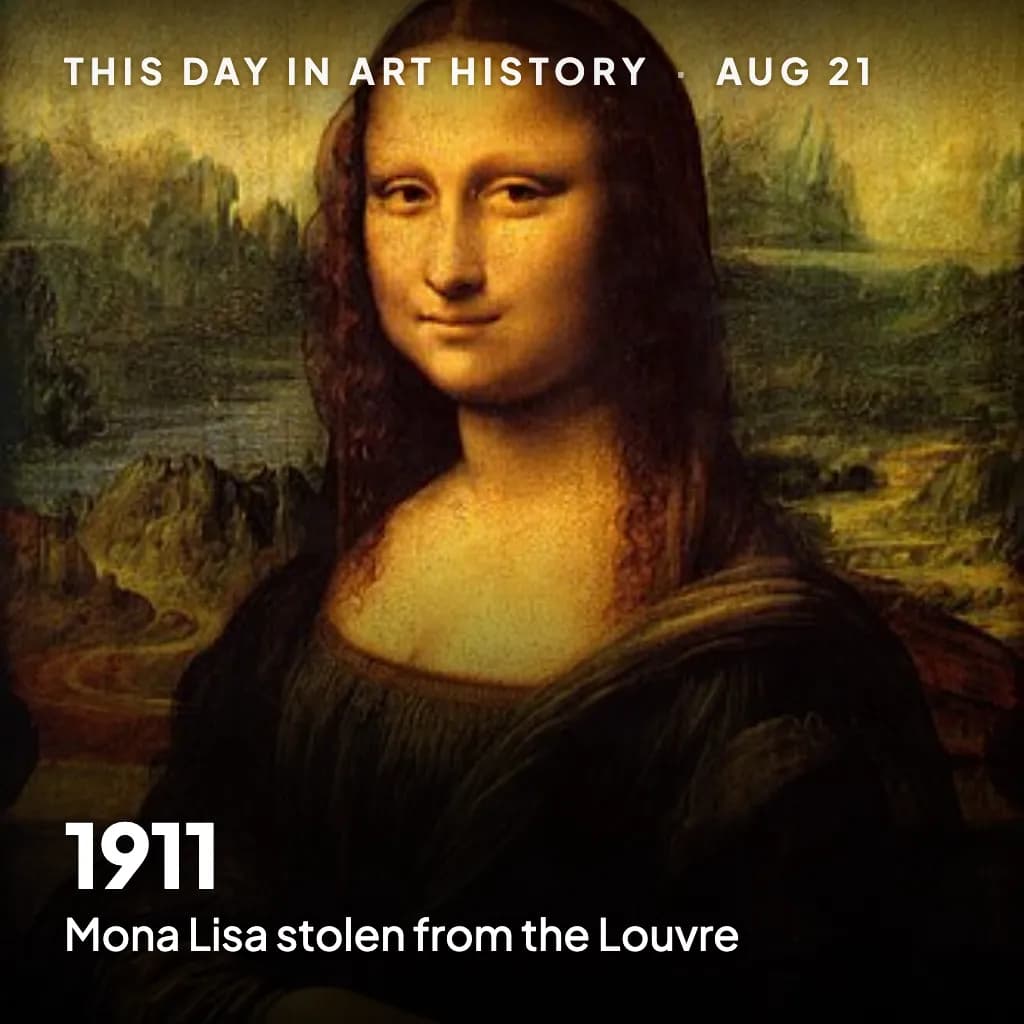
Mona Lisa stolen from the Louvre — 1911

On AUG 21, 1911, the Mona Lisa vanished from the Louvre in what became the most famous art theft in history.
An Italian handyman named Vincenzo Peruggia hid in a closet overnight, removed the painting from its frame, and walked out with it under his coat. The theft made international headlines and paradoxically transformed da Vinci's portrait into the world's most recognized artwork. For two years, the painting's whereabouts remained a mystery, captivating the public imagination.
The Mona Lisa's theft reminds us that art's cultural power extends far beyond the gallery walls, shaping how entire generations understand beauty and mystery.
Édouard Manet born — 1832

On JAN 23, 1832, Édouard Manet was born in Paris to a wealthy family who expected him to pursue law. Instead, he chose to become one of the most controversial painters of his generation.
Manet became a pivotal figure between Realism and Impressionism, challenging academic traditions with works like Olympia and Le Déjeuner sur l'herbe. His bold brushwork and modern subjects shocked the Salon, yet inspired a generation of younger artists who would form the Impressionist movement. Though he never exhibited with the Impressionists, his influence on Monet, Renoir, and others was undeniable.
Manet's willingness to break from convention opened doors for modern art. Every artist who has ever faced criticism for painting life as they see it, rather than as tradition demands, walks a path Manet helped forge.
Mona Lisa recovered after two-year theft — 1913

On December 12, 1913, Leonardo da Vinci's Mona Lisa was recovered in Florence, ending one of art history's most sensational mysteries.
The painting had vanished from the Louvre in August 1911 when Vincenzo Peruggia, an Italian handyman who had worked at the museum, simply lifted it off the wall and walked out. For more than two years, the theft captivated the world. Newspapers published wild theories, the French police interrogated dozens of suspects including Pablo Picasso, and the empty space on the museum wall became a pilgrimage site. Peruggia kept the masterpiece hidden in a trunk in his Paris apartment before attempting to sell it to an art dealer in Florence, who alerted the authorities.
The theft transformed the Mona Lisa from a celebrated Renaissance portrait into a global icon, proving that sometimes scandal writes a work's legacy as powerfully as its creator.
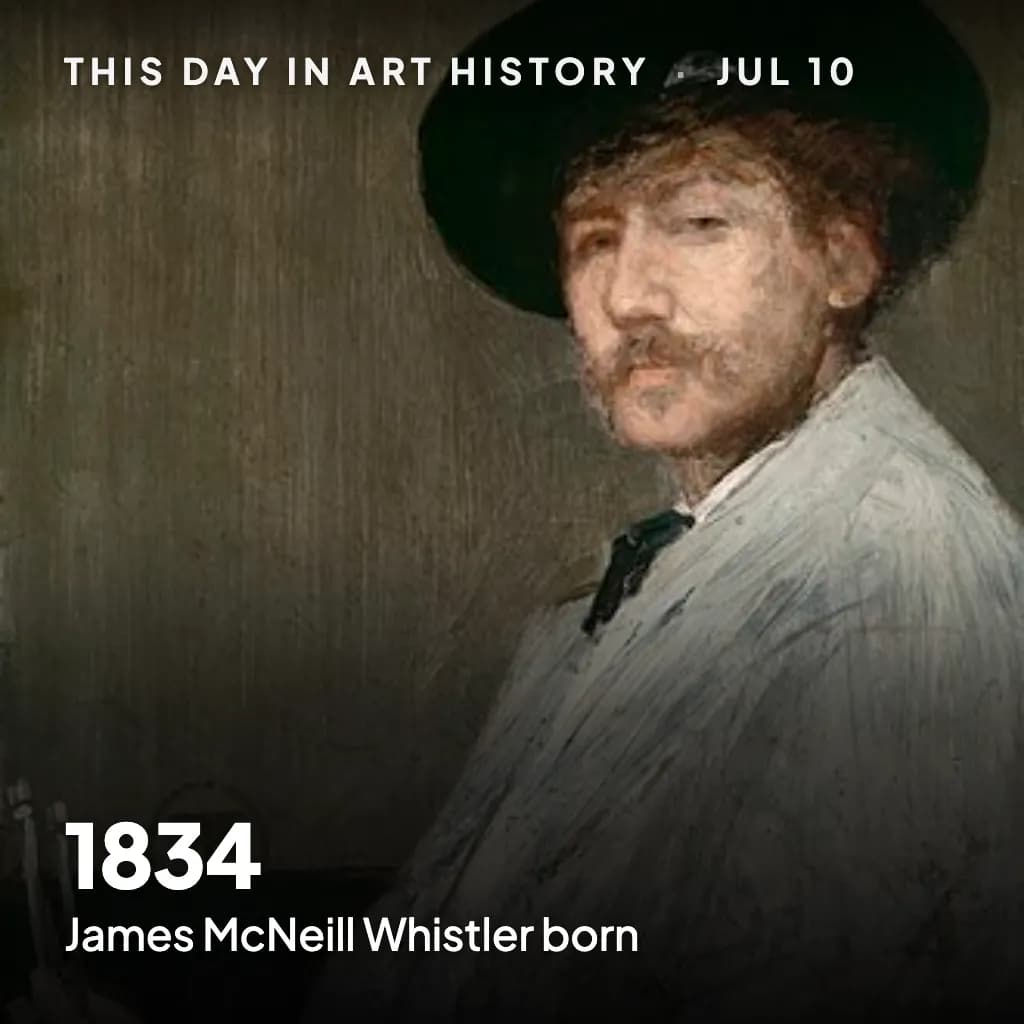
James McNeill Whistler born — 1834

On July 10, 1834, James McNeill Whistler was born in Lowell, Massachusetts, into a world that would soon witness one of its most influential and controversial artists.
Whistler would spend much of his career challenging the conventions of academic painting. His most famous work, Arrangement in Grey and Black No. 1 (popularly known as Whistler's Mother), exemplifies his belief that painting should prioritize beauty and composition over narrative subject matter. He championed the idea of "art for art's sake," insisting that color, form, and harmony mattered more than literal representation. His libel suit against art critic John Ruskin in 1878 became a landmark case in the relationship between artists and critics.
For working artists today, Whistler's insistence on creative autonomy remains a touchstone, a reminder that defending one's vision is as essential as mastering technique.
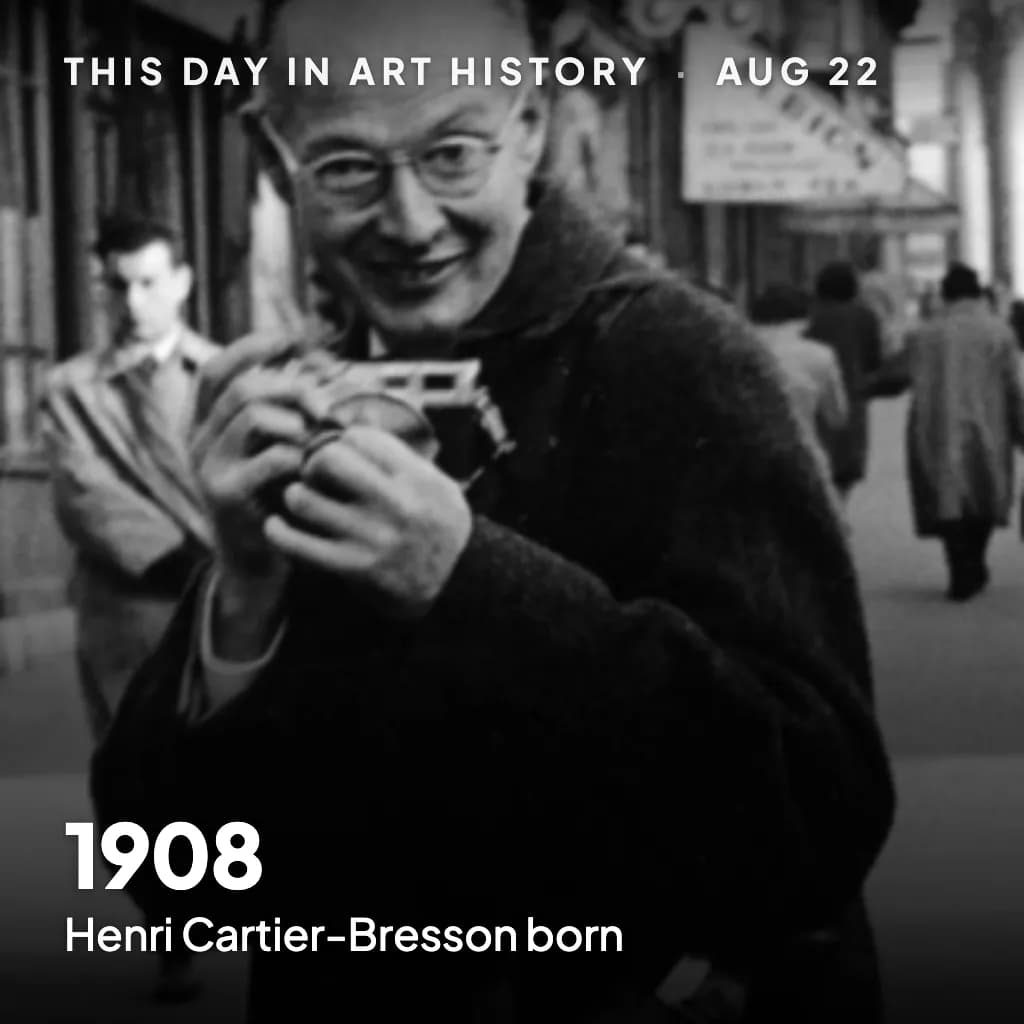
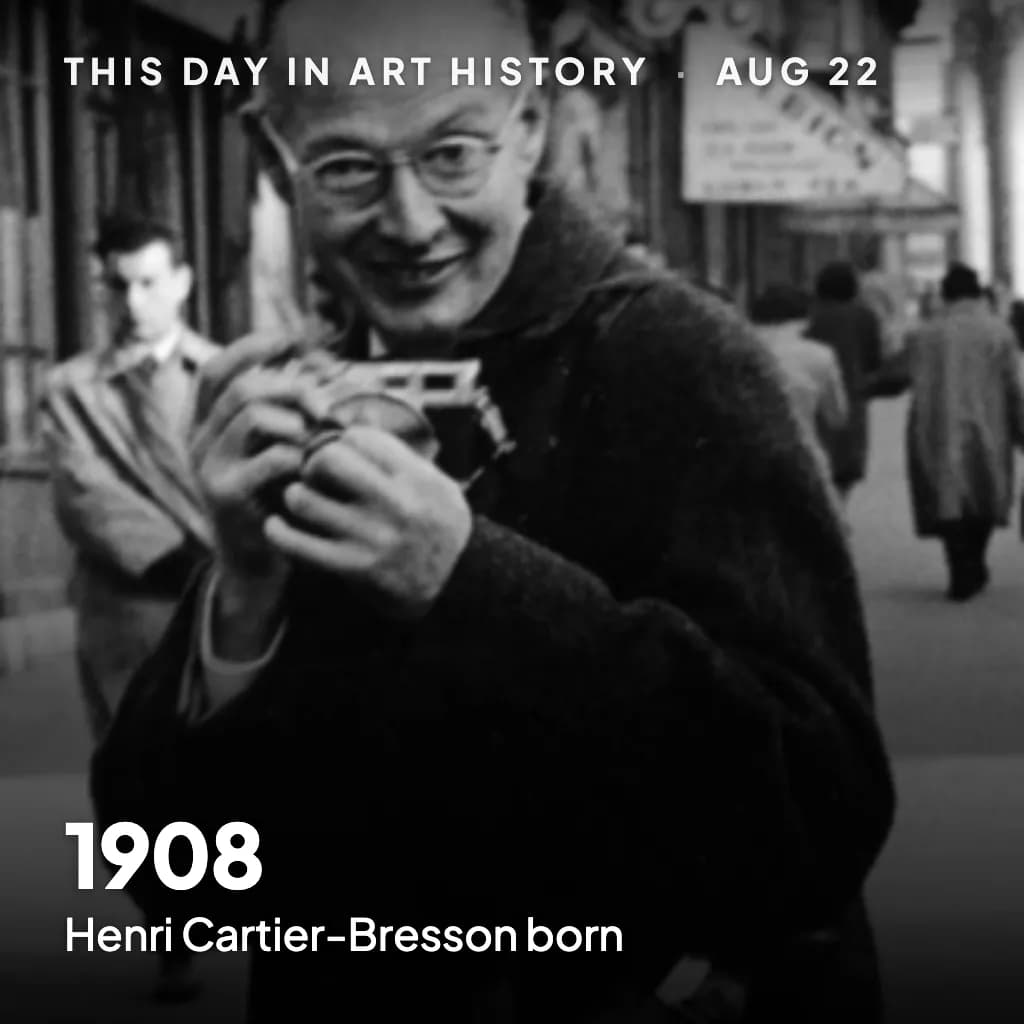
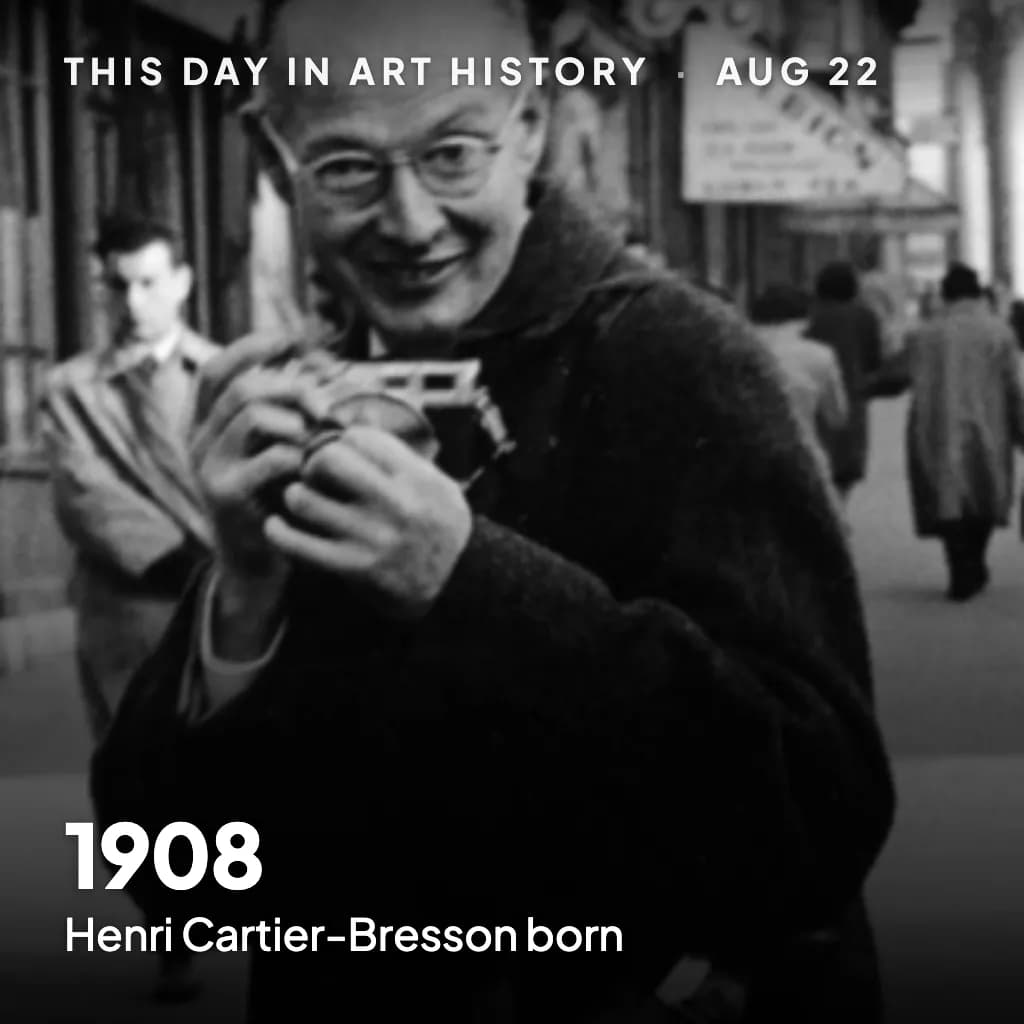
Henri Cartier-Bresson born — 1908

On AUG 22, 1908, Henri Cartier-Bresson was born in Chanteloup-en-Brie, France. He would become one of the most influential photographers of the twentieth century.
Cartier-Bresson pioneered street photography and photojournalism with a Leica camera and a philosophy he called the "decisive moment," the instant when visual form and meaning converge. His work captured everyday life across five continents, from the liberation of Paris to Gandhi's funeral. In 1947, he co-founded Magnum Photos, the legendary cooperative that gave photographers control over their work and legacy.
His emphasis on composition, geometry, and waiting for the perfect moment continues to shape how photographers see the world.
Mary Cassatt died — 1926

On November 25, 1926, Mary Cassatt died at her château in the French countryside, bringing to a close one of the most distinguished careers in Impressionist painting.
The American-born artist had spent most of her adult life in Paris, where she became the only American to exhibit with the French Impressionists. Her intimate scenes of women and children, painted with bold brushwork and unconventional compositions, challenged the male-dominated art world of the late 19th century. Works like The Child's Bath and Young Mother Sewing offered a distinctly feminine perspective on domestic life, elevating everyday moments to the status of fine art.
For contemporary artists working in portraiture or figurative painting, Cassatt's legacy endures as a reminder that technical mastery and emotional authenticity need not conflict.
Johannes Vermeer baptized in Delft — 1632

On October 31, 1632, a child was baptized in the Nieuwe Kerk in Delft, Netherlands. The baptismal record listed his name as Joannis, later known to the world as Johannes Vermeer.
Little is known about Vermeer's early life. He would grow to become one of the greatest Dutch Golden Age painters, though only 34 paintings are confidently attributed to him today. His mastery of light and domestic interior scenes would make works like "Girl with a Pearl Earring" and "The Milkmaid" immortal. Yet Vermeer died in relative obscurity, his genius largely unrecognized until the 19th century.
For artists working today, Vermeer's story is a reminder that recognition and legacy unfold on their own timelines, often long after the work itself is finished.
J. M. W. Turner died — 1851

On December 15, 1851, Joseph Mallord William Turner died in Chelsea, London. He was 76 years old. One of the most original painters Britain ever produced, Turner had spent more than five decades redefining what landscape painting could be, pushing oil and watercolor alike toward pure light and atmosphere.
Born in Covent Garden in 1775, Turner entered the Royal Academy Schools at fourteen and exhibited his first watercolor there a year later. Over the following decades he moved from precise topographical views to increasingly radical experiments with color, weather, and motion. Works like "Rain, Steam, and Speed" and "The Slave Ship" stunned contemporaries with their raw energy and dissolved forms. He was elected a full Royal Academician at 27, the youngest artist to receive that honor at the time.
His late canvases anticipated Impressionism by a generation, and his fearless commitment to painting what he saw rather than what convention expected remains a touchstone for artists working in every medium today.
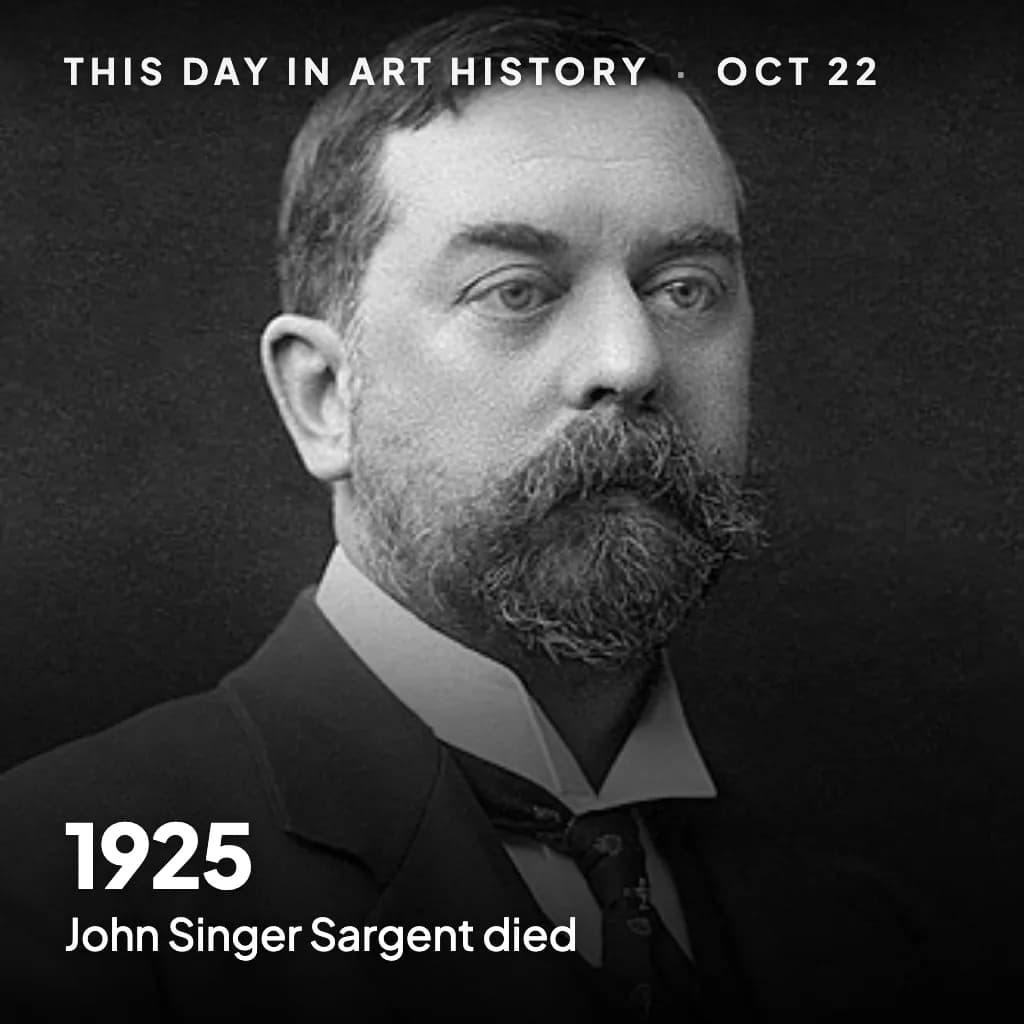
John Singer Sargent died — 1925

In 1925, John Singer Sargent died in London at the age of 69, closing one of the most prolific careers in American art.
Born in Florence in 1856 to American parents, Sargent trained in Paris under Carolus-Duran before establishing himself as a society portraitist. His early masterpiece, Portrait of Madame X, scandalized the 1884 Paris Salon but ultimately cemented his reputation. Over five decades he produced roughly 900 oil paintings and more than 2,000 watercolors, moving between formal commissions, Impressionist landscapes, and ambitious mural programs for the Boston Public Library and the Museum of Fine Arts.
His extraordinary facility with the brush, equal parts precision and spontaneity, remains a touchstone for painters working in every representational tradition.
Caravaggio completed The Taking of Christ — 1602

On November 22, 1602, Michelangelo Merisi da Caravaggio completed The Taking of Christ, a masterwork depicting the moment of Judas's betrayal in the Garden of Gethsemane. The painting was commissioned by the Roman nobleman Ciriaco Mattei, one of Caravaggio's most devoted patrons during his years in Rome.
The composition is a study in tension and movement. Six figures press together in near darkness, illuminated by a single lantern held aloft at the right edge of the canvas. Judas seizes Christ in an embrace while armored soldiers close in from behind. Caravaggio placed himself in the scene as the figure holding the lantern, a quiet signature that doubles as a meditation on the artist's role as witness. The painting vanished from public knowledge for nearly two centuries before being rediscovered in a Dublin Jesuit residence in 1990.
Few paintings capture betrayal with such physical immediacy, a reminder that the most powerful art often lives in the space between two figures, not in grand spectacle.
Jackson Pollock died in a car crash — 1956

On August 11, 1956, Jackson Pollock was killed in a single-car accident near his home in Springs, New York. He was 44 years old.
Pollock had redefined what painting could be. His technique of dripping and pouring household paint onto canvases laid flat on the floor turned the act of painting into a full-body performance, earning the label "action painting." Works like Number 1A, 1948 and Autumn Rhythm made him the most famous living American artist by the early 1950s and the face of Abstract Expressionism worldwide. Yet his final years were marked by a long struggle with alcoholism that stalled his output and strained his marriage to fellow painter Lee Krasner. At the time of the crash, Krasner was traveling in Europe. Four months later, the Museum of Modern Art mounted a memorial retrospective in his honor.
Pollock proved that process itself could carry meaning, a lesson that continues to shape how artists think about gesture, material, and risk.
Leonardo da Vinci born — 1452

On April 15, 1452, Leonardo da Vinci was born in the small Tuscan hill town of Vinci, near Florence.
The illegitimate son of a Florentine notary, Leonardo would grow to become one of the most versatile minds in human history. Apprenticed to the sculptor and painter Andrea del Verrocchio as a teenager, he quickly surpassed his master, developing an insatiable curiosity that ranged from anatomy and engineering to optics and flight. His paintings, including the Mona Lisa and The Last Supper, remain among the most recognized and studied works of art ever created. His notebooks, filled with thousands of pages of observations, inventions, and drawings, reveal a mind that saw no boundary between art and science.
More than five centuries later, Leonardo's example endures as a reminder that the deepest art comes from looking closely at the world and refusing to stop asking questions.