Community

Art Fairs

Your community hub for discovering, discussing, and preparing for art fairs.

Posts

First artfair

Post image 1

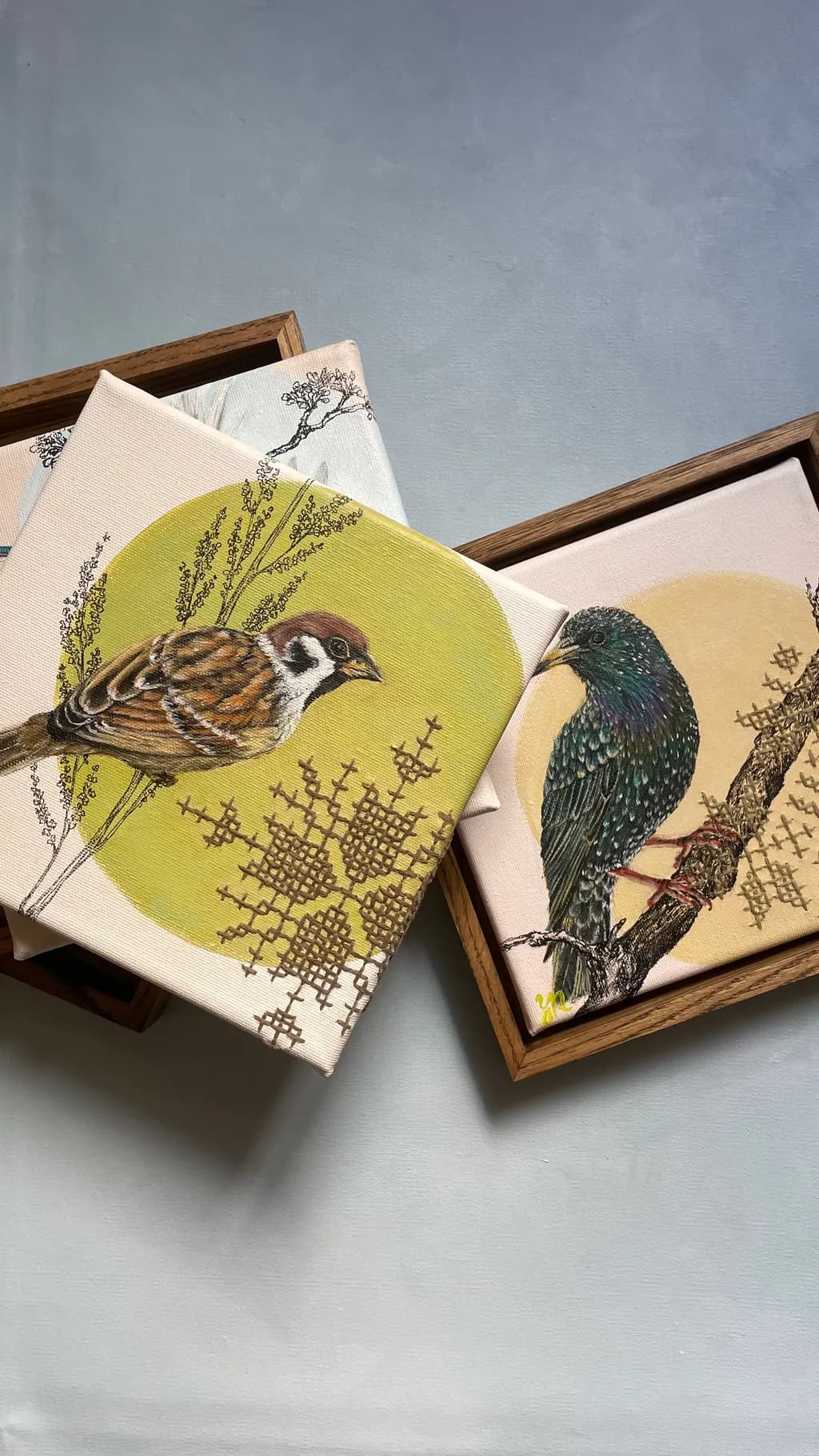
In a week I’ll have my first art fair and, honestly, it feels a bit scary. And I worry not about selling… I’m going there hoping to connect with people more than anything else. I still believe that real conversations and meeting people face to face can be one of the most valuable ways to grow as an artist.

Lately I’ve been thinking about something.

Part of me wants to tell people what I meant when I created my work — the thoughts, emotions and ideas behind it. And another part of me hesitates, because I know every person can see something different in the same painting.

I don’t want to hand people a single answer. Maybe art lives somewhere between 🤔

I’m curious — when you look at art, do you want to hear the artist’s story behind it, or do you prefer to discover your own?

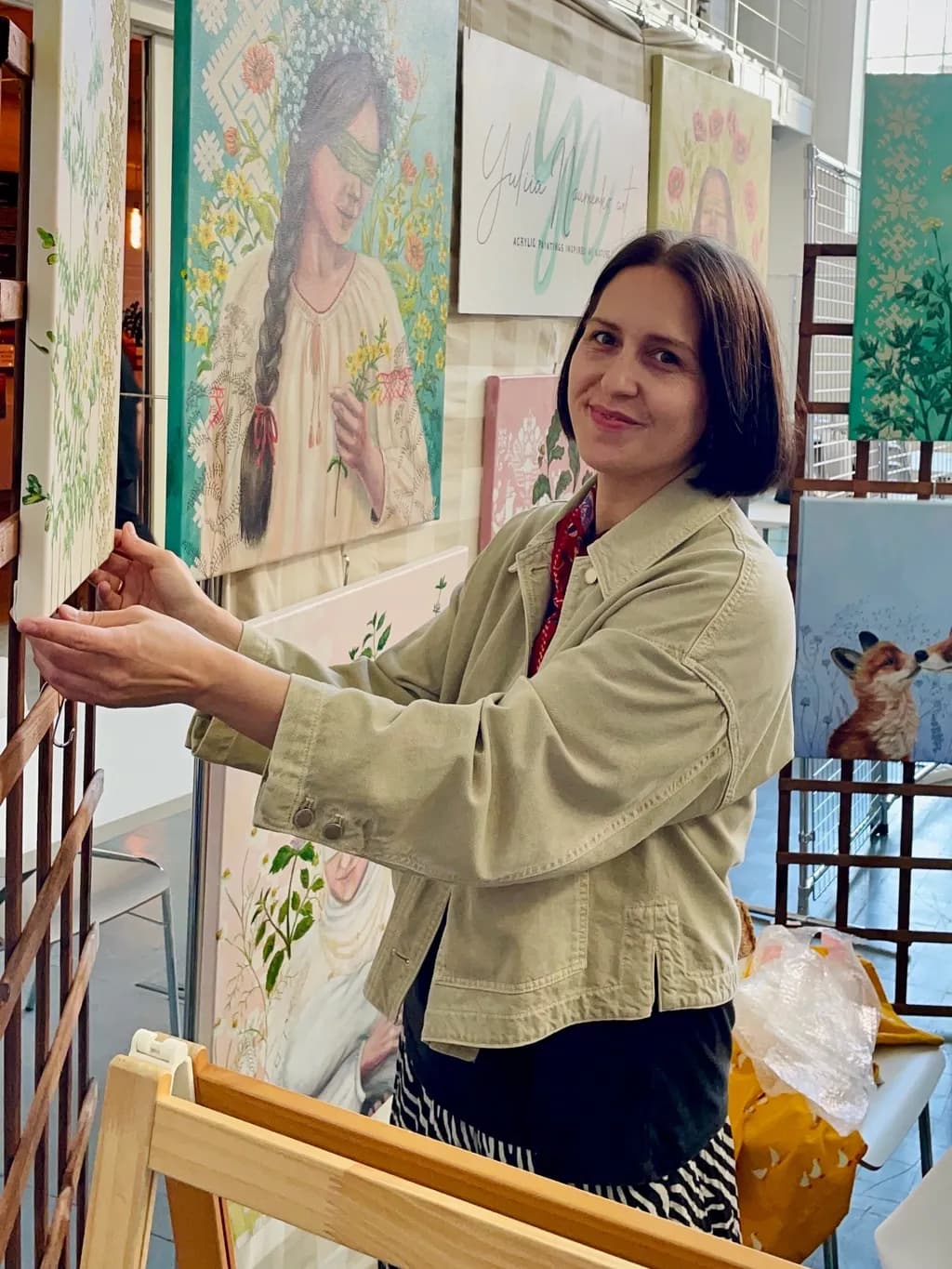
P.S. On the photo: some of my small paintings waiting to be framed and getting ready for the art fair.

5

The best and the worst

What was the best outdoor art show you ever had and what was the worst?

y best was on 5th Ave. S in Naples 25 years ago when reproductions of art on tile was just coming to market and I was one of the first ones to have it--made over $7,000 just selling 8 x 10 dye sublimated tiles. The worst? a day at the Cape Coral FL Rotary Art show where I almost was arrested for throwing water at a man who was using my booth as a pass through by entering from the rear. He had me arrested for assault and then let me off the hook when I apologized-Never did that show again!

3

Your Favorite Backstory

Post image 1

In an earlier post I mentioned how much fun it was doing my first craft/art show. And although I didn't get rich, I gained so much enjoyment talking about my photos. I was actually surprised by how many visitors actually enjoyed hearing the stories behind specific images. I'm sure we would all love hearing yours too. So, post one of your photos and tell us the backstory! I'll start it off with my photo (above) that got the most attention at the show. I was hiking in Yosemite National Park with my daughter (Katie) and her little dog (T. Rex). The two of us didn't even notice the black bear until her chihuahua ran up to it and started smelling its leg. The bear looked down at the dog, realized it was too small to be a threat, and went right back to eating Manzanita berries. Katie yanked T. Rex away and hid behind a tree, all while yelling at me to put my camera away and get back there with her. Eventually, the bear walked away and down to the lake behind us for a swim. When we got back to the trailhead a ranger told us that the bear and its mom had been hanging out in the area. And that we were all lucky that the mom, which was likely hiding in the brush nearby and watching us, didn't come bounding out of the brush to protect its young.

3

How do you display your tote bags?

For those who sell tote bags, what do you use to display them at art fairs and markets? I'm doing a weekly market and a bunch of other events this summer, and I'm looking for a solution that looks nicer (and neater) than just hanging them randomly on hooks. Thanks!

3

First Art/Craft Fair

Post image 1

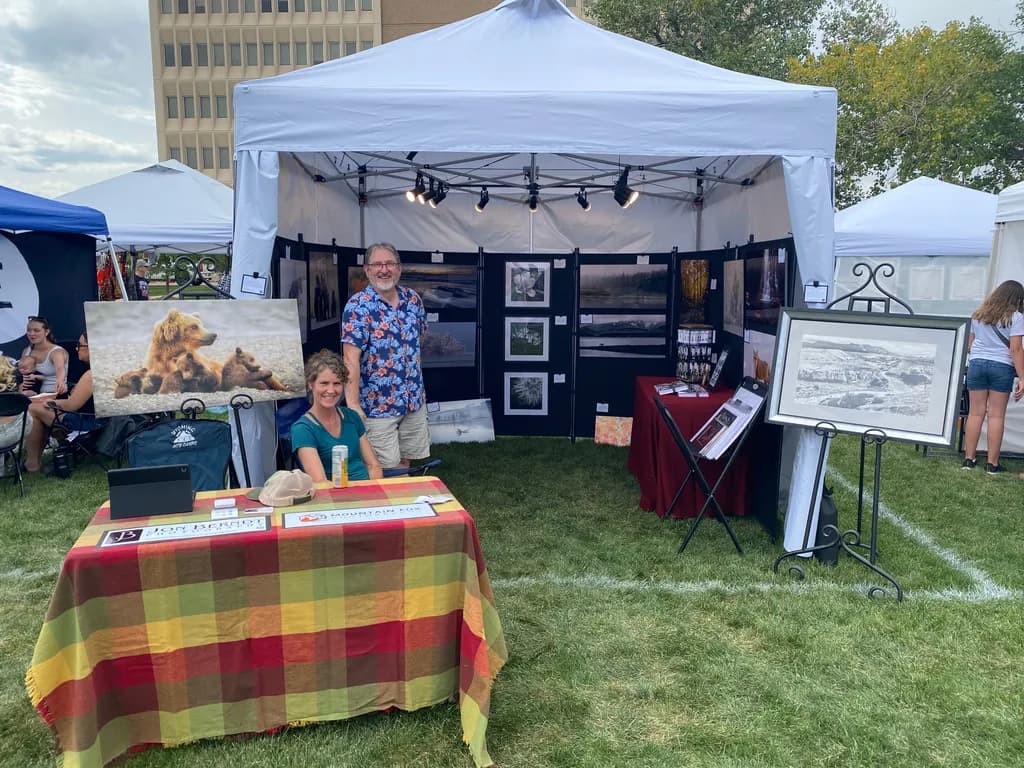
I just completed my first craft/art fair this past weekend. First, it was so much fun getting to meet talk to so many interesting people. As for the results, they were mixed. And because I am a first-timer, I have no benchmark to compare to. So I thought I would ask folks for input here. This was a relatively small event with 14 or 15 craft/art vendors and a half-dozen food vendors, and live music. On Saturday I sold one $175 medium-sized print and a number of smaller prints, cards, photo magnets and photo stickers, making a total of $365. Enough to pay the $200 space fee for both days plus a little. On Sunday, although I had lots of lookers and plenty of praise about my work, I had zero sales! The day 2 crowd was definitely different, with more young families with kids and people there to drink. Please weigh-in with your experiences.

65

New canopy banner.

Post image 1

Making sure our new banner will stay put on our canopy. Had to figure out away to fasten it without putting holes in the canopy. Bungee cords and rope to the rescue. Cindy (aka Cindi Hale) is my wonderful wife.

2

Expo Chicago 2026 Opens With Fewer Galleries and a Different Feel

Post image 1

Expo Chicago opened its doors this week and something felt different from the moment you walked in. The crowd was there, the galleries were there, but the scale had shifted and the mood had shifted with it.

A Smaller, More Deliberate Fair

The 2026 edition came with fewer galleries than recent years, and that reduction was visible on the floor. What it traded in size it seemed to gain in focus. Booths were more curated, presentations felt more considered, and there was less of the frantic energy that big art fairs sometimes generate when everyone is competing for the same eyeballs at once. Gallerists who made the trip to Chicago appeared to be there because they wanted to be, not just to maintain a presence on the circuit.

Chicago's Larger Cultural Moment

Part of what makes this year's Expo feel significant is the city it is happening in right now. The Obama Presidential Center is taking shape on the South Side, and there is a palpable sense that Chicago is in the middle of a larger cultural reckoning about what it stands for and who its institutions serve. Expo Chicago has always had a civic dimension that sets it apart from more commercial fairs, and in 2026 that dimension feels more pronounced than ever. Several exhibitors noted the fair's relationship with local institutions and communities as a genuine point of pride, not just a marketing line.

What the Collectors Were Actually Doing

Reports from the opening days suggested a more intentional kind of collector on the floor. People came to look seriously and buy deliberately. The opening-night spectacle was quieter than it might have been in peak fair years, and the consensus seemed to be that this was fine. Maybe better than fine. An art fair where the serious collectors outnumber the people there to be photographed is not a bad thing for anyone trying to actually sell work.

What This Means for the Broader Market

Expo Chicago's reset raises questions that go beyond one city or one fair. The past few years have seen galleries rethink their participation in the art fair circuit more broadly, weighing the costs of shipping, staffing, and booth fees against the returns. What Expo Chicago is modeling in 2026 is one possible answer to that math: do less, do it more intentionally, and see if the quality of engagement goes up when the quantity of booths goes down.

Whether that experiment pays off commercially will be interesting to track over the coming weeks as sales reports trickle in. But even setting aside the numbers, there is something worth noticing about a major international art fair choosing to shrink rather than grow. It is a different kind of statement, and Chicago is making it loudly this spring.

2

Best Pole Bags for Flourish Canopy

Hey guys. Do any of you have pole bags that actually stand up to the wear and tear of art fairs? I bought three from Amazon, and one has holes and one's zipper gave out after two events. I saw bags on Flourish, but I want to keep the connectors on, and it looks like they're not big enough for that.

3

Presentation

After years of travelling around the UK and The Channel Islands with my art I learned a great deal about prospective sales to customers, and seen where the power lies when it comes to selling.

A couple will approach the stand, the man will get drawn to a painting, and he might even start pulling out his wallet when his wife issues a “hmm.”

Nothing loud, just a silent “hmm” as she stands there.

It may have been silent, but both the husband and I felt it tremor across the floor.

The man looks at a painting and thinks, “Great”

The lady looks and thinks, “What will this go with”

I've even had people bringing a piece of wallpaper and holding it against artwork on my stand.

Your only chance of beating this situation is if the man is looking for something to hang in his office at work.

Or his wife is a retired train driver, then you may be able to sell them a painting of “The Flying Scotsman at King's Cross”.

Looking back now, one thing that mattered far more than I realised at the time was how I presented my work. I didn’t always understand it, and it took years to get it right.

Whether you’re exhibiting in a village hall, a shopping centre, or showing work to a gallery or shop, presentation quietly does the talking long before you ever get the chance to open your mouth.I would have to start with advice on presentation of your artwork.

This covers two scenarios: at an exhibition or showing in a gallery or shop.

When I travelled round the country at various art exhibitions, I had a professional display stand made by a company local to me. The stand featured various panels that slid into the sides of poles. They could display the stand in various ways to suit the space I had paid for. It was both light to transport and rigid when in use.

This is not about the stand so much as how I displayed my work. I would display a painting on one panel, leaving plenty of space around it. (Sometimes two or more, if they were small paintings).

The aim was to allow the potential buyer to visualise the artwork as it might look on their wall. The rest of the paintings at the beginning of an exhibition were stacked upright behind the stand with a few on the floor in front, gradually moving up onto a panel as another sold.

***“You need to keep people on your stand”***

This also had the effect that customers would always be on my stand browsing through the ones on the floor and “discovering” some piece of art that wasn’t on view. If you can get people to stay on your stand and browse, they will attract others who wonder what they are missing.

An exhibition in Guernsey highlighted this to me, where the lady next to me wasn’t doing well and couldn’t understand, because her paintings were very good. They were all flower paintings in oils, and they were good.

The problem was she had them all on display on her stand at once, pushed together frame edge to frame edge. She even had extension panels above the rest which needed steps to hang them.

You needed binoculars to view the top paintings.

The result was just an entire wall of flowers with nowhere for the eye to rest; she was frightened that a customer would miss a painting, but the fact was that the others made them miss it.

I suggested she give more space to the paintings and place more on the floor so that they could be “found” by browsing customers.

That evening I helped her sort the stand, and it looked good, but when I returned the next morning, she had put them all back on the stand. She just couldn’t risk a customer missing a painting.

I have often thought about that stand since, because it taught me something no one had ever shown me before, and I had never read it in any book.

It wasn’t about flowers, or oil paint, or even taste — it was about how people look, how long they linger, and what makes them stay.

Lynn and I still have this discussion, fight, every time we set up a new exhibition, where I will suggest one painting per wall and she doesn't want to see any wall.

A compromise works out to a good balance, meaning I give way.

None of this guarantees success, of course.

People will still walk past, tastes will still change, and some days you’ll pack the car wondering why you bothered. But a good presentation gives your work a fair chance.

It allows people to pause, imagine a painting on their own wall, and feel they have discovered something rather than having been sold to.

Lynn and I never press a visitor to our gallery; we give them space and time to browse, and hopefully, they will "discover" the painting that has been sitting there waiting to be discovered.

Over the years I learned that if I respected the work enough to give it breathing room, eventually the right customer would find it.

Which, in the end, is all you can really ask.

2

Wait list at big fairs

I recently got waitlisted at the Naples National Art Fair, and the Westchester Art Fair, in the photography category. I'm wondering about others' experience with larger art shows, do they often pull from the wait list? And is it more difficult being a photographer (smaller # of spots for the show) to get a spot? Worth applying multiple years in a row, or you just never know? Thanks in advance for any insights!

4

Flourish Tent Poles Question

Hey guys. I'm doing several spring art fairs this year, and bought a used Flourish tent from a dead guy. Haha-you read that right. Dead guy. I guess he bequeathed it to his estate. But I got the tent and a full set of mesh panels for $1400. Not a bad deal.

But that has nothing to do with my question. I put these monsters up myself, and it seems the poles don't want to slide together and the push pins are hard to press. Have any of you used WD-40 on them? Or something else? I have another one next weekend, and am trying to find ways to make it a little easier on myself. 😅

1

Art Basel Hong Kong 2026: Slower, Smarter Buying Takes Center Stage

Art Basel Hong Kong wrapped up today — and if you're trying to read the room on where the international art market actually stands in 2026, this is the fair to watch.

A Different Kind of Energy

Art Basel Hong Kong 2026 had packed aisles, celebrity sightings, and million-dollar sales — but the vibe on the ground told a more nuanced story. "This doesn't feel like the First Choice VIP day but more like a public day," one attendee told Artnet News, describing the opening hours. That observation captured something important: the spectacle of a major art fair was present, but the urgency to buy that once defined opening-day previews has quietly evaporated.

Collectors in 2026 are taking their time. Dealers across the fair described a more deliberate pace of deal-making — buyers who are interested but unhurried, considering rather than competing. Marc Payot, president of Hauser and Wirth, put it diplomatically: "What matters is long-term engagement — building relationships, not just transactions." He noted that a major Louise Bourgeois work sold at last year's fair took nine months to fully place.

The Sales Picture

Top transactions during the VIP preview included Pablo Picasso's Le peintre et son modèle (1964) at approximately $4 million, a Liu Ye painting at $3.8 million, a Marlene Dumas work at $3.5 million, and a Louise Bourgeois piece at $2.95 million. White Cube moved a Tracey Emin work for £1.2 million, and Gladstone sold an Alex Katz for $1.3 million. The blue-chip tier held up, but most confirmed sales throughout the day were in the five- to six-figure range — suggesting a market where established names still transact well, but speculative buying at the emerging end has cooled significantly.

Geopolitics and the Cost of Doing Business

This year's fair didn't exist in a vacuum. The US-Israel conflict with Iran, which began on February 28 and has now caused over 1,500 deaths, disrupted global shipping and flights. Art Dubai postponed its 20th edition entirely. In Hong Kong, return shipping costs to the US are projected to rise by approximately 50 percent, and costs to Europe could double — a meaningful additional burden for international galleries already operating on thin fair economics.

Hong Kong's auction market has also been contracting sharply: 2025 saw sales fall to a decade low of $715 million, down 20 percent year over year and more than 60 percent from the 2021 peak. The city dropped to fourth in global auction rankings, falling behind Paris for the first time. Against that backdrop, Art Basel's announcement this week that it has secured Hong Kong as its exclusive Asia-Pacific host for the next five years was notable — a sign of institutional confidence even as market metrics tell a more complicated story.

What This Means for Working Artists

For artists not operating at Picasso price levels, the signals from Art Basel Hong Kong 2026 reinforce a theme that's been consistent across the past year: the market rewards patience, relationships, and regional connections more than it rewards spectacle and speculation. Galleries that returned this year reported stronger results when they came with deep familiarity with Asian collectors rather than trying to simply export their western roster into the region.

The art market isn't broken — but it has fundamentally changed its tempo. Artists and galleries building for the long term are better positioned than those still chasing the energy of the 2021 boom.

4

art fair displays

hello, all! I'm just starting to look at display options for entering art shows- could anyone/everyone post some of their displays so i can see options? i have mostly pictures, but some things that need to be on tables (they're on stands and don't hang)

4
1mo ago

Is it just me or are Art Fairs having a full-on renaissance right now?

Post image 1

Haley Meyer made $5,000 selling paintings last year. She invested every single dollar of it into one art fair booth.

Meyer is a first-time exhibitor at Artist Project Toronto, which runs this week with over 250 artists and 17,000 expected visitors. She paid $3,800 just for the booth space before insurance and other costs. No gallery backing. No safety net beyond her husband's support. Just her paintings, her story, and a bet on herself.

Here's what makes Artist Project different from fairs like Art Toronto: there's no gallery middleman. Artists exhibit their own work. If a collector buys something, 100% of the profit stays with the artist. At a traditional fair, galleries take a 50% commission. That math changes everything.

And Meyer isn't alone. Photographer Finn O'Hara started prepping his booth six months out — framing, marketing, transport, delivery. All on his own. He calls it the price of creative freedom. "You can make this whatever opportunity you want," he says.

Is it just me or does it feel like art fairs and shows are having a genuine renaissance? Booth fees are up because demand is up. Applications are oversubscribed. First-time artists are treating fairs like their gallery debut — and skipping the gallery entirely.

The old model was: get a gallery, let them handle everything, give up half your sales. The new model is: invest in yourself, show up, keep what you earn. It's riskier. It's more work. But it's yours.

Have you ever done an art fair? Would you put your entire year's earnings into a single booth if it meant selling directly to collectors with no middleman?

https://www.cbc.ca/arts/artist-project-2026-toronto-art-fair-preview-9.7141760

7

How to Actually Succeed at Art Fairs: A Practical Booth Guide

Post image 1

Art fair season is here — and whether you're a first-timer or a seasoned booth veteran, a little prep goes a long way.

The team at Artsy Shark put together one of the most practical guides I've come across for artists selling at fairs and festivals. Rather than vague advice, it breaks down exactly what to bring, how to set up, and how to actually connect with buyers on the floor.

Here are the highlights worth knowing:

Your booth is a store — design it like one

Eye level is buy level. Your best-selling work should be at eye height, not on the ground or tucked in a corner. Use height and depth in your display — multi-level setups attract attention even through crowds. And light your work properly: a dark booth turns people away before they ever step inside.

The price mix matters more than you think

Don't just bring your big pieces. A range of price points — entry-level gifts, mid-range bread-and-butter items, and high-end anchor pieces — means you can connect with every type of buyer who walks through. The expensive piece often sells the cheaper one. People walk in drawn to it, and leave with something they can actually afford today.

Capture emails, not just sales

The people who browse your booth but don't buy are still warm leads. A simple guest book or QR code signup at your table lets you follow up after the show. A short email a few days later reminding them of your work and pointing them to your site can close sales that didn't happen in person.

Your "go bag" checklist

A few things the article recommends never leaving home without: plenty of change for cash purchases, a card reader and charger, business cards, packaging materials (bags, tissue, tape), water and snacks, and a way to track sales. Small stuff — but easy to forget.

Be present, not distracted

Put down the phone when someone's in your booth. Make eye contact, smile, acknowledge everyone. You don't need to pitch — just be genuinely available. When someone shows real interest in a piece, hand it to them. That simple act closes sales surprisingly often.

Art fairs are exhausting, but they're one of the few places where people get to experience your work in person and talk to you face-to-face. That's irreplaceable.

If you want the full guide, it's worth a read: artsyshark.com — search "Pro Artist's Guide to Art and Craft Fair Success."

What's your top tip for surviving (and thriving) at a fair?

6
Art Fairs | ArtHelper Communities