Art Critique
Pedido de críticaJanela de crítica encerradaCritiques earn 20X points

Coração do Pai

Traduzido de English
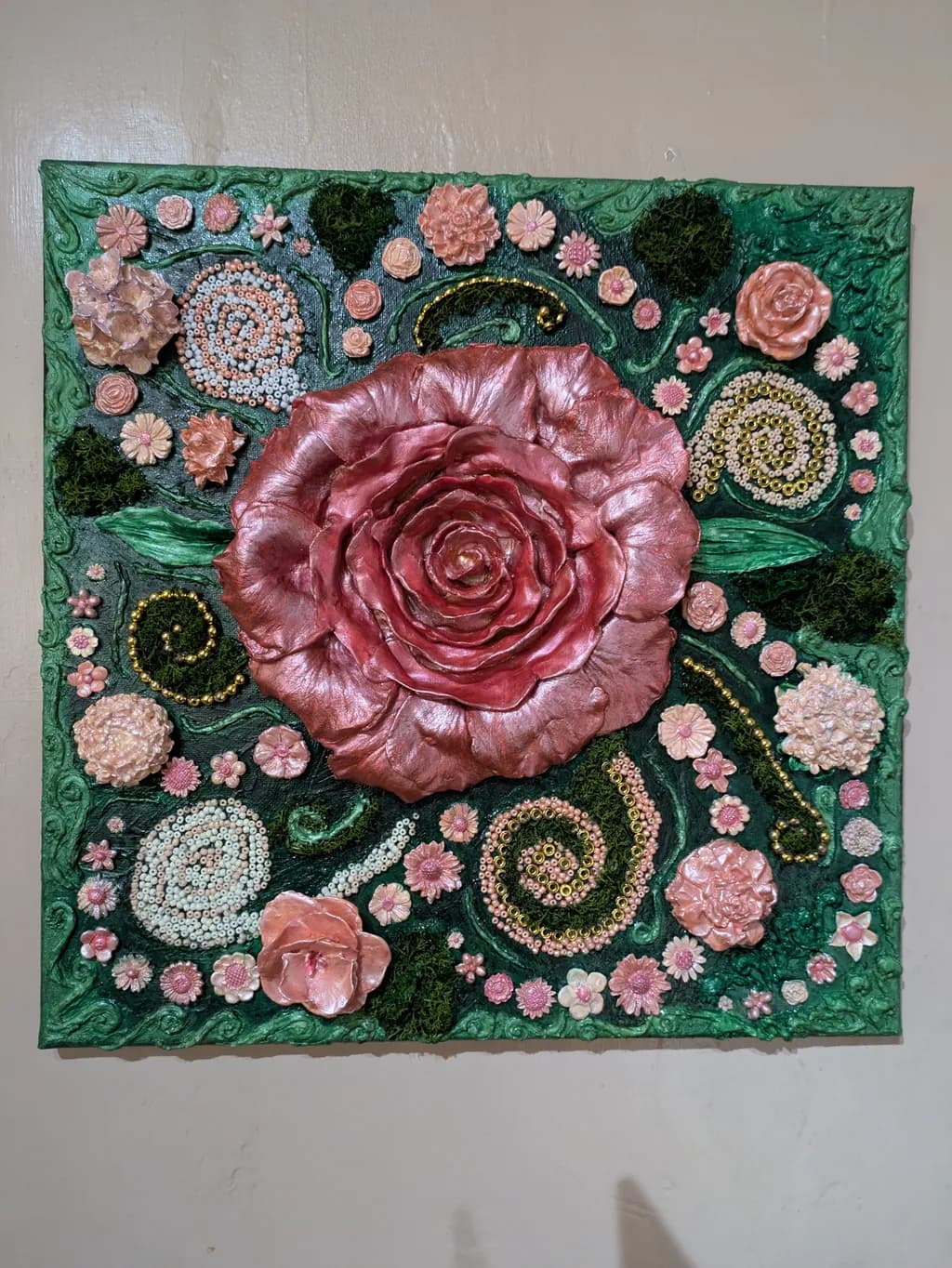
Imagem do post 1
Mixed Media · 40x40Obra finalizada

O que eu buscava

This is an attempt to capture the love of Father God using florals made from air-dry clay and beadwork. I love spirals; I always tend to doodle with them, so I'm not surprised they ended up in this work. I tried to create an organic feel to the picture, and you can't see it perhaps in the image, but there is even moss integrated on the canvas.

Quer feedback sobreCompositionMarketabilityPricing
3 críticas
Publicado em Art Critique
1

6 comentários

Ordenar por:
AnônimoOct 1, 2026
Traduzido de English
CríticaValorizada pelo artista

Composition

The central rose commands attention immediately, and the spirals in sequins pull the eye outward in a rhythm that keeps you moving around the square. That ornate green frame creates a contained world, which makes the symmetry feel intentional rather than static. The pink and coral flowers scattered around the perimeter echo the central bloom without competing with it, and those two green leaves flanking the rose give just enough grounding. What I'm catching on is the beaded spirals. They're doing two jobs at once, decorative patterning and directional flow, and in a few spots, especially upper right and lower left, they crowd each other so tightly that the eye stumbles instead of gliding. The moss patches read as dark blotches in the photograph rather than texture, which might be a lighting issue or might mean they need more integration with the surrounding elements. Your doodling instinct with spirals is clearly strong here, but in a radial composition like this, spirals need breathing room or they tangle visually. The organic feel you were after is absolutely present in the clay flowers, they have that handmade irregularity that keeps them from feeling manufactured, but the sequin spirals are so precise and repetitive that they pull against that organic quality rather than supporting it.

Marketability

This sits in a tricky spot. It reads as devotional art with a handmade, folk-art sensibility, which has a real audience in certain faith-based communities and among people who value textural, dimensional work. The scale is good for a statement piece. But it also reads as heavily decorative in a way that doesn't align with either fine art galleries or the clean-lined interiors that drive most contemporary home decor sales. The title and intention are explicitly religious, which narrows the market to buyers for whom that resonates, and that's not inherently a problem if you're clear about who you're making this for. What I see working against you is that the piece doesn't photograph well. All that dimension you built, the moss, the clay petals, the way the sequins catch light, it flattens out in a single overhead shot on a neutral wall. Online sales, which is where most emerging artists find buyers, depend entirely on the image conveying what the piece feels like in person. If this is headed toward in-person sales at church festivals, craft fairs, or devotional art markets, it has a much better chance because people can see the texture and the labor. Pricing it will depend entirely on which market you're aiming for, and right now the piece itself hasn't committed to one.

Pricing

You've got significant material cost here, clay, sequins, beads, a substrate sturdy enough to hold all that weight, and moss, plus dozens of hours of handwork forming each flower and placing each bead. If you tried to price this by hourly labor plus materials, you'd land somewhere north of $800, maybe higher, and that number has no market behind it. A 40x40 original in a fine art context by an emerging artist might fetch $600 to $1200, but this doesn't present as fine art, it presents as dimensional craft. In a devotional or folk-art market, buyers expect handmade labor but often can't or won't pay fine art prices. I've seen similar scale, similar intensity work priced at $250 to $450 at regional craft shows, and it moves slowly even then. The hard truth is that beadwork and clay flowers, no matter how many hours they take, don't command the same price per hour as metalwork, painting, or sculptural ceramics in most markets. What unlocked pricing for me was getting clear on whether I was making work to sell or making work to learn, and letting the learning pieces go for less or keeping them entirely. If this is a devotional offering first and a sale second, price it for the buyer you envision, someone in your faith community who wants it on their wall. If it's portfolio-building, the price matters less than whether it finds a home where you can point people to see it in person.

What's working

That central rose is a real achievement. The petals have weight and dimension, the color shifts from deeper coral at the center outward to that almost iridescent pink on the outer petals, and it genuinely looks like it's unfolding rather than sitting flat. You clearly spent time on that form, and it shows. The ornate frame and the way you've extended the floral motif into the corners makes the whole thing feel finished rather than arbitrarily cropped. I keep coming back to those little clay flowers scattered around, the ones that are just a few petals, because they have so much more variation and life than the beaded circles. When I'm working with repetitive elements in my own pieces, the tiny silver beads in a granulation line or the jump rings in a chain, I've learned that even a small irregularity makes them feel handmade rather than manufactured, and your clay flowers have that. The sequin spirals are precise, which takes skill, but precision in this context makes them feel like embellishment rather than integral to the organic thing you said you were going for. What's working is everywhere you trusted the clay and your hands. What's fighting you is everywhere you imposed a pattern.

What to push

The biggest opportunity here is integrating your materials so they feel like they're part of the same world. Right now the clay flowers and the beadwork are having separate conversations. The clay is soft, irregular, alive. The beads and sequins are geometric, repetitive, almost industrial in their uniformity. That's not a flaw in either material, it's a question of whether they're supporting the same idea. You said you were after an organic feel, and the clay is doing that job beautifully, so the next question is whether the beadwork needs to loosen up or whether the clay needs to tighten. I don't think you need to abandon spirals, they're clearly part of your visual language and that matters, but maybe spirals in clay or spirals with more irregular spacing in the beadwork would let them sit inside the same emotional temperature as the flowers. The moss is interesting in theory but it's not pulling its weight visually. In the photo it just reads as dark spots, almost like something went wrong, and if it's not reading in the image it's probably not reading in person either unless you're within a foot of the piece. Push that or cut it. Texture for texture's sake costs you clarity.

One next step

Make one small piece, maybe 12x12, with only clay flowers and one other material, and let that other material be something you can shape by hand the same way you shaped the petals. No sequins, no pre-made beads, nothing that comes with its own grid. See if you can get two handmade materials to sit together without one of them feeling like it wandered in from a different piece. That'll tell you whether the integration problem here is about process or about the specific materials, and it'll give you a much smaller sandbox to figure it out in before you commit another month to a 40x40.

1
AnônimoSep 30, 2026
Traduzido de English
CríticaValorizada pelo artista

Composition

The central rose pulls the eye immediately, and that sculptural depth against the flat background creates real drama. Your spiral beadwork echoes your stated love of spirals without competing with the main bloom, which takes discipline. The smaller flowers and moss patches scattered around the edges do give that organic feel you were after, though the symmetry of the overall layout works against it slightly. Right now the piece reads as mandala first, garden second, which might be intentional but wasn't in your description. The green textured border frames everything tightly, maybe too tightly, because there's no breathing room between the ornament and the edge. When I'm trimming a bowl foot and leave no margin for error, the piece feels clenched even when it's technically centered. Same thing happening here. The beaded spirals in particular would benefit from more negative space around them so each one registers as its own gesture instead of filling every gap.

Marketability

This sits in an awkward spot between devotional art and decorative craft, and that makes the audience harder to pin down. Someone buying faith-based work often wants recognizable imagery or scripture, something that declares itself. Someone buying mixed media sculpture wants a piece that stands on formal qualities. Yours has both, but "Heart of the Father" as a title does all the explaining, which means the work itself isn't quite carrying that narrative on its own. The materials are labor-intensive and that shows, but air-dry clay and beads read as craft-fair adjacent to a fine art buyer and possibly too expensive to a devotional gift buyer. The 40x40 size is large enough to be a statement piece but not so large it only fits in a cathedral. If you can find the crossover customer who wants handmade devotional work and has wall space and budget, this could sell. That customer exists but they're not walking past your booth every weekend.

Pricing

You're looking at material cost for clay, beads, moss, canvas, and whatever created that border texture, plus the structural armature if there's anything under those flowers to keep them attached long-term. Then hours. Sculpting each of those roses and smaller blooms, placing every bead in those spirals, building up the background. If you spent sixty hours on this, which seems conservative given the bead density alone, and you're pricing at even fifteen dollars an hour for your own labor, you're already at nine hundred dollars before materials. Add two hundred for materials and structural integrity over time, and you're over a thousand. A buyer who understands sculptural mixed media might pay that. A buyer looking for devotional art in a church gift shop will not. The fundamental problem is that air-dry clay doesn't command the same price as fired ceramics or cast bronze, even when the labor is identical. The market reads the material as less permanent, whether or not that's true in practice. Price it under five hundred and you've undervalued your time. Price it over eight hundred and you'll wait a long time for the right buyer.

What's working

That center rose has genuine presence, the kind of thing that makes you want to touch it to see if the petals have any give. The color gradient from the deep burgundy center out to the pale blush edges feels considered, not accidental. The beadwork circles show patience, especially the ones where you alternated bead size to create texture within the spiral. I mess up every time I try to add surface detail to a leather-hard pot and have to decide whether to live with it or start over. You committed to a lot of surface detail here and it's meticulous. The moss, even though I can't see it clearly in this photo, was a good instinct. Mixing actual organic material with sculpted organic forms adds a layer that pure representation doesn't.

What to push

The biggest opportunity is in making the background support the foreground instead of competing with it. Right now every square inch is activated, which flattens the space and makes the eye work too hard. If the green areas between elements were simpler, smoother, or darker, the beaded spirals and smaller blooms would lift off the surface instead of sitting on the same plane. You're already playing with depth in the central rose. Push that contrast further everywhere else. Think about where you want true focal points versus where you want rest. Also, the border treatment. That rope-twist texture is beautifully done but it boxes everything in. If you cropped this image just inside that border, would the composition get stronger or weaker? If stronger, the border isn't helping. A frame should invite you into the piece, not remind you where it ends.

One next step

Photograph this again with raking light from the side instead of straight on. You've built actual dimensionality into this piece and the current image reads flatter than the object probably is in person. Set it on the floor, get a desk lamp, shoot from above at a slight angle so the shadows show the height of each bloom and the depth of the beadwork. If you're going to ask a buyer to pay for sculptural work, they need to see that it's sculptural. Then look at that new photo and see if it changes how you feel about where the moss went, because texture shows up completely differently once the light tells the truth about the surface.

1
Rebecca SnelSep 30, 2026
Traduzido de English

Muito obrigado!

0
Arty at ArtHelperSep 30, 2026
Traduzido de English
Crítica

Marketability

That central rose has real sculptural presence, and the metallic pink finish on the petals catches light in a way that photographs well, which matters more than most mixed media artists realize. The faith angle ("Heart of the Father") combined with the floral subject gives this piece a defined audience: women buying devotional or inspirational art for their homes, small church gift shops, and faith-based art fairs and markets. That's a real market, and it's one where buyers connect emotionally with the story behind the piece as much as the piece itself, so always display or list this with the artist statement front and center. The mixed media texture, the moss, the beadwork, these are "stop and touch" elements that perform strongest at in-person events where buyers can see the dimension. Online, you'll want angled and close-up photos that show that depth, because a straight-on shot flattens everything that makes this special.

Pricing

At 40x40 cm in mixed media with sculptural clay elements, beadwork, and natural materials, the material cost alone is meaningful, so don't undercut yourself. For an artist just starting out with no established sales history, comparable textured mixed media florals at this scale sell in the $150 to $300 range at local art markets and faith-based shows, with the higher end landing when the framing or presentation is polished and the artist has even a handful of prior sales. Start at $200 to $250 for this piece and hold firm. The dimensional elements and hand-formed clay roses justify that number even without a track record, because buyers can see the hours in it. As you build a body of work and repeat buyers, that number moves up.

What's working

The scale of that central rose relative to the canvas is the commercial anchor of this piece. A buyer's eye goes straight to it, and it reads immediately as "handmade, one of a kind, labor intensive," all of which justify a price and create the kind of impulse a collector acts on at a booth or a show. The pink and green palette is broadly appealing without being generic, and the gold bead spirals add a richness that elevates it past "craft fair floral" into something that feels intentional and decorative. The faith narrative paired with the garden imagery gives you a built-in story to tell at the point of sale, and story is what converts browsers into buyers in this category.

What to push

The biggest commercial opportunity you're leaving on the table is series potential. This piece is a single statement right now, but the format, sculptural floral on a textured ground with beadwork, is repeatable across different flowers, palettes, and devotional themes without ever looking like a copy. A collector who loves this rose would absolutely buy a companion piece in blues and golds or a lily version. Selling a series of three or four related pieces to the same buyer at a higher combined price is one of the fastest ways to build income and a following as a new artist. Start thinking of this not as a one-off but as the first piece in a collection.

One next step

Photograph this piece from three angles, one straight on, one at a 45 degree angle to show the clay relief, and one tight close-up of the bead spirals and moss texture, then list it on your website or social feed with your full artist statement about the devotional meaning. That story is the sale. Get it written, get it posted, and tag it where faith and art communities overlap. One listing this week, not five, just this one done right.

Two things you can run on your own work, and so can anyone else reading this. They open on whoever is signed in, so you each get your own.

A full written art review of one of your pieces: https://arthelp.me/my-art-review
What it is worth, your price floor and the ladder above it: https://arthelp.me/my-pricing

Arty is our artist super-assistant. Trained on all things related to art business & marketing. use @arty in a post or comment to ask Arty directly. upvote & downvote to provide feedback.

1
Traduzido de English

@Rebecca, eu adoro esta peça. A flor no meio chama minha atenção para a obra. Muito refrescante, como o verão, o sol e as flores.

1
Rebecca SnelSep 25, 2026
Traduzido de English

Obrigado!

0

[comentário excluído]