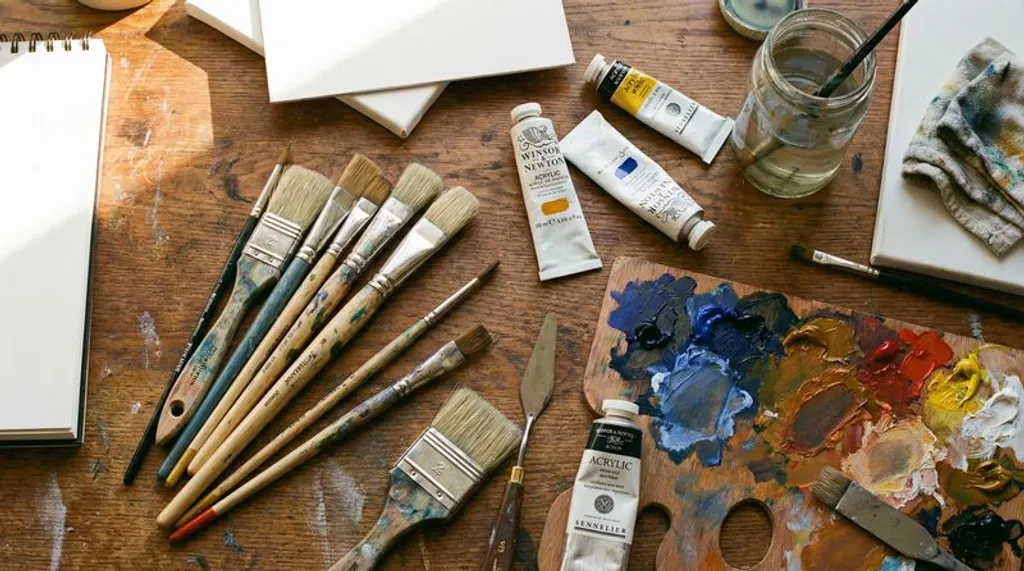
35 Painting Techniques Every Artist Should Know — And Why They Matter
The difference between an artist who plateaus and one who keeps growing often comes down to one thing: how many tools they have in their toolkit. Technique isn't about following rules — it's about having options. The more approaches you understand, the more intentional your choices become.
Here are some of the most valuable techniques to add to your practice, whether you work in acrylics, oils, or mixed media.
**Subtraction (Acrylic)**
Most artists think about painting as adding. Subtraction flips that — you apply a thicker layer and then remove paint with a cloth, sponge, or brush while it's still wet. What's revealed underneath is often more interesting than what you planned. This technique is excellent for creating organic textures and unexpected depth.
**Chiaroscuro**
This is the dramatic use of light and dark contrast to create volume and three-dimensionality. It's the technique behind the intensity you see in Caravaggio and Rembrandt. Even in contemporary work, strong value contrast is one of the fastest ways to make a painting feel powerful rather than flat.
**Alla Prima (Wet-on-Wet)**
Working wet-on-wet in a single session forces spontaneity. You can't overthink it. The paint blends directly on the canvas, and the result has an energy that's hard to replicate any other way. This is the technique behind most plein air painting and many of the best portraits.
**Scumbling**
A dry brush technique where a thin, lighter layer of paint is dragged over a darker dry layer, letting the underlayer show through. The result is soft and atmospheric — ideal for clouds, foliage, and any surface that needs texture without hard edges.
**Glazing**
Thin, transparent layers applied over dry paint. Glazing doesn't change the form — it changes the light. A warm glaze over a cool shadow can make a painting feel luminous in a way that direct paint application rarely achieves. This is one of the most underused techniques among self-taught painters.
**Underpainting**
Starting with a monochromatic layer to establish values before adding color is one of the most reliable ways to build a painting that holds together. It removes two problems at once — you solve the value structure first, then focus on color. Many painters who struggle with muddy color are actually struggling with values.
**Sgraffito**
Scratching into wet paint to reveal the layer beneath. This creates sharp, defined lines and intricate textures that brushwork alone can't produce. It's particularly effective in oil painting for adding fine detail without losing the freshness of the surface.
**Stippling**
Building form through small dots rather than strokes. It's time-intensive but produces a quality of texture — especially for skin, fabric, and foliage — that feels tactile and detailed. Even using stippling selectively in one area of a painting can create a compelling focal point.
**The Bigger Point**
Every technique on this list is a way of seeing differently. Chiaroscuro teaches you to see in terms of value. Glazing teaches you to see color as light. Alla prima teaches you to trust your instincts. The goal isn't to use all of them — it's to understand enough of them that you can choose deliberately.
What technique has made the biggest difference in your own work? Drop it in the comments.