
© 2026 Art Storefronts
v4.5.18© 2026 Art Storefronts
v4.5.18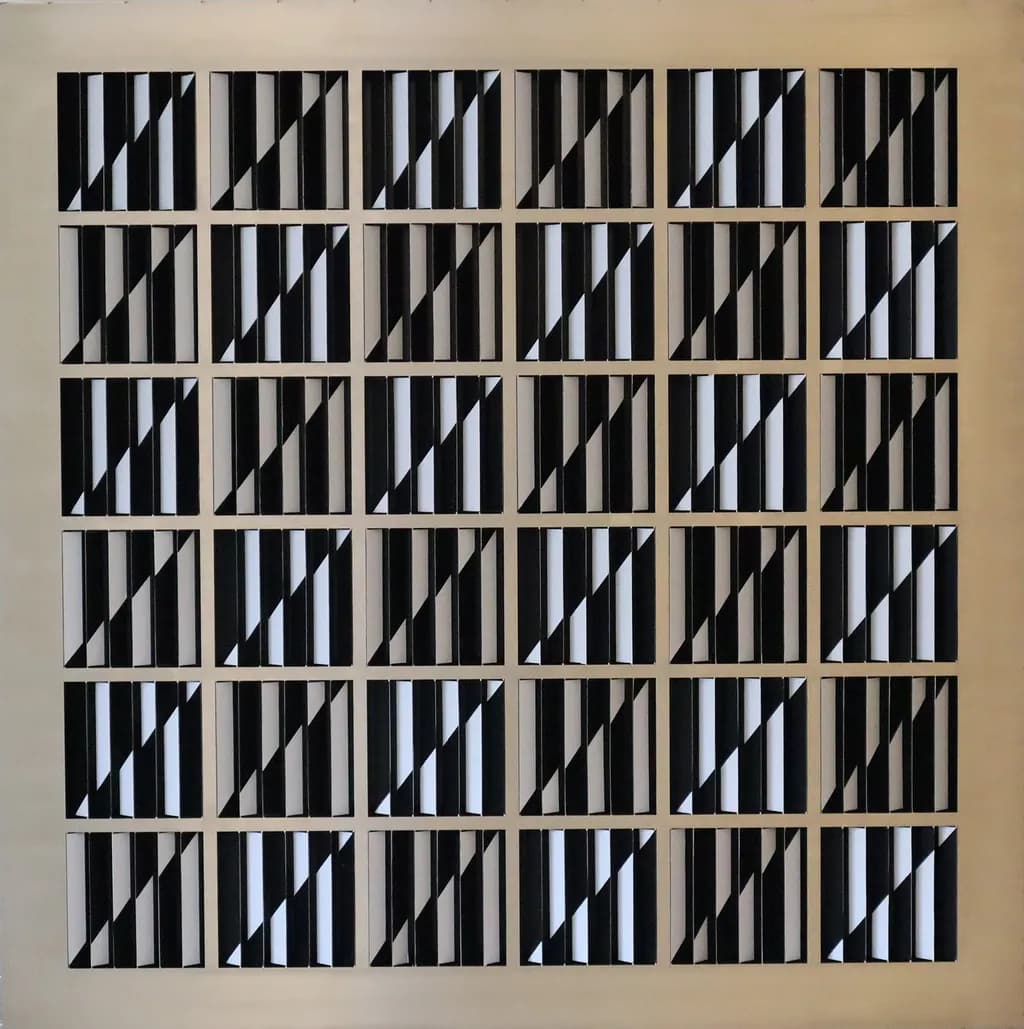
This artwork presents a meticulously arranged grid of black and white rectangles, each divided diagonally to create a dynamic interplay of contrasting tones. The repetitive pattern forms a rhythmic sequence that conveys a sense of order and precision. Within each square, the sharp diagonal division produces a visual tension, balancing light and shadow in perfect proportion. The consistency across the entire grid establishes a harmonious unity, while subtle variations in contrast between adjacent blocks introduce movement and depth. The use of monochrome not only emphasizes form and structure but also invites viewers to focus on the geometric relationships without distraction. The alternating diagonals guide the eye horizontally and vertically, encouraging an exploration of the piece's architectural quality. The background’s muted tone frames the grid, adding warmth and grounding the stark black and white elements. This contrast enhances the dimensional effect, causing the shapes to stand out as almost three-dimensional. The precision in alignment and spacing highlights the artist's careful consideration of negative space, creating an equilibrium that feels both rigid and fluid. The work expresses a disciplined yet dynamic character, reflecting themes of balance, repetition, and variation. Its minimalist approach allows it to connect with a broad modern aesthetic, suitable for both contemporary and classic interiors. Placed in a space, this piece offers a strong visual anchor that invites contemplation and adds a structured elegance. It’s an excellent choice for those who appreciate abstract design and seek to introduce a refined sense of geometry into their environment.
Lubomír Hruška (1954) In the seventies, he studied at the Faculty of Civil Engineering in Brno. In 1978, he transferred to study architecture at the Academy of Fine Arts in Prague.