The Stone Blossoming of Time
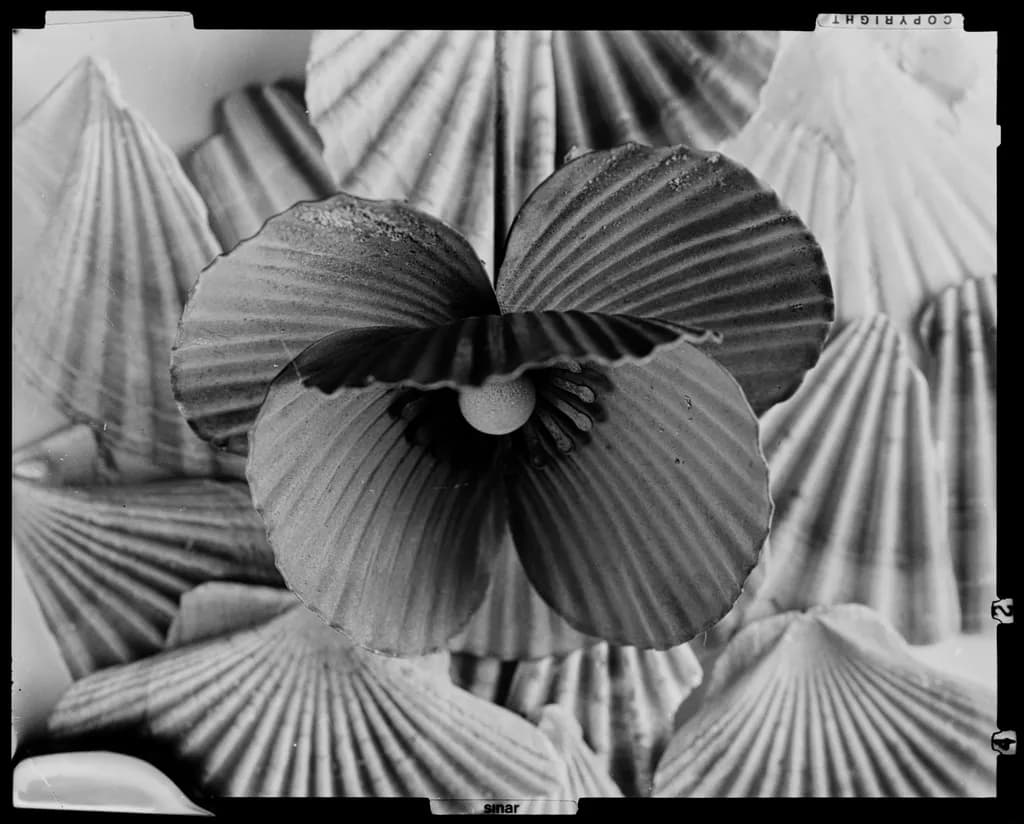
In the precise, uncompromising nature of large-format analog photography, a world of nature is revealed to us—one that references its own forms. Limestone shells, once shelters for life in the deep ocean, come together here to form a blossom that will never wither. It is a play on the dimensions of being: the maritime imitates the floral; the hard shapes the soft.
The delicate grooves of the scallops, rendered almost tactile by the three-dimensional depth of the large-format camera, resemble the veined petals of a bizarre anemone. At the center rests, protected and mysterious, a round core—like the promise of a pearl or the ovary of a new existence. The visible film edge of the Sinar not only frames this composition; it grounds it. It reminds us that we are looking at a fleeting moment, fixed for eternity by silver halides.
This photograph reveals to us the fundamental geometry of the world. Everything flows into one another; everything repeats itself. The sea brings forth blossoms that seem hewn from stone, and time stands still for the blink of an eye to show us that beauty often lies in the collage-like dialogue of the elements.
The film edge made me pause. It's a choice that says "this was built on a ground glass," and it works because the composition is so deliberate it can carry that frame. The shells read like petals because you positioned them with that rhythm, that repeating arc, and the large format gives you the resolution to make those grooves feel close. The core at the center holds weight. It's the kind of image that only exists because someone took the time to arrange it, light it correctly, then wait for the exposure to be right. That patience shows.